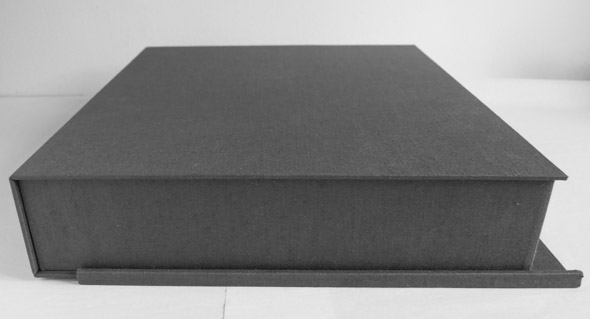
A drop-spine box for heavy and oversize books. The cut out areas on each side of the inner tray allow both hands to lift the book out.
For large, heavy books there are a couple of ways to beef up a regular drop-spine box.
Like most people, I usually make them with double walls.
I also make a modified inner tray, so that both hands can lift the book when removing it. The book this is for is around 19 x 15 inches, and quite heavy.
For even larger books, a lift off lid is a good idea, so the box doesn’t take up so much table space when open.
Since this book will be stored flat, on a metal shelf, and the client intends to read it once a week, there is a a slide off bottom piece to wear out. Even a durable cloth, like this canapetta, can wear quite quickly when slid on and off the shelf, there is an example here. It is adhered by friction, and when it wears through the client can mail it back for a new one, much cheaper than a new box.
The partially removed bottom piece. It slides off, but stays in place by hooking over the edge of the head and tail squares.
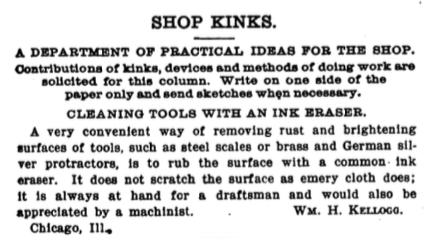
Daniel Mellis send in this useful info concerning surface cleaning rusty tools; which, ahem, some of us may have a small number of. Originally this idea was published in the column “Shop Kinks” from Machinery in 1907. It’s a wonderfully provocative title — I may have to steal it — a refreshing take on usual “Tips and Trick”. A kink, in this sense, is a new aspect, twist, or take on something.
Daniel makes artist’s books and is currently working on a English translation of Tango with Cows, a Russian Futurist book printed on wallpaper with important early experimental typography. www.danielmellis.com
He writes:
Recently when trying to clean up a ruler and straight edge, I hit upon the use of ink erasers to remove rust. This is not a new idea, Wm. H. Kellogg from Chicago noted in January of 1907 in Machinery Magazine that:
A very convenient way of removing rust and brightening surfaces of tools, such as steel scales or brass and German silver protractors, is to rub the surface with a common ink eraser. It does not scratch the surface as emery cloth does; it is always at hand for a draftsman and would also be appreciated by a machinist.
Compared with other methods of rust removal, the ink eraser is convenient, especially for small areas, and it does not require any noxious chemicals like naval jelly or even any liquid. As noted by Kellogg it also does brighten surfaces. Caution should be exercised as ink erasers will scratch softer metals like cast iron.
The biggest difficulty is actually locating them. Common enough in the 90s and probably early 00s, they are no longer a standard item in office supply stores. The site www.jetpens.com carries the Tombow Mono Sand Eraser, as well as the Seed Sun Dolphin 3 Electric Eraser for which you can get 60 count ink eraser refills. These are relatively small, the larger size strips for heavy duty electric erasers, #72, were discontinued about 5 years ago. Boxes are still available on ebay, starting at $59, which works out to about $5 per strip. Some of the descriptions state they are for abrasion testing; a specialized industrial use may justify the price. Perhaps small drafting supply houses might have some in a corner somewhere.
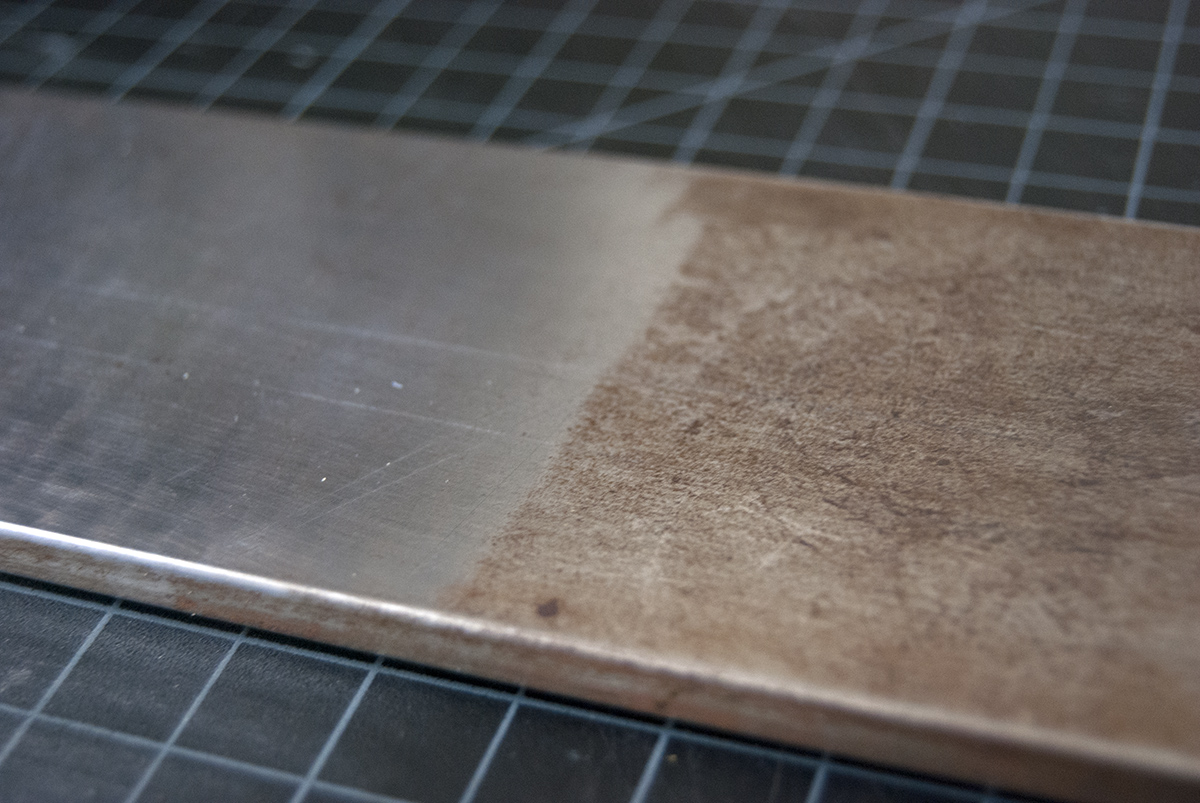
When cleaning a straight edge, I used one of the larger strips; the in process shot shows its effectiveness. The electric erasers can leave a pattern on the surface due to variable reflectiveness, but that is easily removed with a quick polish with something like Mother’s Mag and Aluminum Polish.
In progress shot of cleaning a rusty steel straight-edge with an electric eraser. Photo: Daniel Mellis
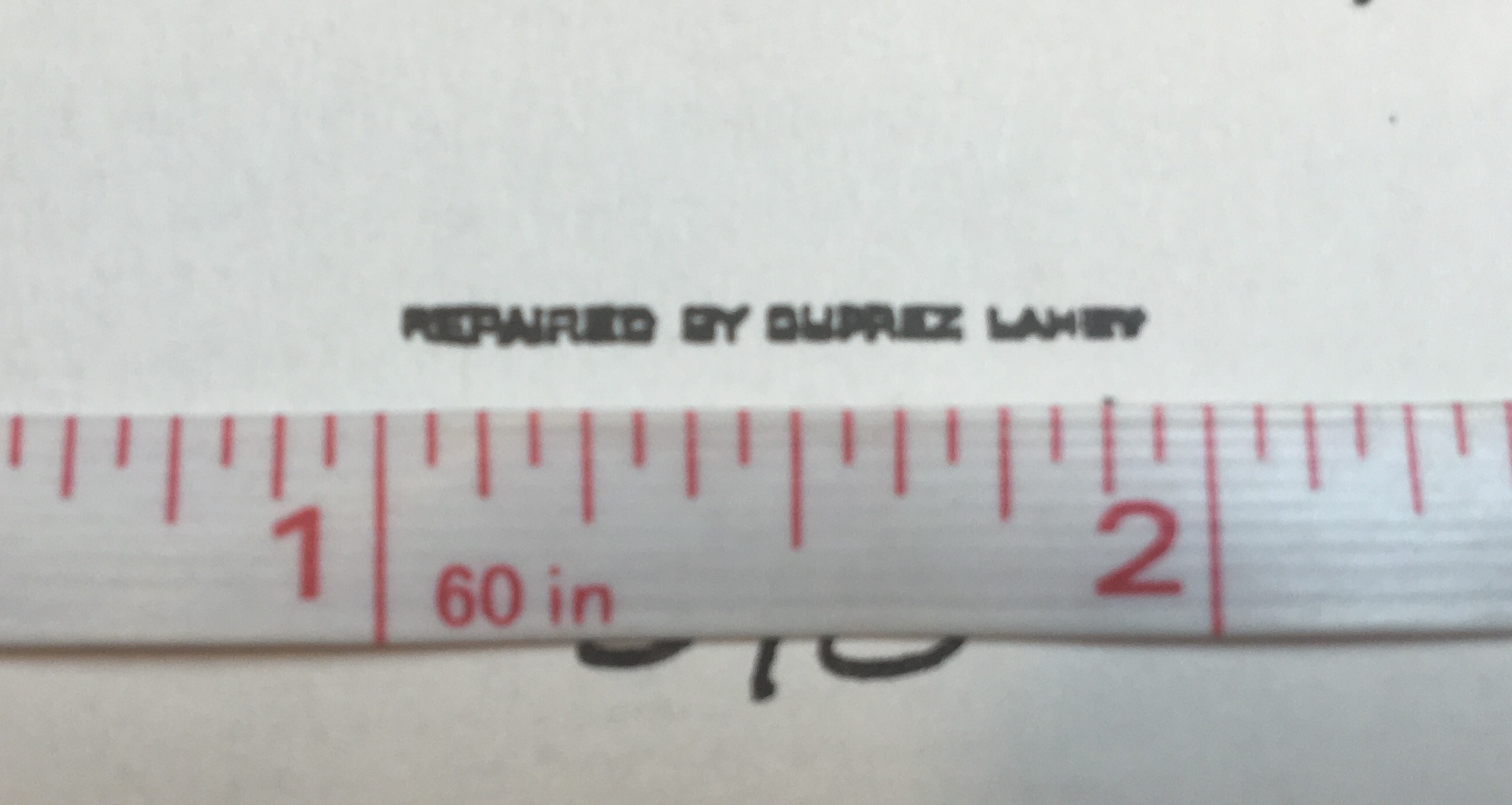
This partially effaced stamp is unusual, in that it says repaired by, rather than bound by. But who repaired this book? “REPAIRED BY DE xxxxxxHSY” or maybe “REPAIRED BY DAVID xxxxHSY”? The letters are .5mm high, and it is positioned in the bottom left corner of the front board pastedown.
retroReveal, which can sometimes aid in legibility of fragmentary marks didn’t help in this case.
Robert Milevski, author of “A Primer on Signed BIndings”, was not familiar with it. He did send a useful overall typology of binders stamps, however:
In research done in Princeton University Library about 15 years ago (before many 19th c books were transferred from the open stacks to offsite storage), my recording methods were necessarily primitive and thumbnail (because I had to get through half a million books rather quickly), lacking in detail, usually, other than a call number, binder’s name, and type of mark. When I went back to these records and books (a couple of years later after their going offsite), I ignored anything not obviously English. Some of the bindings represented by these ignored minimal records probably had some interesting stamped signatures, similar to yours. (A sad thing, however, is that in that interim, some of the books, because of condition, had been rebound, thereby losing their binder’s signature history.)
I did look at my main spreadsheet of English signed bindings (3600 records at present, with more than 1000 yet unrecorded) and found a couple categories of mark other than ‘bound by’ but nothing like your mark. These others include: 1. just the last name of the binder; 2. last name of binder and location; 3. name of binder, address and designation as binder, usually in a two or three-story stamp. Of course, there is 4., the category of ‘bound by x for y’, usually a department store. And 5., ‘bound by x, successor to y.’ And 6., name of binder with a month and year, or more fully, 7., name, address and year. And 8., there is also the rare upside down stamp, usually only the surname, probably from getting the front and rear boards mixed up. That’s all I can say.
Generally, before modern art conservation principals began to be applied to books in the mid-twentieth century, most restorations and repairs attempted to be as invisible as possible. So why try and point it out by stamping the book? And then why did someone else try to crudely scrape it away?
***
Added 8 August 2016
Below is an image of the stamp Maria Fredericks mentions in the comments.



 Peachey Conservation