Peter Verheyen’s Research on Ernst Collin. A Forthcoming Letterpress Edition

Peter Verheyen recently announced his translation of Ernst Collin’s Pressbengel will soon be published in a letterpress limited edition. If you have not encountered his omnipresent online presence, you are the last. Start here: philobiblon.com.

Peter answered three questions about this project:
1. Why did you call this “The Bonefolder”?
2. What do you see as the role of tools in this work?
3. Why should someone purchase this limited edition when you have already released a version online for free?


Bone Folder title-2
Title page of “The Bone Folder”


Peter writes:

I’ve actually received questions about the choice of title since I first started with this project back in 2008/9. Collin was writing from the perspective of one for whom the German bookbinding tradition was their DNA, despite the anglophilic predilections of the firm of his family – the court bookbinders of W. Collin in Berlin. All binding traditions have their own unique tools or techniques, and in the German tradition the pressbengel seems to be one of those. The image below from Paul Adam’s Lehrbücher der Buchbinderei: Die einfachen handwerksmässigen Buchbinderarbeiten ohne Zuhilfenahme von Maschinen (1924), a very basic introduction to binding without the use of „machines“ shows the binder tightening the screws of a German backing press using a pressbengel.

The Pressbengel had been translated into Czech (1925) and Italian (1996)  before I started with my mine. In Czech the title translates as “Wrench” and in the Italian it was given as the “About the Art of Bookbinding,” so there was precedent for a retitling. Collin’s text is iconic in the German bookbinding literature and was meant to introduce the bookbinding trade and its traditions to a lay audience. What tool could be more iconic in bookbinding than the bone folder and recognizeable to todays book workers and bibliophiles.

Collin’s iconic Pressbengel focuses on the core set of German binding techniques that a bibliophile would encounter, describing these in a fair level of detail including describing differences with other national traditions, largely French. Throughout, as he describes these techniques he discusses tools and how they are used, but not with much detail given to the tools themselves. What he does do in this dialog is to juxtapose the quality of the hand-bound book with that produced by machines. In an example from the last day on tooling and finishing, the Bibliophile insists that the Master do all his tooling by hand – no machines…

BOOKBINDER: Well, even then it might not be possible to avoid using a blocking press to form some larger, more complex designs, for example a coat of arms or some specialized text elements.

BIBLIOPHILE: No, Master, under no circumstances. In a work whose distinguishing character is determined by the work of the hands, there is no place for machines. If binders are so quick to switch back and forth between handwork and that of machines, they shouldn’t be surprised if their work becomes devalued. The masters of old were able to put large seals or coats of arms on their bindings, too, without resorting to a blocking press.

There are two things that set this new edition apart from the past one. The first are the photographs of John (Hans) Schiff depicting the bookbinding process and taken after the publication of the Bremer Presse’s Faust being bound in 1925 and the emigration of Schiff to the US in the latter half of the 1930s. The photographs are also part of never published series of 34 original negatives, so publishing a selection of them is significant, especially as they are very rich tonally with a great detail.

In selecting the images, Don Rash and I felt that it was important to show the hands of the binder at work in order to personalize the process. The images selected, one for each “day” in the text, depict: Sewing by hand over raised cords on the sewing frame; Sewing by hand over raised cords on the sewing frame; Attaching the boards to the textblock using the frayed ends of the raised cords; Sewing the headbands; Shaping the headcap on a leather binding; Gold tooling the board utilizing gold leaf and a decorative roll. The image of the bone folder working the leather over the cords is exclusive to the prospectus and not used in the text.


Schiff, Hans John - Bremer Press Series - 24
Photo courtesy Peter Verheyen, http://pressbengel.blogspot.com


The other thing that sets this new edition apart from the past edition, that yes was published open access online, is the completely new and greatly expanded introduction that provides much greater familial context to Ernst Collin and his background as the grandson and son of the last German court bookbinders describing their origins beginning with the early Jewish migration to Berlin in the first half of the 1800s, their growth as a significant trade bindery with close ties to the court and leading advocates for a new German bookbinding trade and tradition. Wrapped up in all this was the creation of the German empire, World War I, to the rise of Nazi Germany.

The introduction also corrects several errors in Collin’s biography that were introduced in national bibliographies, edited correspondences, and elsewhere, disambiguating him from “the other Ernst” that lived in Berlin at the same time, and his fate of being murdered in the Shoah. It also gives a much better sense of the broad range of Collins writings, including describing the other translations and editions of The Pressbengel. In addition it provides a description of the life and work of John (Hans) Schiff, the photographer.

This project became deeply personal to me when I was contacted by a geneologist who believed she was related to the Collins by marriage, and whose questions made me dig deeper into the history of the family and the writings of Ernst Collin. It was only appropriate that these findings be included in a new edition. Pairing this edition with the exquisite photographs of Schiff (who was able to escape Collin’s fate) makes the Don Rash’s Boss Dog Press edition even more special, and builds on the other titles he has issued on the topic of the German bookbinding tradition that to date have focused on the writings of his mentor Fritz Eberhardt who trained with Ignatz Wiemeler, among others.

The prospectus provides more details on the edition of 100 copies that will be available in quarter leather, full paper, and sheets for binding – an edition that is seeing interest (and orders) from libraries, bibliophiles, and binders. I would love to see an exhibit of the bindings that our peers create with the sheets, something more than the successful Bind-O-Rama on the downloadable sheets that have been available since the publication of the first translation in 2009. Ultimately, what is more attractive than a fine hand-bound book paired with original illustrations – no online/”e” text can duplicate that haptic experience.
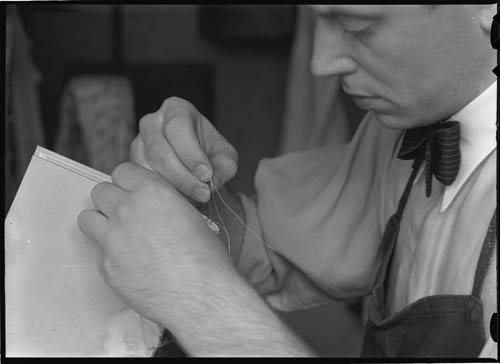
 

Schiff, Hans John - Bremer Press Series - 18
Photo courtesy Peter Verheyen, http://pressbengel.blogspot.com


This has been one of the longest research projects I have undertaken, and the findings have been shared “in real time” via my Pressbengel Project blog under “Colliniana” and more formally in the The Collins: W. Collin, Court Bookbinders & Ernst Collin, the Author of the Pressbengel that I published online open access in English and German. Though I grew up bilingual, lived and worked in Germany for several years, and converse in German quite a bit verbally and in writing, doing this project bilingually was a real and significant challenge.

In the end I am quite happy with the outcome as these texts include much more of Ernst Collin’s familial context, images of bindings and other items that W. Collin produced, and a “history of the life” with description of Ernst Collin’s writings that describe the German bookbinding trade, its practitioners, and the economic and political context of a dynamic yet turbulent time in Germany. The texts also include a title-level bibliography with chronological and subject lists of Ernst Collin’s known writings. None of this would have been possible without the digital collections that have come online, so the bibliography is also online on the Pressbengel Project blog along with links to a spreadsheet that includes links to the digital content where available.

Together I hope that these contribute to closing the dearth of information on German bookbinding traditions lamented by Tom Conroy in his section on the “German Influence on American Hand Binding” that was published as part of his “Teaching Genealogies of American Hand Bookbinders” in the Guild of Book Workers’ Journal, Vol. 28, 1990.

This Is Not an Ambidextrous Scissors

scissors
Boker V 88 Razor Steel Scissors

I purchased this scissors at a flea market last weekend, basically because it looked weird.

I thought it might be ambidextrous, but after playing with it a little, and doing a bit of research, I realized it is not a genuine ambidextrous scissors. But it is an interesting design.


Screen Shot 2016-07-11 at 9.41.36 AM
The 1944 patent claims this is an ambidextrous scissors. Source: https://www.google.com/patents/US2343527?dq=2343527&hl=en&sa=X&ved=0ahUKEwjeyrn9-enNAhWFKyYKHeM3DdYQ6wEIHTAA

Simply putting a thumb and finger ring on each side does not make an ambidextrous scissors. Otherwise any scissors with symmetrical ring holes would be ambidextrous. For a scissors to work properly, the top blade must be attached to the finger ring, so a scissors has to be right or left handed.  This arrangement accentuates the natural action of the hand as it closes, so the cutting edges are squeezed together. If a left hander tries to operate a right handed scissors, the natural action pulls the cutting edges apart, putting the action at a mechanical disadvantage. So a genuinely ambidextrous scissors is a mechanical impossibility, at least if it operates with thumb and finger rings.

Secondly, there is a discrepancy between the patent drawing and the actual product. The patent drawing shows the curved areas of the rings that could be used right or left handed. The actual product uses the same shape on each side, making it uncomfortable to use left handed. Would this difference invalidate the protection of the patent? Possibly this was done to save money when making the mold for casting.

scissors1
Detail, before immersion in vinegar
scissors2
Detail, after four hours in vinegar

Nevertheless, I decided to clean the scissors and sharpen them. These scissors are very comfortable and convenient to use by right handers since it doesn’t matter which way they are picked up.

After taking them apart, I immersed the scissors in white vinegar for four hours, occasionally removing surface rust with a Scotch Brite pad. I’m amazed at how well the vinegar works, and still surprised how satisfying it is to fix up a tool, returning it to useable condition. It just feels good.

If you are interested in the “proper” way to cut paper with scissors, check out this 1927 illustration from Palmer’s A Course in Bookbinding for Educational Trainning 

Miriam Schaer (see first comment) sent me this photo of a lefty scissors (note the top blade attaches to the finger rings), with even weirder placement. I can’t make sense of where you would put your fingers.

scissors3
Photo: Miriam Schaer, http://miriamschaer.com/

Bill Minter on Cobden-Sanderson’s Bindings and the Taste of Leather. Additional Comments by Marianne Tidcombe

Bill Minter sent me some recollections about Cobden-Sanderson’s bindings, which raise several interesting questions.  Are bookbinders and book conservators—especially those in private practice—skewed in their appraisal of bindings since they generally deal with books that need to be fixed?  Could Cobden-Sanderson actually taste the quality of leather? Does Bill have a second wind since he took a straight job with a regular paycheck?

Before accepting the newly created position of Senior Book Conservator at The Pennsylvania State University Libraries (aka: Penn State), Bill was in private practice. While some may know of him as the developer of the ultrasonic welder for polyester film encapsulation, he has also dabbled with other ideas in book conservation. His email is: wdm14<at>psu<dot>edu

Bill is far too modest in this brief bio. Some of his “other ideas” include intact washing of water damaged books, a velcro based tying-up press, a video of how to maintain and adjust a board shear, the use of aluminum to lighten and make more rigid oversize drop spine boxes, and tips on how to quickly flatten rolled documents for digitizing. Most recently he has attempted to quantify some of the properties of teflon and bone folders. His poster should be in the poster area of the AIC website soon.


***


Bill writes (1):

I recently saw your blogpost about Cobden_Sanderson.

You wrote:  “…but his bindings are really beautiful. I’ve had the opportunity to see many of them and to work on a couple of them as well. They are quite refreshing from much of the trade work of the day. Unfortunately, many of the materials he used are often poor quality. The books I’ve been able to see the structure of have common late nineteenth century structural weaknesses: very thin slips, tissue thin leather jointed endsheets, and overly pared covering leather. Ironically…”

I would suggest that when you are in Chicago the next time that you try to see his bindings at the various libraries.

Many years ago, Marianne Tidcombe was to speak to The Caxton Club. She arrived days early to see C-S’s bindings, as well as research her next book on woman binders. I insisted that she stay with my family, so that I could be her chauffeur.

When she arrived on Saturday afternoon, I told her about my 3-volume set of signed C-S bindings in brown leather and blind tooled. After much discussion, she had me (almost) convinced that my books were not C-S, because “he never bound in brown leather”.  Upon going to my shop, indeed they were C-S. Until then, she had only seen rubbings of that particular binding.

(Teaser — the boards were detached as you might assume, but read on.)

Well, for two days we went to numerous libraries and, as I recall, every C-S binding was in excellent condition with the boards intact! AND, as I recall, there were no ‘brown’ leather bindings; most were either red, blue, green or other. After seeing maybe a dozen or more (20?) books, I asked the question, “you said that he did not bind in brown leather”. She explained that C-S knew that brown was not a good leather, for three specific reasons:  1) from working with the leather, 2) XXX?? (I do not recall the reason), and 3) (the best part) — that he could TASTE that the leather was TOO ACIDIC.

[Marianne Tidcombe writes:, “What I said in 1992 was not that C-S did not use brown leather for binding, but that he rarely used dyed pigskin – brown or any other colour – because it was acidic.  He had an instinct for judging leather, and could tell by handling, smelling, and (yes) tasting, if it was acid.  He chose goatskin, sealskin, and alum-tawed pigskin, all of exceptional quality, which is why his bindings have held up so remarkably well compared to many others bound in the same period. Your blind-tooled ‘Golden Legend’ bound at the Doves Bindery in about 1904(?) in brown dyed pigskin is an exception.  I suspect he risked using it in this case because it took the blind impressions rather better.”] (2)

Aside from him tasting that the leather was too acidic, how would he have known that that was a problem? At the same time: how did they test for acidity during that time — litmus paper?
ANYWAY:   To further enhance this story, the last stop was at the U Illinois — Chicago campus where there are approximately 19 bindings by Ellen Gates Starr of Hull House. Starr studied with C-S in the early 1900s. Her collection of bindings include, from my perspective:  one binding using C-S leather and tooled by C-S; one binding tooled by EGS on leather supplied by C-S, and the remainder were (shall I suggest) other leathers that have not survived as well as the C-S type —– again, from my perspective. The bindings using C-S leather were, as I recall, in much better condition than the others. At the same time, one would assume that all of the books have been held in the same, Chicago environment all these years.

I wish there were a way to determine whose leather C-S used and how that leather was tanned, especially compared to other tanners. AND, why is it that he rarely used brown leather? Perhaps a world-wide survey of the condition of all C-S bindings would be helpful? This story (information) is from the 1990s, though I did see the Starr bindings again in 2003.

Hope this raises some questions about the condition of Cobden-Sanderson bindings.

One other comment:   While you have done far more research than me, I would suggest that as conservators in private practice, we only see the failures and rarely get a chance to tour the stacks to examine a large number of bindings.

[Marianne Tidcombe writes: Re: Jeff Peachy, Cobden-Sanderson and leather, etc.  Some of what he says is of course true, but I’m afraid he generalizes, based on a couple of books bound at the Doves Bindery, which is rather unfair.  C-S had only a short period of training (with a trade binder), and his forwarder at the Doves Bindery was a tradesman.  However, C-S was a trailblazer in advocating sound methods and materials, and passed his ideas on to Douglas Cockerell, who in turn promoted conservation binding.  C-S had to find solutions to problems himself, and work out better methods as he went along.  See, for example, the structurally sound Kelmscott Chaucers he bound at the Doves Bindery, and the concertina sewing he devised for Doves Press books printed on vellum.”] (3)


***


Peachey responds: First, let me acknowledge I am basing my original observations on a handful of bindings brought to me for conservation work, so this may well be a self-selecting sample.  Secondly, Marianne Tidcombe, who is the world’s foremost expert on Cobden-Sanderson, and I am honored to have her comment here. She has written books on the The Doves Bindery, Cobden-Sanderson, and knows his bindings better than anyone. So in terms of the relative durability of his bindings to the general trade work of the day, I stand corrected. And I should have made it clear that I was only considering the books I have worked on, which were his tight-back tanned leather bindings.

However, another aspect to consider is the use or abuse that a book may have during its life. A high end signed Cobden-Sanderson binding likely was expensive, collected, used less, and therefore preserved better? Isn’t this also a self-selecting sample? And I would bet good money that any late nineteenth century tight-back tanned leather bindings (Cobden-Sanderson’s included) will not prove to be as durable as many other earlier bindings — both materially and structurally — though would like to learn what specifically Cobden-Sanderson did differently.

Are turn of the 20th century tight-back tanned leather bindings due a reappraisal?


NOTES:
__________________________________________________

  1. Email to Jeff Peachey from Bill Minter, 18 June 2016, 12:57 PM.
  2. Email to Bill Minter from Marianne Tidcombe, 22 June 2016, 2:05 PM.
  3. Email to Bill Minter from Marianne Tidcomve, 22 June 2016, 2:05 PM.