

Book Conservation

I initially thought this was the most massive two rod screw press I had ever seen.
The center screw was six inches in diameter diameter with a very low thread pitch. The rods were almost four inches in diameter. The upper and lower platens were doubled, one completely encircles the rod and the other runs along it, which I’ve never seen before. It could squeeze the ink out of a book.
But looking closer, the wheel troubled me: it was oddly placed, way too high to be easily accessible, and delicate looking when compared to the rest of the press.
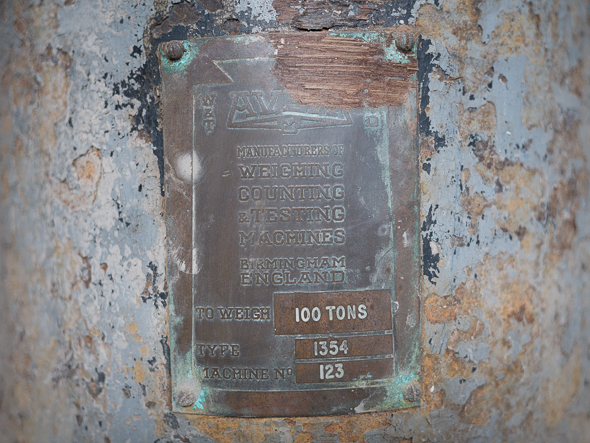
Upon reading the nameplate, it turned out this was a scales and not a press. Likely the machine which did the measurement fit inside the platens, and the screw was a way to calibrate it. I also think this machine was connected to the inside of the brick making kiln behind it.
The W & T Avery Ltd. Co., who made this machine is still in business, and one branch of the business is Avery-Denison. They make sheets of PSA stickers to run through a computer printer, very much the opposite end of the weight spectrum from this monster.

This is not the way I would ever repair a book. On the other hand, this is my book, and I bought it because of this repair; the massive amount of masking tape. I can appreciate that the owner—likely a machinist—did anything possible to keep this book functioning. This book was as important to a working machinist in pre-internet days as any of his other tools.
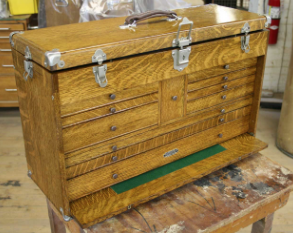
Machinery’s Handbook contains charts, reference information and formulas, and was so useful that Gerstner, a wood machinist chests manufacturer, incorporated a special drawer in some of their machinist’s chest to store this book.
All books are tools for reading, but in many ways this book is even more of a tool than other books. So should it be repaired, conserved or restored differently? Nineteenth century owner repairs, which are often sewn, are becoming increasingly valued as part of the history of a book’s circulation, value, and usage. Could a masking tape repair be similarly prized a hundred years from now? But what would be left? Could the “patina” of cross-linked deteriorating adhesives someday be valued?
Mindy Dubansky recently posted other cool examples of owner repairs at ” It Seemed like a Good Idea at the Time: Crazy Book Repairs, Part One” In general, I don’t consider these types of repairs crazy, though. They are expedient. practical and reflective of the bookbinding knowledge of the owner, which is understandably low. Just don’t expect them to last too long.
 Peachey Conservation