Confusing Book Conservators

It is confusing for the public to understand the differences between Bookbinder, Book Restorer and Book Conservator. Book Conservationist is never used, except by the uninitiated.  Below are how some of these terms are commonly used — more precisely, how I wish the terms were commonly used — in the United States.

Bookbinder: Someone who makes books consisting of partially prepared materials from other crafts, rebinds and sometimes repairs older books.

Book Restorer: Someone who makes old books look an imagined “new”.

Book Conservator: Someone who preserves the historic, intrinsic, artistic and artifactual value of books through preventive measures and physical intervention.

The New York Public Library has muddied the waters even further, with a program called New York Public Library Conservators.  In this case, the term “Conservator” means someone who supports or maintains NYPL financially. This adds confusion, and creates the need for more explanation. But if you have an extra $15,000.00 – $24,999.00, you can call yourself a New York Public Library Carnegie Conservator, which sounds like an endowed professional position.

conservators
Application form for New York Public Library Conservators Program, 2015.

Further resources if you want to read more of my rants discussing these terms:

https://jeffpeachey.com/2010/03/30/outside-of-the-text-my-work-in-book-conservation/

https://jeffpeachey.com/2010/03/11/a-future-for-book-conservation-at-the-end-of-the-mechanical-age/

http://www.bookbindersmuseum.org/the-future-of-book-restoration/  The second comment.

https://jeffpeachey.com/2013/05/07/book-conservation-and-book-restoration-and-ngrams/

 https://jeffpeachey.com/2008/11/11/comments-on-clarkson-conservation-and-craft/


Laotian Kitchen Knife and Vietnamese Vegetable Peeler

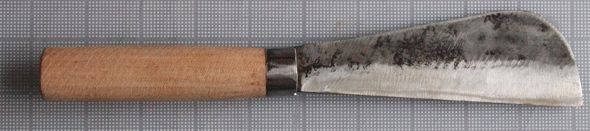
veg knife

In Laos, at a food market outside Vientiane, I purchased this kitchen knife. I saw many people using knives similar to this. There are many crude forging and grinding marks on it, gradually tapering to a decent cutting edge. Much like the  hacksaw paring knife I wrote about previously, this knife is pure function with little effort expended on decoration or polishing.  The steel itself is a very respectable HRC 55-60. One interesting feature is the complex curve on the back of the blade, possibly to add rigidity to the tip, since the blade is fairly thin, between .048-.051″. Many kitchen knives I saw were shaped like this. Or it might be give the blade additional life as it is reground, since the tip may get reground or used more?  The blade is partially morticed into the steel ferrule, which makes it feel quite solid. The blade angle is slightly offset from the center axis of the handle, an indication it is designed to be used freehand, not on a cutting block.  The handle was turned on a lathe, there are marks from a tailstock center on the bottom, and it was quickly smoothed with a rasp. This gives the unfinished wood handle (some kind of dense hardwood) a very pleasing feel and grip. I really like the feel of unfinished wood for tool handles, though they do get dirty quite quickly.

.

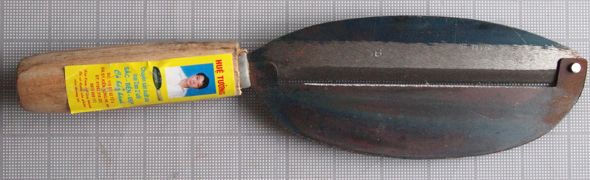
peeler

I purchased this vegetable peeler in Vietnam, and believe it or not, this 12″ long version was the smallest of five sizes offered.  The name of the company, or man who made it is named “Hue Tuong”. Vegetable peelers (as well as  mandolins, scabbard planes, spill planes, and a few others) interest me because they reverse the standard way planes or spokeshaves are used— what is usually the waste is actually the useful product. The steel is similar to the knife above, HRC 55-60, but it looks like it is made from rolled stock. This knife is also offset from the central axis, like the Laotian knife above. The knife is made of two pieces, I suspect both to make the manufacture and resharpening easier. A rivet holds the two pieces together at the top, and by simply removing the handle it can be opened 180 degrees and resharpened. Very clever. This knife is sharpened to a finer grit than the one above. I’m still working on my technique when using it.

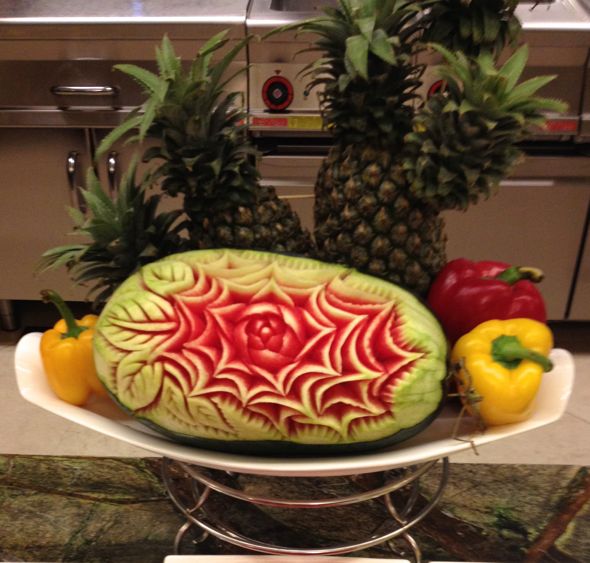
Now that I have these knives, I really should try some of the fancy fruit and vegetable carving, like this beautiful watermelon.

watermellon


Nguyen Era Vietnamese Books

Also in Huế, Vietnam, which I wrote about last week, I noticed several books in the Museum of Royal Fine Arts. There made from copper and silk. All of these books were from the Nguyen Era (1802-1945) but were not dated more precisely. I wish I knew more about Vietnamese book history, and if these materials were common or only used for special books.

These material extremes of leaf material are of interest: nothing drapes quite as well as a silk book, or as little as a metal one. The copper book is held together with four large rings, and the silk book is bound in what we usually call a Chinese style binding, stab sewn at the spine with the pages folded at the foreedge.

As I look back at these images, it seems the cooper book must also have a fold at the fore edge—for the repossé or chased decoration is on both sides of the leaf— or possibly the leaves were much thicker than I recall. I guess I need to go back to re-examine….

Hue 1

Copper Book. Huế Museum of Royal Fine Arts, 1802-1945

.

Hue2

Copper Book. Huế Museum of Royal Fine Arts, 1802-1945

.

hue3

Silk Book. Huế Museum of Royal Fine Arts, 1802-1945