Upcoming Lecture at Syracuse University Library

.

***NOTE: This lecture and the workshop have been canceled due to the storm.

I will post the new dates once they are determined, likely spring 2013.***

On Thursday, November 1, I will be giving the 2012 Brodsky Series for the Advancement of Library Conservation lecture at Syracuse University Library in Syracuse, NY.

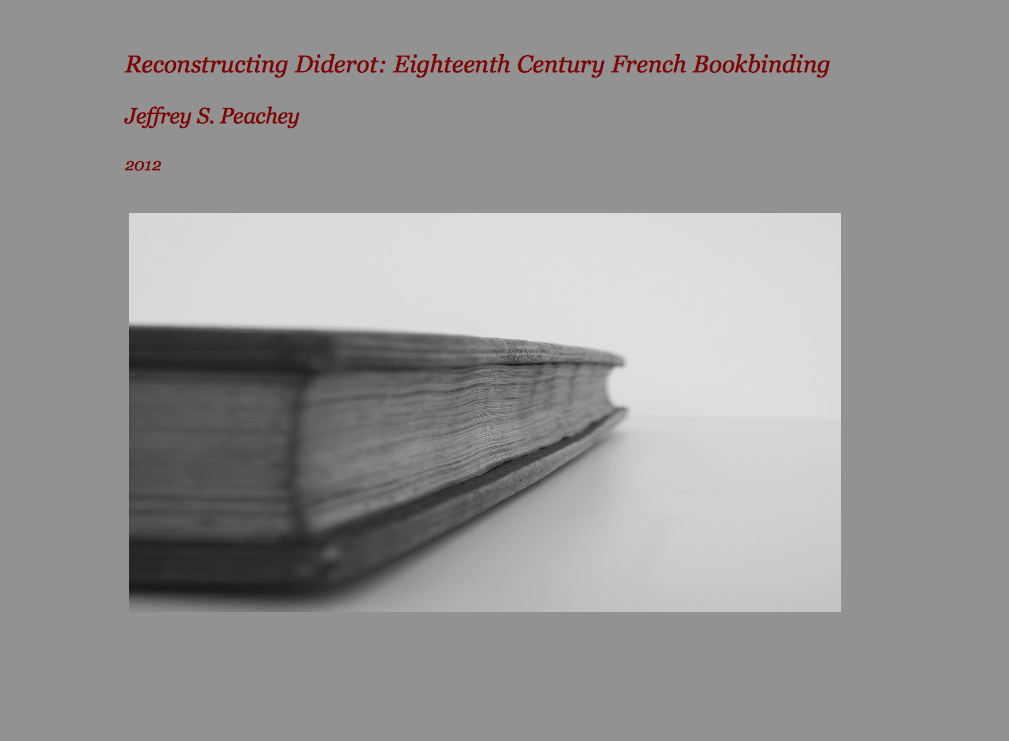
Each time I present Reconstructing Diderot: Eighteenth Century French Bookbinding, I spend some time incorporating new research and tweaking it for the intended audience. This version is well suited for a more general educated audience, without specialized book knowledge. Recently, I’ve compared the working methods of eighteenth century bookbinders with the industrialization of the nineteenth. I’ve also been interested in looking at bookbindings as products of technology (rather than art or bibliography) as a methodology. In some senses, I am continuing a Diderotian approach by closely examining and emphasizing the tools and equipment that bookbinders used.

On Friday, November 2, there is a one-day workshop based on this lecture, which is full and there is a waiting list.

The lecture is free and open to the public, and will be held in the Peter Graham Scholarly Commons in Bird Library at 3 p.m. with reception to follow. Directions to the Library are at: <http://library.syr.edu/about/visit/liblocation>.

Dr. Christopher Clarkson on Conservation Education

I could write a number of posts just introducing Christopher Clarkson. This is the very,very short version. He graduated from the Royal College of Art, London, then worked for S. M. Cockerell, and Roger Powell. In 1966 he was sent to Florence after the flood & taught in Italy and England till 1971. In 1972 Clarkson moved to the Library of Congress, concentrating in Special Collections. In 1977 Clarkson moved to The Walters Art Gallery, Baltimore to set up a book conservation studio, he also helped Dr. Lilian Randall, adding many of the parchment & binding descriptions  to her great manuscript catalogue. He returned to England in 1979 as the first Conservation Officer at The Bodleian Library Oxford. Concerned about training, in 1987 Clarkson moved to West Dean College, where he ran an internship programme & worked on many medieval manuscripts. Most recently Clarkson has reported on the early 5th century Ms. Syriac 30 & the ‘New Finds’ of Codex Sinaiticus for the Monastery of St. Catherine’s. Currently he is conservation consultant to Hereford Cathedral Chained Library & Mappa Mundi, The Bodleian Library & to The Wordsworth Trust.

Quite likely, he has done more to create awareness of traditional materials, research the context of older structures, and impart sensitivity to treatments than any other book conservator.  And he generously shares this knowledge through teaching and in publications. Many of his articles form the foundations of the field. In July, he was awarded an honorary doctorate from The University of Arts London. Chris describes that he “was given two minutes for a speech in which he wanted to try to heighten the profile of conservation within the University also to stress why an art school system is probably still right for the  subject.”

Like most of his writing, the speech below is quite dense and warrants reflection.

…..

CLARKSON’S HONORARY DOCTORATE SPEECH

“It is a great pleasure to be back amongst art school people. I started at Camberwell School of Art in the 1950’s when I was thirteen, when it was still very much academic & Arts & Crafts based. The observational, painting techniques & graphic printing skills I learnt there have been essential in my later career as a conservator.

Conservation is a subject that bridges many disciplines – history, chemistry, engineering, material science etc. Possibly because of this, specific educational committees have said, “this is not ours” & passed it on to other committees. Above everything, it is a discipline which requires a high level of visual & craft skills plus ‘historical awareness’, my phrase, meant to express a deeper knowledge, sympathy & thus respect for the integrity of a period artefact. The danger in poor restoration/conservation training is ‘facsimile’ – the misconception that past cultures & their artefacts can be recreated – they cannot.

What I have tried to develop and teach are the principles of conservation as applied to period book structures, the diversity and the unexpected is what I am trying to preserve. This means teaching a wide and ever growing variety of techniques, utilizing a wide variety of materials and treatments out of which imaginative and historically sensitive young people can begin to find the answers to the problems that damaged books will present.

I am very interested in the choices conservators make in their treatments and how these decisions may influence our interpretation of an object. Thus observational skills are central to any conservation programme, I mean traditional drawing skills – to train the eye is to train the mind.

Conservation belongs in the Humanities, which are suffering badly in the present educational climate. I do hope the University can continue to support, & if possible broaden its commitment to its conservation course. It is a resource intensive discipline, expensive in time, training & quality materials, tools & equipment; a high percentage of bench-work is essential.

There has never been a greater need for well-trained conservators who not only know the techniques but also the cultural significance of what they will be working on. The support that the University gives to such courses is of enormous value.

I would like to congratulate all the students receiving their degrees today & wish you a bright & interesting future.

To the University I thank you for the honour you bestow on me.”

-Christopher Clarkson, 16 July 2012

Soon to be Published! Suave Mechanicals: Essays on the History of Bookbinding, Volume 1

UPDATE 2/13/2013: This book is now available for purchase from The Legacy Press

I’m quite excited about this forthcoming book for two reasons: my essay on the beating of signatures is included and I’m really looking forward to reading the other essays. Julia Miller is the editor as well as the author of an essay on scaleboard bindings. This is the first of a volume of a planned series on the history of bookbinding.  Binders take note, there will be copies in sheets available. This book is scheduled to be published in early 2013 and if you want to know when it is published email: thelegacypress (at) comcast.net

Cathy Baker, founder of The Legacy Press,  also publishes a number of other award winning books on book and paper history. I wrote a review of her own excellent book, From the Hand to the Machine: Nineteenth-Century American Paper and Mediums, Technologies, Materials and Conservation, in the The Bonefolder, Volume 7, 2011. Books from her press are thoughtfully designed, well made, and most importantly contain valuable, original content.

My essay, “Beating, Rolling and Pressing: The Compression of Signatures in Bookbinding Prior to Sewing”  is a comprehensive examination of the tools, techniques and effects of beating. It is difficult to overestimate the importance of beating in the forming the appearance and function of virtually all textblocks from the handpress era. Prior to the 1830’s, all bound book were beaten by hand with hundreds—likely many hundreds—of hammer blows. Records indicate it could account for up to 25% of the cost of a binding.  Today beating is virtually ignored or barely mentioned, even in most book histories and in specialized workshops on historical bindings. Beating hammers are very rare and I’ve only located about a dozen of them, though I suspect there are many more as yet unidentified. The study of the history of tools is often divorced from the study of the history of the objects they were used to make: here, I attempt to integrate the two. I trace the history of beating, the evolution of beating tools and machines, and interpret the results of beating in an essay of over 21,000 words with 42 illustrations.

Abstract for “Beating, Rolling and Pressing: The Compression of Signatures in Bookbinding Prior to Sewing”

The tools and techniques of bookbinding have received little attention within the study of book history, bibliography and book conservation. From the fifteenth century until the beginning of the nineteenth, the compression of book signatures prior to sewing was accomplished by hand beating with a large hammer. Signatures were beaten for various reasons at different times, but generally to meet expectations of solidity, smoothness, and openability. In 1827 the introduction of the rolling machine replaced hand beating in large binderies in England, and quickly spread to other countries. Both literally and figuratively, the transition from hand beating to the rolling press demarcates the end of bookbinding as a vernacular hand craft and the beginning of machine bookbinding. Papermaking, printing and book structures also changed radically around this time. The rolling press and descriptions of other presses are well documented in early bookbinding manuals, trade records, nineteenth century encyclopedias and other accounts of which together provide an unusually rich and detailed insight into this time period. This study will follow one technique of bookbinding—the compression of signatures prior to sewing—and investigate how it was done, how the tools changed, what the technique meant to the bookbinders, and how it affects the bookbindings themselves.