Paul Hasluck, Work, Gloophlex, and a Copy Press

Paul Hasluck edited the manual Bookbinding in 1903, and it was part of a series which included other titles such as Cycle Building, Taxidermy and Electric Bells: How to Make and Fit Them.  As a bookbinding manual, it’s ok, though not nearly as good as others from this time written by Cockerell, Crane or Zaehnsdorf. This time period is important in the history of bookbinding manuals, since many are specifically written for amateurs for the first time. Hasluck’s manual was reportedly written by an anonymous London binder and a Mr. Brown.[1]  One potentially useful aspect of this book are the many plans detailing how to make your own equipment. This book goes far beyond most bookbinding manuals in the complexity of DIY equipment projects. For example, it provides instructions for not only one, but three styles of a plough.  Most of the woodworking information is pretty reasonable. There are a number of editions and various publishers of this book.  All that I’ve seen share a distinctive, narrow format and very thin, semi-flexible boards. At least there is a 1903 Cassel and Co. edition,  a 1907 Cassel (available on Internet Archive),  a 1912 from David McKay, Philadelphia, and an undated one from Funk & Wagnalls Co., NY and London. The F&W edition has American style joints on the case and l’m guessing is from the 1920’s. The book is interesting in its early DIY ethos, and there is the corresponding commercialism of product placement and an interactive didactic aspect; readers are encouraged to write in with their questions.

Fig. 1. Advertisement for “Gloophlex” on the front pastedown of Hasluck’s 1903 “Bookbinding”.  

Prominently featured on the front pastedown of the 1903 edition is a full page advertisment for Glooplex, a product I haven’t heard of before, or since. The text makes a point of mentioning that “Bookbinders use large quantities of glue in their work, and doubtless much time would be saved by employing some such preparation as ‘Glooplex’, an elastic glue, guaranteed by the makers to be strong and reliable.” [2] I’m guessing it is a hide glue with an additive, quite likely glycerine.  Sometimes alum was also mentioned as an additive to make the glue more waterproof around this time, which unfortunatly results in a glue that is less easily reversible. It is quite uncommon to find specific products mentioned in early twentieth century manuals.

The interactive, didactic component in the undated Funk & Wagnalls edition is an appeal from the publisher for readers with questions to write in to Work: An Illustrated Magazine of Practice and Theory, for all Workmen, Professional and Amateur, which Hasluck was also the editor. “This treatise on Bookbinding is … so simply worded that even inexperienced readers can understand it. Should anyone, however, encounter unexpected difficulty, he has only to address a question to the Editor of WORK” [3] This creates a symbiosis between the book and the magazine (and the products mentioned therein), suggesting that they can function as a practical, though distant, teacher. One reader acknowledges this in the testimonial section of the book; “I have earned many pounds with WORK as my tutor; it is the best pennyworth I ever bought.” [4]

Fig. 2. Cover of  the 1903 edition. I assume the cover design is the same for the entire series.

Joel Moskowitz, founder of Tools for Working Wood, is reprinting Work magazine in a cool manner; reissuing the original once  a week, 123 years after the original publications dates. Originally each issue cost a penny, now they are free. They scans are quite large, so it is possible to read this magazine and examine the illustrations in detail. Work is a fun, varied read, and Joel mentioned he has about four years worth of material. In this era of shortened attention spans, I’m curious to see if Work resurrected will hold current readers interest.

Fig. 3. Diagram of a copy press from ‘Work’. Courtesy Tools for Working Wood.

In particular, Bookbinders may find the article “How to Make a Wooden Copy Press” (Vol. 1, No. 2) useful. I haven’t tried to make it, but the instructions seem to be adequate for making a light duty press, quite similar to entry level presses still sold today. I might be tempted to double the thickness of the wood on the platens, depending on the final size, and a metal screw would add a lot more force. David Denning, author of this article and a woodworker, wrote four books on woodworking including in 1891 The Art and Craft of Cabinet-Making, available in facimile from Toolemera. Denning manages to avoid the most difficult aspect of this project, making the screw, mentioning he found one in the trash— a man after my own heart. If you are not so lucky, it shouldn’t be too difficult to modify one from a woodworking vice, make your own from commercially available acme threaded rod and handles, or if you are feeling adventurous learning how to cut a wooden thread using taps and dies or a router jig. In my early years, I even made a crude standing press out of a scaffolding leveling jack that I had found. I placed the nut under a frame made of 2 x 4’s  to tighten. Crude and awkward to use, but it generated a ton of pressure.

Fig. 4. A scaffolding leveling jack. 

Work covers a wide range of crafts, not just woodworking. Perhaps a testimonial in the back of the Hasluck’s Bookbinding for Work magazine is reason enough to dwelve into this journal. “I owe to WORK a house for my family, a tranquil night’s rest, and an education for my children.” [5] What’s to loose?

……………………………….

NOTES

1. Paul N. Hasluck,ed. Bookbinding (London: Cassell and Co., Ltd., 1903), Preface.

2. Hasluck, Bookbinding, 32.

3. Paul N. Hasluck, ed. Bookbinding (New York and London: Funk and Wagnalls Co., [nd]), Publishers’ Note.

4. Hasluck, Bookbinding,1903, page opp. 160.

5. Hasluck, Bookbinding,1903, page opp. 160.

On the Permanence and Beauty of Books

“Day by day it is announced in one or more papers in some form or another that there is no need for higher-priced [substitute paper based] books, when others can be bought at the nearest draper’s or starioner’s for a few pence. As well might one say there is no need for architectural beauty or scientific stability in our buildings; no need for permanence in our arts; and no room in our lives for joy and pleasure.”

-Alexander J. Philip, The Business of Bookbinding (London: S. Paul, 1912) 10.

Family Bibles

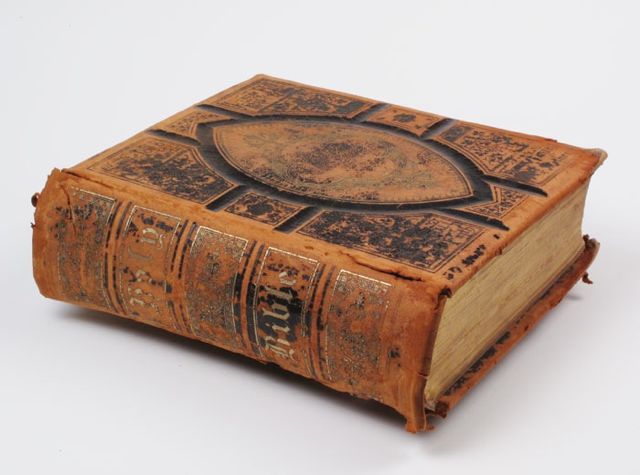
Mentioning Family Bibles to a group of bookbinders will provoke a variety of responses somewhat similar to the Kubler-Ross model of the five stages of grief: denial, anger, bargaining, depression and acceptance. In the end, most of us accept the fact we will work on them—many, many, of them. Anecdotally, there seems to be less of a demand to work on these in New York City than some of my country based colleagues report; perhaps NYC is just not a Bible keeping/reading kind of town. Family Bibles (along with family cookbooks filled with recipes, notes, butter stains, etc..) are often the only books of valued enough by the general public to consider preserving, a trend that is likely continue and increase.  The large size and poor quality materials of these Bibles make them difficult to work on. Claire Manias is familiar with these challenges and wrote this brief essay about Family Bibles for an exhibition at the Museum of Biblical Art.

Clare is the Conservator of Rare Books at the Museum of Biblical Art, and has twelve years of experience in conservation. She has worked in major institutions around New York City including the New York Academy of Medicine, The New York Botanical Garden, the Metropolitan Museum of Art, Union Theological Seminary, as well as in private practice.  She is a former co-chair of the NY Chapter of the Guild of Book Workers, 2006-2010.

A Note on the Conservation of Family Bibles

Clare Manias

Family Bibles like the ones displayed in The Book of Life: The Family Bible in America were purchased to begin and maintain important record-keeping traditions for families. Major life events, emotional trials, and joyful expressions were recorded by family members and passed down through generations.

These Bibles were read, shared, displayed, stored, passed around, neglected, and found. All of this activity rendered itself not only on the pages of the book, but also on its binding. Hands left worn spots, paper was torn while reading, and the binding was strained by articles pressed between the pages. These changes occurring over time are as important to the history of the book as is what is printed on the pages.

Fig 1. These Family Bibles were designed to appeal to the purchaser’s idea of what an important book looks like. Photograph by Gina Fuentes Walker for MOBIA.

The design of Family Bible bindings was meant to invoke a sense of tradition. The Bible with Apocrypha, printed in Syracuse, New York at the Bible Publishing House in 1882 (Figure 1) is an fanciful example of what a great book is supposed to look like. The binding’s style evokes medieval books which had thick wooden boards, large raised bands, metalwork, and elaborate tooling on the covers. Family Bible bindings also emulate the style of fine binding of the seventeenth century with tooled board edges, elaborately gilt spines, and shiny text paper edges.

New technologies like color lithographic printing, wood engraving, machine paper making, and industrial leather production helped make it possible to bring these luxurious books to their respective families quickly and less expensively. The advancements in paper making and leather tanning, however, would prove to be unfavorable for the preservation of these books. Rushed tanned sheepskin rapidly breaks down and is very acidic. Early machine-made paper had not yet had time to turn brown and brittle from age, so the effects of time on poorly refined wood pulp paper were yet to be discovered.

It is also possible that items placed in the Bible for safekeeping have distorted its binding or stained its pages. Thick cardboard items or locks of hair can strain the sewing and cause the spine to split. Newspaper clippings and pressed leaves release acids as they age that cause them to “print” their silhouette on the pages between which they are interspersed.

Fig. 2. The best way to preserve your family’s historical objects and documents is to store them in protective housing in a stable environment. Photograph by Gina Fuentes Walker for MOBIA.

Poor materials combined with heavy use make a conservator’s job much more challenging. Consider the Complete Domestic Bible, published in Syracuse, New York by Watson Gill in 1873 which has brittle paper that is almost impossible to repair and “red-rotted” sheepskin leather that is very difficult to retain (Figure 2). These fragile materials hold the marks of the Bible’s owners but require extensive conservation treatments to return them to readable condition. This is not feasible because so many of these Bibles were sold and so many copies survive, thus making the Bible relatively inexpensive even today. Though the book itself is not rare, the markings and changes brought upon it by the family that owned the book make it unique, and therefore a candidate for careful preservation. The binding should be preserved to retain the evidence of its history, even if that means stabilizing the Bible in a state of disrepair.

The best way to preserve unique family records is by careful storage. Libraries and museums maintain clean, temperature- and humidity-regulated storage environments as the most effective way to preserve their holdings. Keeping storage temperatures at 70 degrees and maintaining a humidity of 50% is the best way to keep brittle papers from yellowing further or already dry leather from breaking off and crumbling. Books and family records can also be kept in custom-made, archival storage boxes that support the book on the shelf and protect fragile paper from damage and soiling incurred from handling and long-term storage.

In preparation for The Book of Life, only minimal conservation treatment was implemented to ensure that the books shown are as close to their current state as possible, without trying to make them look brand new. This ensures they will retain the evidence of the family records they contain and invoke this historical period for viewers now and in the future.

…………………………………..
Reproduced with permission from the exhibition catalog, The Book of Life: Family Bibles in America, New York: Museum of Biblical Art (MOBIA), 2011.