The M2 Paring Knife used for edge and overall paring.
For spines and headcaps in full leather binding and when rebacking, several tools are usually used. Some binders like to use a straight English knife and modified spokeshave or razor blade paring machine for this. Others like to use a straight English style and a round French or Swiss knife to accomplish this. But the M2 hybrid can do the job of all of these, and many like the simplicity and economy of using one knife.
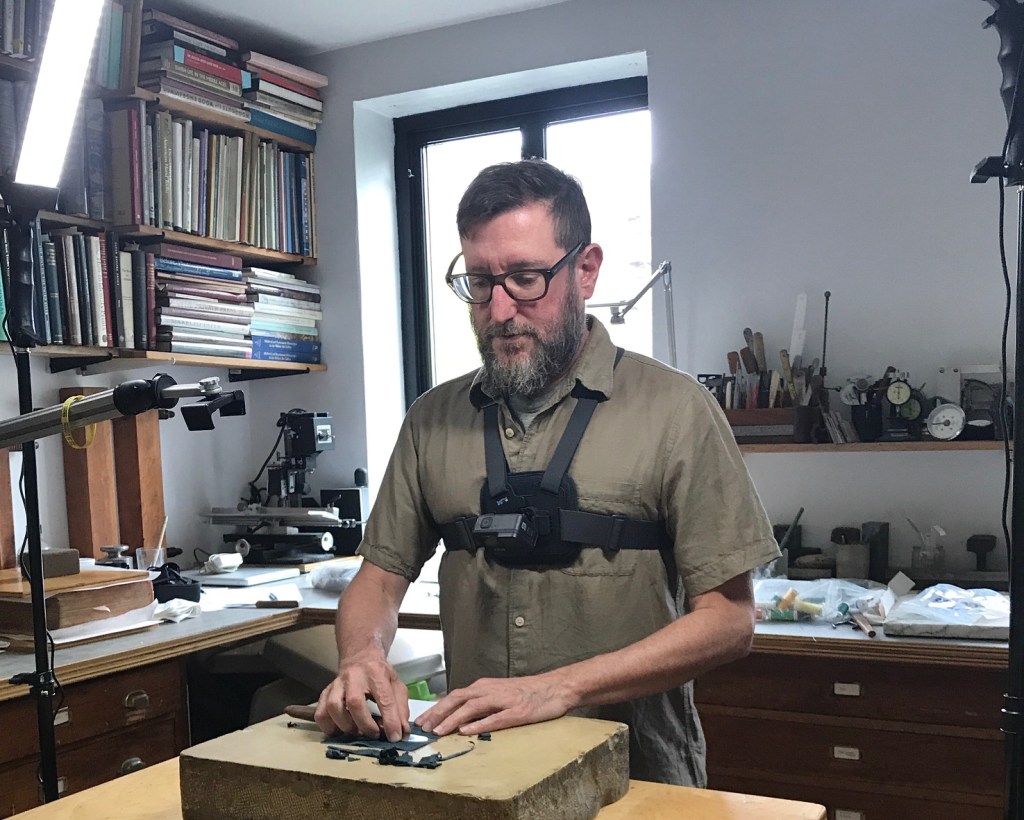
Body cam with heart center point of view!
I’ve been honing my video skills in preparation for more online workshops. Lots of new gear and tech: computer, lights, Vimeo plus, Zoom pro, wireless earbuds, GoPro, and iMovie. Oy!
I’m working on converting my repertoire of existing workshops into online versions. If there is something that particularly interests you, mention it in a comment or contact me directly!
Many thanks to Jeff Altepeter, Head of Bookbinding at North Bennett Street School, Karen Hanmer, Bookbinder and Book Artist, Henry Hebert, Conservator for Duke University Special Collections, and Andrew Huot, Owner of Big River Bindery, for sharing practical pedagogical advice about teaching online!
A couple of months ago, I asked a number of colleagues what they considered the five most essential bookbinding tools. But nobody — myself included — mentioned what I now think the most essential tool for any craft is. Ok, it may not *technically* be a tool, but it is fundamental to most crafts.
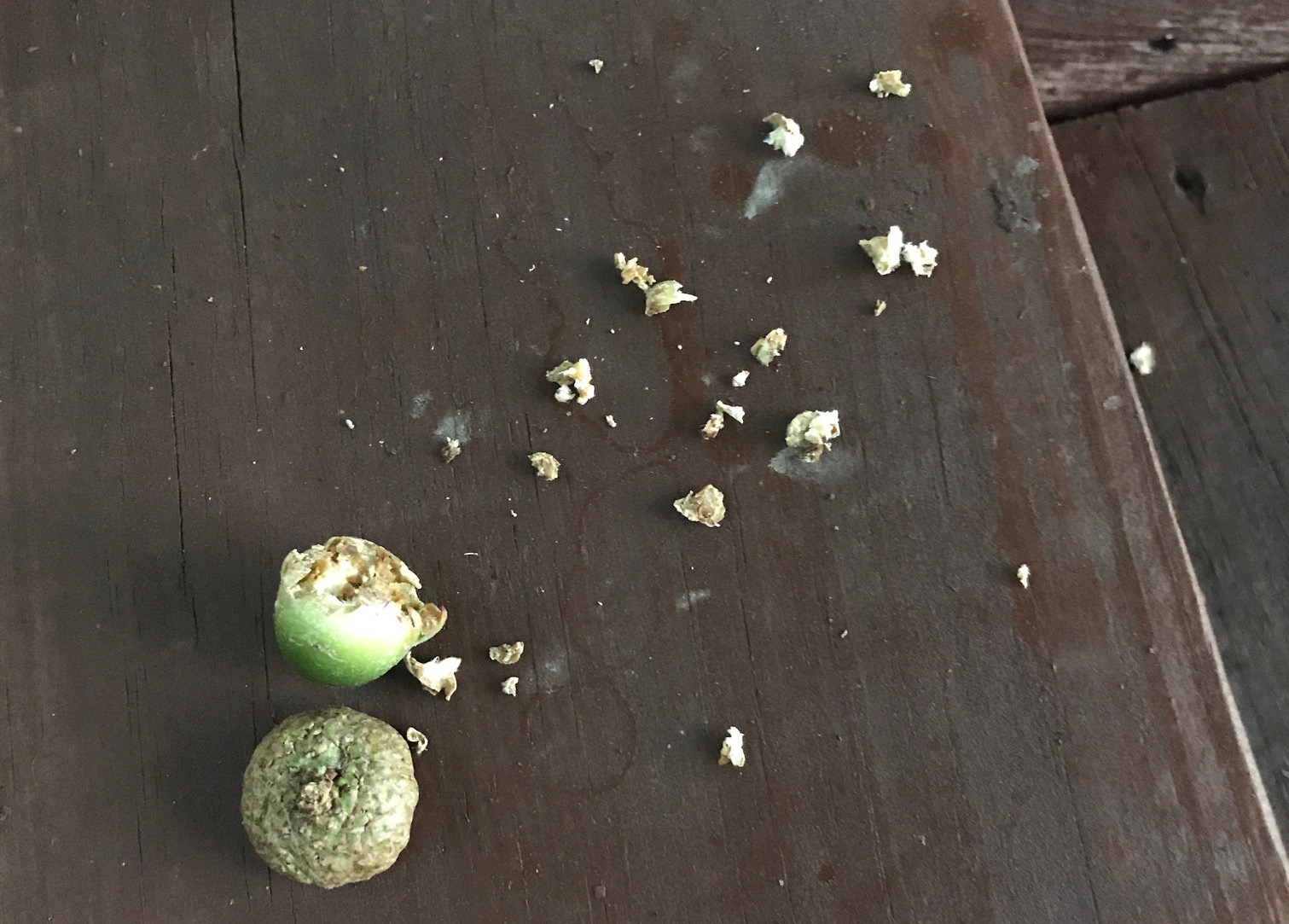
Many animals use tools like this, for example the chipmunk that used the wood stairs below to break open an acorn. The tool or piece of equipment? A workbench.
A chipmunk used these wood stairs as a workbench to crack an acorn.
Workbenches are important to book conservators, both practically and conceptually. A wobbly or insubstantial bench makes the most common activities much more difficult. The term serves as a shorthand for how one was trained: bench trained, apprentice trained, program trained. Every book conservation lab I’ve seen has a dedicated bench space for all full time technicians and conservators. Bench time is often specified as a percentage of work time distinct from other duties in job descriptions, though I’m always interested to hear from colleagues how accurate this turns out to be!
Why are workbenches are called benches. Aren’t they really worktables?
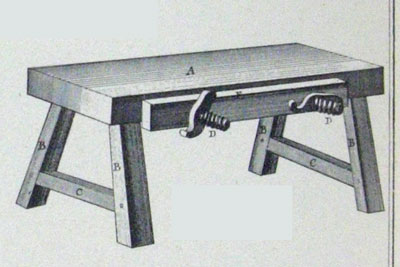
It turns out not to be a big mystery. Scott Landis, in his wonderful out-of-print book The Workbench Book, traces the workbench to an Egyptian carpenter’s bench from ca. 1475 B.C.E. And guess what, early workbenches look very much like a modern bench, not a table.
Roman workbench from Scott Landis, The Workbench Book, Taunton Press, 1987, p. 8.
Landis describes a Roman bench ca. 250 B.C.E. that looks pretty much the same: a solid wood surface (about 2.75 x 14.5 x 102 inches, four splayed wooden legs, mortised into the top. Both appear roughly knee height. In other words, a bench.
Very similar workbenches continue until the 18th century for many trades, with subtle variations. Woodworking benches often had mortices for bench dogs or vices attached.
Bookbinders are often portrayed working at one of the three fundamental tools of the trade: a lying or cutting press, a sewing frame, or a standing press. In the second quarter of the 19th century, the shift to case binding as the predominate structure likely created a need for a more table like work surface. Many trades have different names for similar tools. For example, what most trades call a “tommy bar” bookbinders call a “press pin”. But the term workbench may have been borrowed from other trades.
Joel Moskowitz of Tools for Working Wood had a fun quiz on his blog a couple of years ago, trying to match seven workbenches found in Diderot to the trade associated with them. Although the prize is long gone, it is still quite fun to imagine how each bench may was used. And as he mentions, no cheating by looking it up!
Last week, I blogged about a scene from a movie depicting a copy press on top of a safe, and wondered if it was a way they were actually used in offices. Darryn Schneider of DAS Bookbinding in Australia sent me this wonderful image he found from the State Library of Victoria. Bingo! Well, at least there is one documented example….




 Peachey Conservation