A Very Long Tool Roll. And Fantastic Students at The Conservation of Leather Bookbindings Workshop, Emory University.

A very, very, very long tool.

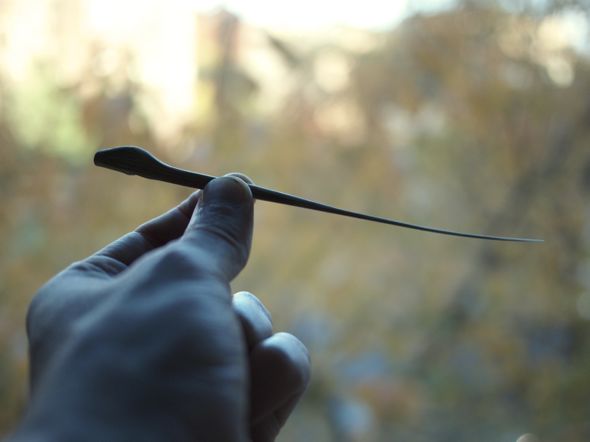
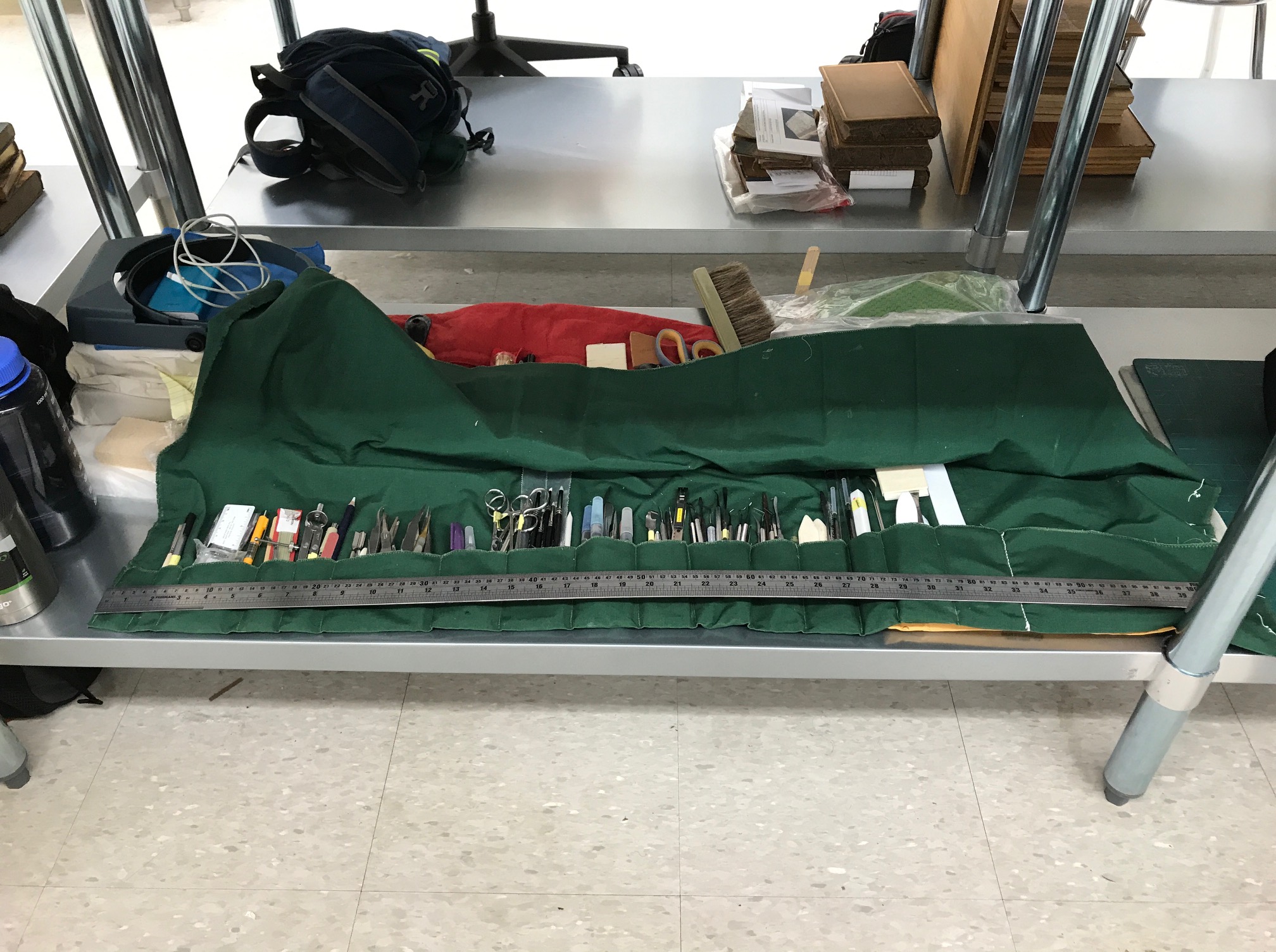
Soyeon Choi, aka. Cat Lady, brought the longest tool roll I’ve ever seen to The Conservation of Leather Bindings Workshop last week at Emory University. It is over 42 inches long and has 16 pockets, each of them stuffed full. Soyeon made it out of cotton fabric. Yet it was not large enough to house all her travel tools, so she brought an additional smaller red one, which is partially visible in the image above. It is always fun to geek out over the tools everyone brings.

In contrast, a “large” tool roll from Highland Hardware of Atlanta is a modest 21 inches in length. It was great to finally visit Highland, BTW, and I bought a gorgeous Auriou hand-cut woodworking rasp there.

Kim Norman, Head of Conservation, and the consummate Emory Conservation Lab crew made this workshop fly. But the best thing about it were the students. Because everyone came with substantial experience in bookbinding, and brought different books with different problems, the discussions were amazing, thoughtful, informative, and filled with practical information. Everyone benifited from thinking about the books others brought, as well as working on their own.

Plans are already in the works to repeat this workshop, which will be announced here.

At the end of week long workshops, I ask the students to vote for a class member who they feel deserves a prize, and explain why. Soyeon Choi won overwhelmingly, for asking pertinent questions, and she added a pair of small bone folders designed for making headcaps to her already overstuffed tool roll.

Payne, Pots, and Bills

Portrait of Roger Payne.  Source: Recent Antiquarian Acquisitions, The Lewis Walpole Library, Yale University. A huge version of this is image is available at: https://lewiswalpole.wordpress.com/2013/11/14/rogerus-payne-2/

I suppose most bookbinders are familiar with this depiction of Roger Payne.  I first encountered it as Plate 59 in Edith Diehl’s Bookbinding: Its Background and Technique, which was the second book on bookbinding I read in 1988. The scene is often referred to as a “dingy garret”,  though to be fair, many slightly later depictions of binderies, ca. 1830’s, are in a similar state, with cracked plaster, dirty looking walls, etc….

There is something appealing about the scene, a locus of honest, if impecunious, craft. His timid, almost mouselike  glance conveys an earnestness. He seems weak, leaning on a book in press to support his thin frame. The press tub itself is so dinky I can’t imagine using it to back a book — how would the press itself stay stable on it? The book on the press is also in an  odd position. It is difficult to believe a binder would press down on the spine like this, when the book is only supported by the foreedge boards. There are other oddities. Why are there books lying on the floor? Why is he wearing slippers and torn pants? Should we chalk it up to the artistic imagination of the artist who drew him?

And what are in the three pots that have spoons or brush handles sticking out of them? Are they barley broth pots as one theory advances, which he was supposedly fond of? Or are they glue pots?  The one in the brightly burning fire would likely be too hot and ruin the glue. The one on the mantle might be a good temperature to actually use. Could the one in the window be kept cool for storage? Or, again, are we back to speculating about an artist’s imagination.

We do have actual evidence of Payne and his work, found in the books he bound, and his invoices, written in his own hand, and very detailed for the time.

Handwritten bill from Roger Payne, The Morgan Library and Museum. # MA 3889.

There is a collection of 35 of them bound together at the Morgan Library and Museum. Accession Number: MA 3889, Unfortunately, they are separated from the books that he bound.  What a loss! There are a number of Payne’s bindings in the Morgan’s collection.

While they do not reveal the mystery of his pots, they do reveal a kind and conscientious bookbinder, as in the above bill.  He mentions reducing the price by one days work because he wasn’t happy with the quality of the result.

His bindings are beautiful, with his often lauded tooling, carefully handled straight grain morocco, and often exceedingly thin boards that are invariably dead flat even today. He is still a role model!

Heat Treated Tonkin Bamboo Hera Blanks for Sale

Tonkin Bamboo. Note the large areas of black power fibers. Compare this to the endgrain of a chopstick.

Hera are small Japanese tools useful for a variety of scraping, lifting, and delaminating tasks. They are common in paper conservation. Tonkin is a dense, flexible and strong type of bamboo that handmade fishing rods are made from. More about Tonkin.  Heat treating increases the elasticity of the bamboo.

Even so, hera with very thin and flexible tips can wear and can crack, so they need to be maintained by sanding, carving, reducing the width, or even shortening.  Once you have the skills to make a hera, they are easy to maintain. If you want to keep things simple, shape it with your Olfa knife, sand it with 220 grit, then finish it with 600 grit.  More tips on shaping bamboo.

These blanks are roughly 6 inches long, and 1/4 – 3/8 inch wide.  If you want to make two narrow hera, you could split a wider blank.  Just ask me for the widest one I have. Making your own tools to the exact size and shape you need is rewarding and satisfying.

Purchase heat treated Tonkin hera blanks here, only $10.00/ each!

Top, bottom, and side views of a typical blank.
A finished hera. This is not difficult to do, but takes a bit of time.