Here is another gem from the Smithsonian Graphic Arts Model Collection, a very early — though not the first — guillotine for books or paper. Unfortunately, a fire destroyed the US Patent Office in 1836, so this model is the only remaining record. Visually, it looks much more like the neck cutting variety rather than ones for book or paper cutting. The massive blade operates by gravity rather than a lever or flywheel; again, like the non-book styles. Similar to all the early guillotines is that the blade operates straight up and down.
It’s always a dangerous game to cite the earliest book you have seen that contains this or that evidence, since it often gets superseded. Nevertheless, the earliest book I have seen that contains incontrovertible guillotine marks (thanks to a very damaged blade) is this Harper’s publisher’s cloth binding from 1834 of “The Works of Mrs. Sherwood”. The machine had a clamp and operated straight up and down. The curvature to the marks resulted from tightly clamping and distorting the unbeaten bookblock when cutting, a feature which the patent model above lacks, and when it is released it springs back into its resting shape.
The M2 Paring Knife used for edge and overall paring.
For spines and headcaps in full leather binding and when rebacking, several tools are usually used. Some binders like to use a straight English knife and modified spokeshave or razor blade paring machine for this. Others like to use a straight English style and a round French or Swiss knife to accomplish this. But the M2 hybrid can do the job of all of these, and many like the simplicity and economy of using one knife.
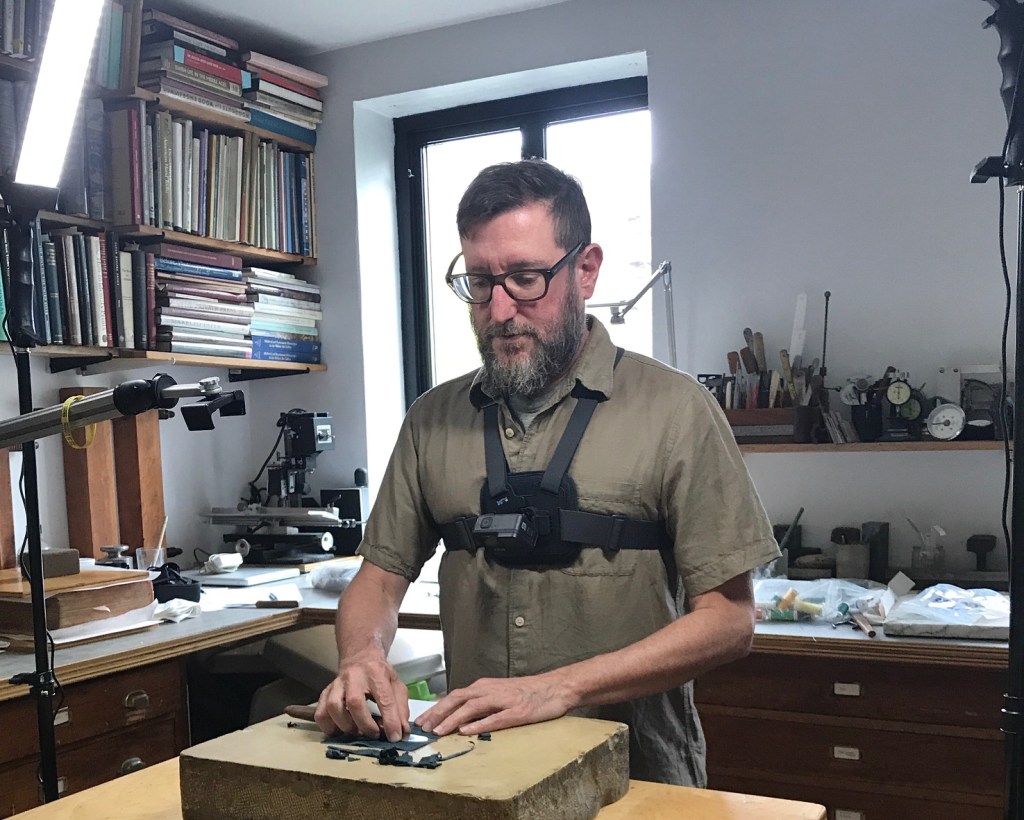
Body cam with heart center point of view!
I’ve been honing my video skills in preparation for more online workshops. Lots of new gear and tech: computer, lights, Vimeo plus, Zoom pro, wireless earbuds, GoPro, and iMovie. Oy!
I’m working on converting my repertoire of existing workshops into online versions. If there is something that particularly interests you, mention it in a comment or contact me directly!
Many thanks to Jeff Altepeter, Head of Bookbinding at North Bennett Street School, Karen Hanmer, Bookbinder and Book Artist, Henry Hebert, Conservator for Duke University Special Collections, and Andrew Huot, Owner of Big River Bindery, for sharing practical pedagogical advice about teaching online!
Dover Publications reprint of Edith Diehl’s “Bookbinding: Its Background and Technique. I’ve used it heavily since 1988.
A recent piece from the NY Times Magazine, “As Everything Else Changes, My Dover Paperbacks Hold Up”, reminded me how much I love my Dover books. From the perspective of a book conservator, Dover made the best paperbacks I know of, combining physical durability, pleasant tactility and legibility.
The Dover sales pitch, on the back cover of every book, is no lie. “A Dover Edition Designed for Years of Use! We have made every effort to make this the best book possible. Our paper is opaque, with minimal show-through; it will not discolor or become brittle with age. Pages are sewn in signatures, in the method traditionally used for the best books, and will not drop out, as often happens with paperbacks held together with glue. Books open flat for easy reference. The binding will not crack or split. This is a permanent book.” In addition to being very well made, Dover books were always very reasonably priced. What’s not to like?
The textblock of my “Bookbinding” is in good physical condition, though the surface pH of the leaves is around 4.5. The spine is becoming concave, due to 32 years of very hard use, but the sewing is completely intact. The covering material, consisting of three layers, is also in good condition. There are only a few detached areas on the spine, some delamination, and tension/compression creasing. The spine glue is still surprisingly flexible. Dover books were always well printed, with nicely chosen paper for reproducing illustrations. The book has a pleasing solidity, reminiscent of a phone book. It is not a book that needs careful handling.
At the beginning of my career, this book was read, reread, abused, annotated, and weighted the book open with a bar of steel while I bound my own books following Diehl’s instructions. While the book repair section is quite dated, the binding information is still solid. My students always get a copy of her calm and detailed checklist of what to do in the flurry of covering a full leather book (pp. 208-209). I like the Dover reprint so much, I’ve never been tempted to buy the original two volume first edition, or the Hacker Art Books reprint.
It is great the Times published a piece about book structure for the general public. As the author notes, the current worldwide instability may drive us to look for more permanent things in our lives, and re-appreciate them. A bit of hope found in a Dover paperback?
Edith Diehl. Bookbinding: Its Background and Technique. New York: Dover Publications, Inc., 1980. Reprint, orig. 1946.
UPDATED 6 OCT 2020: Corrected title from “… Mass Market Paperback” to “… Trade Paperback” in the title. Thanks to Ann’s comment below!




 Peachey Conservation