A Painting of Eighteenth Century French Trade Bindings and Paper Wrappers

Bookbinder Colin Urbina recently posted a number of great images of books in art he noticed at the Art Institute of Chicago on his low_mountain instagram feed. In particular, the painting of Madame Francois Buron by Jean Louis-David caught my eye. It may give us some insight into how books were used in the eighteenth century, though there is always the possibility the books depicted were props.
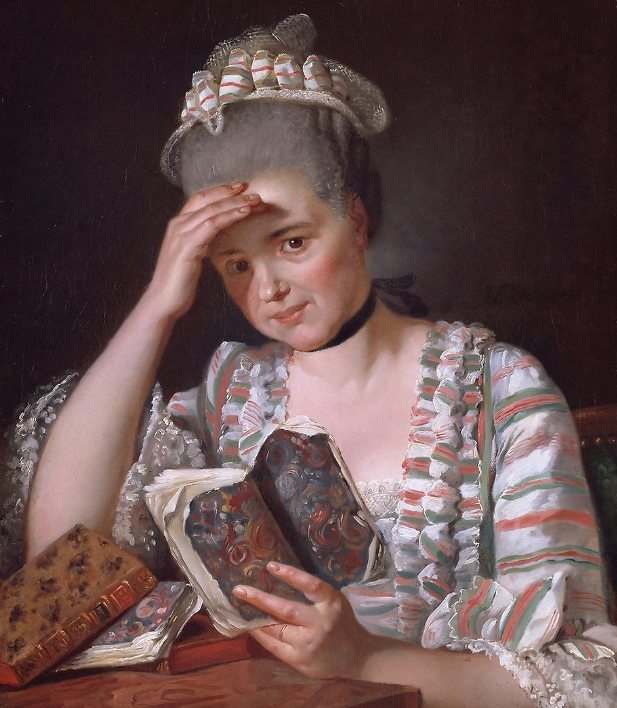
Jean Louis-David, Madame François Buron, 1769. The Art Institute of Chicago.

If this is an actual depiction of reading, it adds to the mountain of evidence that full leather trade bindings and “temporary” marbled paper wrapper bindings were consumed simultaneously. This type of pictorial evidence, along with the evidence from bindings that book historians such as David Pearson have gathered, and the usual working method of bookbinders, are all closing the coffin lid on the longstanding idea that paper bindings were intended to be rebound into a proper leather binding before use. The wear on the paper bindings —deftly painted with a white line along the top edge of the book Mme. Buron is reading — suggests these books may have been read before. 

But it is a little strange to have four books so close at hand, since she doesn’t appear to be a scholar, and three of the books aren’t open to specific pages: evidence of cross-referencing. It could simply be her reading desk, though.

If the books are intended to be props, what can they tell us about the sitter, and how do they relate to the painting? Why has she interrupted her reading to look at us? And what could  she be reading?  Louis-David’s painting technique evokes the solidity of the leather bound books in contrast with the loose airiness of paper ones. The way the paper book is cradled in her hand is incredibly realistic. The brush work on the splayed page edges blend with the her blouse, and the triangular composition is anchored by the books. The books are a key aspect of the composition.

The details of the bindings are rendered exquisitely. The cat’s paw decoration on the full leather trade binding is instantly recognizable. The red over black title labels, full guilt spine, and single blind line on the boards is historically accurate. The paper bindings are covered in a common, or french snail marbled pattern. The pattern is rendered loosely, almost abstractly, in some areas. Or could it depict a spoiled sheet, not good enough for endsheets or other purposes?

Jean Louis-David, Madame François Buron, 1769. Detail. The Art Institute of Chicago.

The book she is holding, with its thick flatish spine apparent at the head, appears to have multiple signatures. Intriguingly, the paper covered book lying flat appears to be a single signature, which would be very unlikely for a letterpress book; could it be a blank book, notebook, or journal? Is it possible she is reading something private, like a diary?

She is shielding her eyes from the light source (truth?), but at the same time the page she is reading is in the shadows. She looks out at us with a concern, and possibly a bit of weary annoyance. The Hasty Book List also noticed she seems a little caught off guard or shy. A full size image is here.

Paring Leather in a Continuous Strip Two Times Around

I’m using a M2 Hybrid knife to edge pare this small rectangle of vegetable tanned goatskin all the way around two times, without breaking the pared strip.

The trick is to reverse the direction of the knife by pushing it to turn the corner.

Five Inexpensive Holiday Gift Ideas for Bookbinders and Conservators, 2018

Peachey branded microfiber towel. $5.00. My first foray into merch! A stylish and practical way to show your support for Peachey Tools. This is a heavy duty, professional grade microfiber towel: 16 x 16 inches, 300+ gsm, 4-thread edge stitching, .1-.2 denier microfibers,  80% Polyester/ 20% Polyamide blend. Perfect for cleaning your knife and microfinishing film during sharpening, the floor, your cutting mat, and even removing excess grease from your nose. The dye sublimation printed logo seems durable on my sample, but it is not possible to have a super dense image on the three dimensional microfiber surface. The fibers fluff up over time: the towel in the image above was washed seven times. The great thing about microfibers is that they trap everything. The terrible thing about microfibers is that they trap everything, so the towel will turn grey over time, likely obscuring the logo anyway. But you will still know it is there! What could be a nicer gift for all your staff members, as well as a gentle reminder to keep things clean? They should be in stock December 11 at Peachey Tools.

.

Seal Skin Thimble. You can cut the strap a bit more to fit larger fingers.

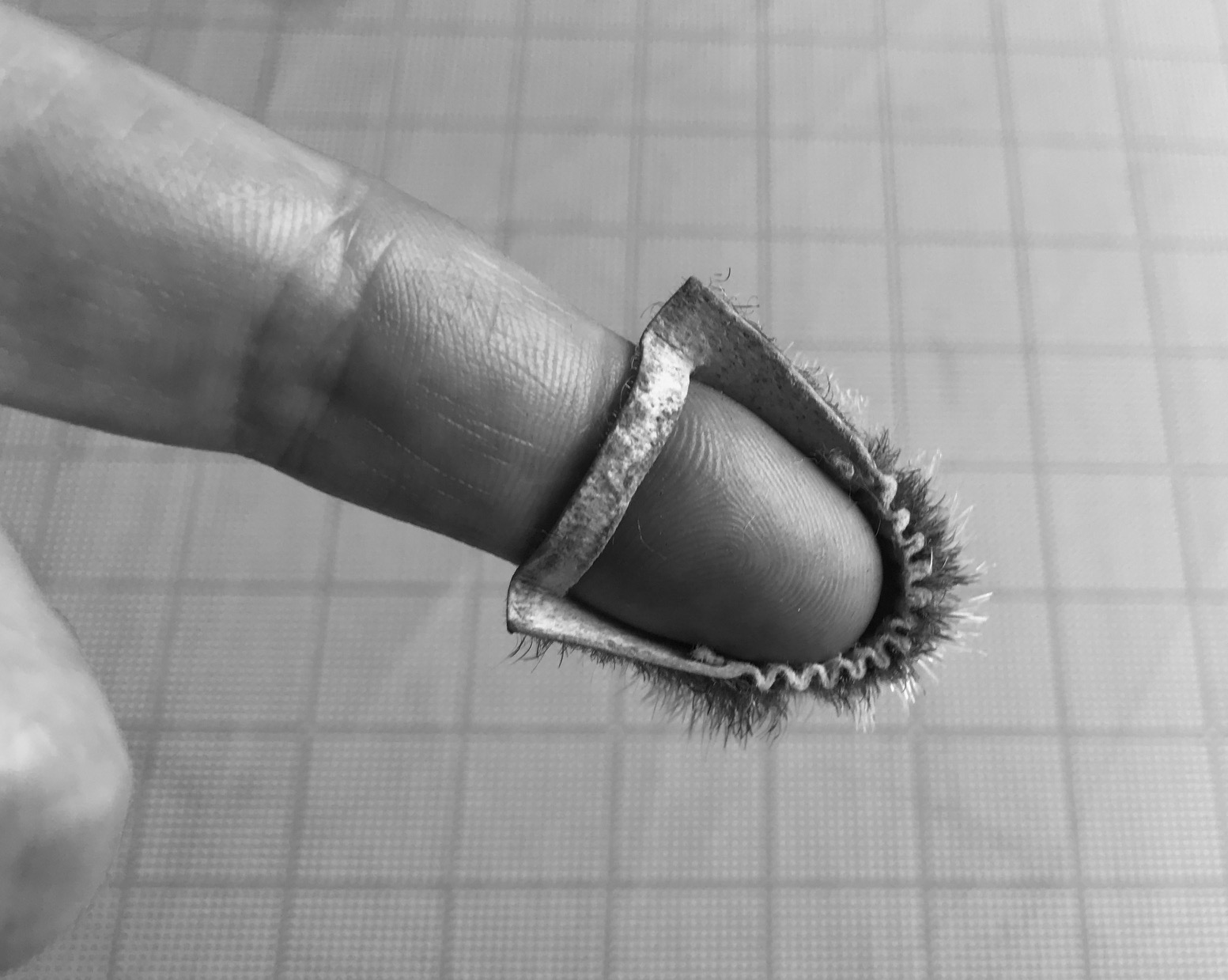
Seal Skin Thimble.  $5.00.  A fantastic tool. Much more comfortable than a metal thimble. I purchased this one in an antique store in Adamstown, Pennsylvania, then a quick google search confirmed it is a traditional Indigenous Peoples of the Arctic craft object. The images of them are remarkably consistent, almost identical. For example, they all have a length of thread holding the crimping in place at the tip, and a clever slit that functions as a finger attachment. The seal skin is rawhide (?), stiff enough to resist a needle head puncture, and the fur is a comforting joy to stroke if your sewing is not going well. It also makes a great finger puppet, though this can be a warning sign you have been working alone a bit too long. Available from Quilted Raven Alaska.

.

Londonderry Linen Lacing Thread. Wonderfully soft and not tightly twisted, just like older threads.

Londonderry Lacing Linen Thread, Size 4.  $7.00.  I love this thread. Seriously. I can sew *almost* everything with it. it is perfect for joint tacketing or sewing extensions during board reattachment. Since it is loosely plied, it is easy to flatten it out inside a gathering to minimize swell. Check out this naturally packed sewing.  A loaded stick also helps to control sewing. The soft thickness of this thread gently supports weak or brittle paper. Mary Uthuppuru, proprietor of Colophon Book Arts Supply, is a wonderful, kind, knowledgeable supplier, a true pleasure to do business with. Available in from Colophon Book Arts Supply.

.

Shop Knife. I’ve used this one for a number of years and altered the handle for comfort.

Shop Knife Style “F”. $13.84. This is a knife that I use dull. It is a perfect size and shape right out of the box for cleaning spines and other general scraping tasks. Where it really excels is for marking binders board for boxmaking: the tip is just the right angle, and a knife mark is much more accurate than even a .3mm mechanical pencil. It is easy to carve the handle a bit to make it more comfortable, especially where the blade transitions to the handle. Available from McMaster-Carr.

.


Delrin Hera. $40.00.  I know what you are thinking. $40? Inexpensive? Please allow me to explain. This tool is so useful that you will end up using it constantly. For example, it is great to gently pry some material for lifting, lift a page to turn it, insert adhesive under a detaching fragment, hold down something for photography, score tissue before dry tearing, and so on. You might like it so much you will keep it with you even when you are not working. Seriously, I use this tool at least an hour a day when doing conservation work. Therefore if you use it an hour a day, for 300 days a year, for 30 years, it only costs 4 thousandths of a cent per hour. Inexpensive or dirt cheap?!  Available from Peachey Tools.