The Financial Benefits of Buying What You Love

As a retailer of bookbinding tools, I cannot recommend too highly the fantastically excellent advice of Carl Richards. In his NY Times article, “The Financial Benefits of Buying What You Love“, he lays out a strong case for buying what you really want, rather than settling for a cheaper option. It is not too much different than the old adage, “Buy the best tools you can afford”.

Seriously, though, I think almost every time I have not heeded this advice for a variety of rationalizations — the tool is too expensive, I’m not going to use it that much, I don’t need something that good, etc… — I have regretted it.

As his napkin illustration summarizes: you buy it, you love it, and you keep it. And even if you fall out of love, you still have something of value to resell, rather than more garbage.


New Store for Peachey Bookbinding Tools!

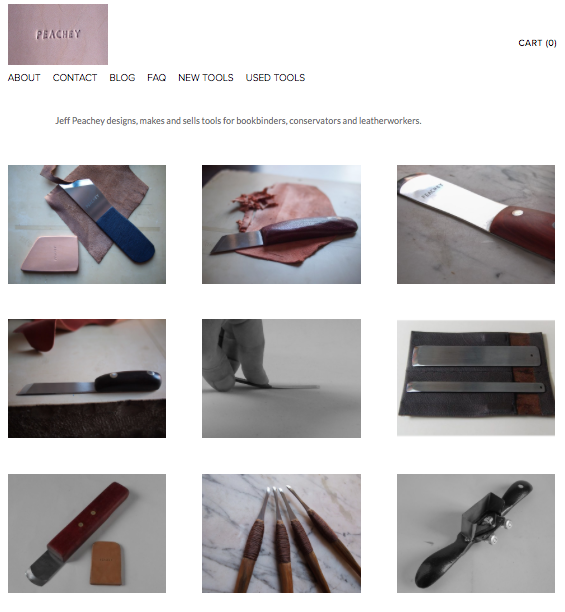
I’ve set up an online store at peacheytools.com for all the tools I make and sell.  There is  a used tool section (which also includes some experimental unique tools I’ve made) with some great deals to kick things off.

https://www.peacheytools.com

screen-shot-2016-12-09-at-9-26-59-am
Go to: https://www.peacheytools.com

https://www.peacheytools.com

Tying the Future to a Thread

over1
J. Howard Atkins, Tying the Future to a Thread. Medford, Mass: Oversewing Machine Co. of America, Inc., 1968. Front Cover. Middleton Z 269.5 .A8 1968. http://library.rit.edu/cary/

What appears to be a 1970’s post-apocalyptic novel concerning the dangers nuclear stockpiling is actually about a far more dangerous situation. OVERSEWING!

A gem from the Cary Graphic Arts Collection, Bernard C. Middleton Collection, Rochester Institute of Technology.

over
Could pass for an artist book installation. J. Howard Atkins, Tying the Future to a Thread. Medford, Mass: Oversewing Machine Co. of America, Inc., 1968. p. 18. Middleton Z 269.5 .A8 1968. http://library.rit.edu/cary/

But seriously, friends don’t let friends oversew.