Shanna Leino’s Online Bookbinding Tool Store

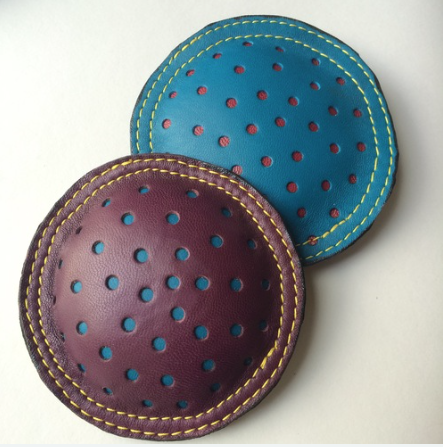
Shanna Leino, who makes beautiful bookbinding tools, now has an ecommerce store, so you easily purchase her wares online. Buying directly from her puts a few more dollars in her pocket, rather than giving it to resellers. Come to think of it, I could use another pair of her leather polka dot paperweights.

Screen Shot 2016-03-08 at 7.34.39 AM
Leather polka dot paperweights. Available from shannaleino.com. Image courtesy Shanna Leino.


Losing It

At Hopes and Fears,  Jared Fischer asks a variety of educators, neuroscientists, and others the question: “How long does it take to lose a skill?”

Most of the answers are theoretical, and the main consensus is that it is dependent on the skill and how it was acquired.  Similar to the ‘you never forget how to ride a bicycle’ adage, crafts and activities that require extensive muscle memory to learn (and the least conscious attention to perform) tend to be the most durable. Many aspects of bookbinding and knife sharpening fall into this category, and these are some of the most difficult skills to initally learn.

It’s a great question, relating not only to the acquisition of craft skills, but the maintenance of them.  Some answers in the article may contain seeds of argument for institutional conservators who feel they are trapped in front of a screen and need to justify bench time. But no practitioners were ask to self-report on their own experience, so I will ask myself.

Q: Jeff, how long does it takes to lose a skill?

A: I usually don’t subscribe to the idea that various crafts and skills sets are so different that there are isolated muscle memories associated with them.  When I teach freehand knife sharpening, for example, I try to emphasize the relationship between sharpening and leather paring: the muscle memory that it takes to hold the knife freehand on the sharpening stone is closely related to the way you need to consistently hold the knife to pare. So in many regards, I think if you are active in some craft activity it can slow the erosion of neglected skills in another.

That said, when I was a kid I tried to learn how the juggle one summer.  It seemed like hundreds of hours were spent, essentially in failure.  But the next summer, I picked up the three balls and for some reason it just worked.  Juggling may be pure muscle memory, since it primarily depends on how accurate you throw the ball.  Now when I try it, I am not nearly as good, but can keep the balls in the air for a short time and suspect if I kept at it could return to a basic proficiency. So in this case, the skill is severely degraded, but not lost.

A dispiriting aspect of this question is that one’s intellectual knowledge of what constitutes skillful performance often increases during the time that the physical ability to accomplish this decreases.

Well worth reading other perspectives:  “How long does it take to lose a skill?”

Ellic Howe, Google Books, and a Bookplate

Screen Shot 2015-12-04 at 5.41.34 PM
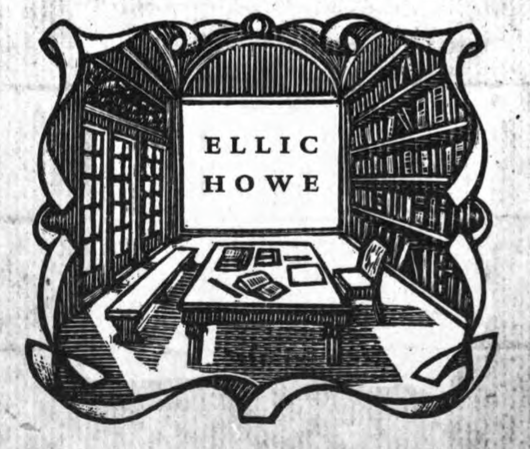
Ellie Howe’s Bookplate. From the front pastedown of The Book-finishers’ Friendly Circular on Google books: https://books.google.com/books?id=LlwEAAAAQAAJ&pg=PAcontents.

When I worked as a book clerk at the late Gotham Book Mart in 1980’s, provenance, especially on modern books, mattered little to me.  So what if someone famous touched, looked at, owned, or read this particular book, I reasoned. What meaning could possibly be transferred from this?

But recently, while doing some research, I stumbled across the bookplate of Ellic Howe, from the digitized version of The Book-Finishers’ Friendly Circular, 1845-51. (BTW, this copy is much easier to read than the Garland reprint) Howe is a well known book historian and I consider his The Society of London Bookbinders, 1780-1951 the best book yet concerning the London Bookbinding trade.

The Book-Finishers’ Friendly Circular is a wonderful slice-of-life, filled with humor, history, poetry, practical information, and reports on meetings. There is endless arguing about who it making more money, quite similar to what binders often talk about now. The primary evidence in this book informed much of Howe’s publications.

Howe’s stunning bookplate made me realize this book once belonged to him. It illustrates a dramatic one point perspective view a private study. It establishes books as a transactional space between the past and the future: a storehouse of knowledge on the right side of the room, which are being used in this scholars library to create more books, his own writings spread out on the table. Howe’s name is projected on what could be mistaken for a movie screen on one wall, which illuminates the room along with the windows. Is this possibly an allusion to the power of the scholarly interlocutor?

More surprisingly, I felt a bit star-struck: even though I knew I was reading this book virtually, it thrilled me to know I was reading Howe’s copy.