Dividers; or, What Problem?

stevens dividers

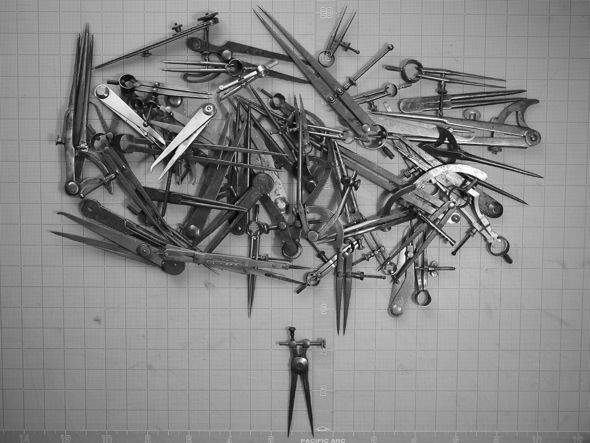
Some of my dividers.  

Sara Bryant of Big Jump Press wrote a breathlessly enthusiastic ode to dividers last month on her blog. Apart from extolling the virtues of comparison measurement, she wondered aloud if she perhaps was becoming a hoarder beause she has six pairs, and if it might be a problem.

My dear Sara, rest assured, you do not have a problem.

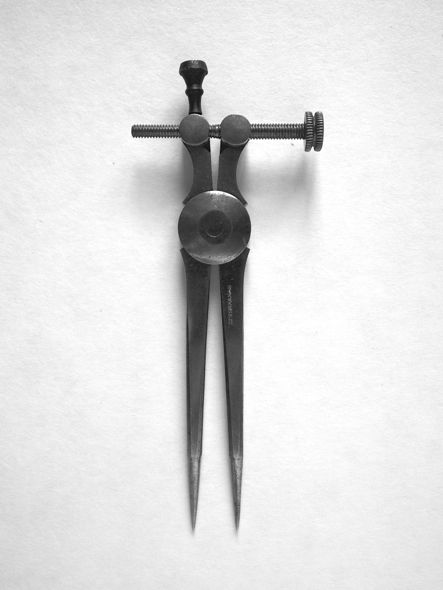
stevens divider

My favorite dividers, a 19th century Stevens & Co. Note the unusual, and extremely elegant position of the adjustment screw above the pivot point.

“Feeling Small” While Paring Leather

There is a recent New York Times article which describes the difficulties of creating a robot with a sense of touch comparable to a human. One of the links in the article, “Feeling Small: Exploring the Tactile Perception Limits”, contains suprising results. It turns out our fingers are exponentially more sensitive than previous research has indicated. Earlier studies used abrasive paper, while this study used wave-like ridges, which may account for some of the difference in the new findings.

Human fingers, when using “dynamic touch” — sliding across a surface — can distinguish a ridge that is 13 nanometers, which is .013 microns, or about .0000005 of an inch. For comparison, the thickness of a sheet of standard copy paper is a mountainous .004 of an inch thick. The average particle size of green chromium oxide stropping compound is .5 micron, which produces a mirror finish on steel.

My mind is blown. Should I be able to feel the individual fibers on a Japanese tissue paper repair? Will I ever be able to pare leather smoothly enough?

Christopher Sower Junior Died While Beating Books

“He began the process of binding these books by the laborious employment of beating them, as is usual, and imprudently completed as much of this work in half a day as is usually done in a whole day. The weather was warm, and by this exertion he became overheated. He went out to a spring where he drank so freely of water as to produce a fit of apoplexy, which soon after terminated his moral existence.”

-Isaiah Thomas, The History of Printing in America 2nd. Ed., Vol. 1. (Albany, N.Y.: : Joel Munsell, printer., 1874), 280.

Christopher Sower Jr. (1721-1784) a Pennsylvania German Anabaptist who, like his father, was a papermaker, bookbinder, printer and jack of all trades. He reportedly preferred walking to any other method of travel, and could maintain four miles an hour. Although bookbinding research is generally a somewhat impersonal activity, this story struck home with me. First, I come from an Anabaptist religious tradition. Secondly, I have been spending a lot of time looking at the Pennsylvania German wood board bindings that Sower made, as well as the Bibles he printed. Thirdly, I recently wrote an article about the beating of books.

I think I will take it easy the next time I beat a text block when making a model….