Below are four inexpensive and useful items that I imagine any bookbinder or book conservator would love to get.
If, perchance, you are thinking of getting me a gift, I really, really, want the new Panasonic Lumix DMC-GM5. Black, please. Thanks in advance!
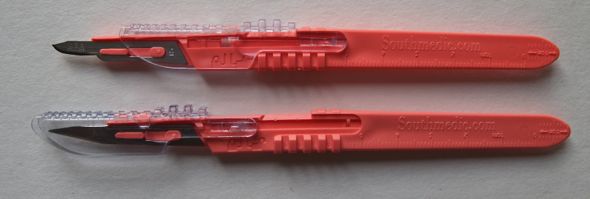
1. The Southmedic disposable plastic handled scalpel. The blades are not removable, which makes them feel quite solid. The blade cover easily slides back and forth, protecting them while traveling. I stop mine (with a small horsebutt strop) to keep it sharp and they last for quite some time. They come in two of my two favorite shapes, #11 and #15. There is a useful metric scale at the end of the handle for determining the depth of puncture wounds. Great fun for kids! McMaster-Carr sells them. About $3.
***

2. Japanese Feather brand double edge razor blades. Apart from vintage, NOS blades, these are the best I have found for Scharfix and Brockman paring machines. The Feather company may be familiar to some, since they also make scalpel blades. Hipsters love them for use in vintage double edge razor blade handles. Many vendors on Amazon sell them at various prices, around 30 cents each.
***

3. Delrin Folder. Delrin folders are new, and to my knowledge far I am the only one making them. They combine many advantages of bone and teflon. I know who has them if you are buying a gift, just ask! But get one for yourself as well. These are designed to perform a number of common scoring, folding and smoothing tasks bookbinders need when working with paper, cloth and leather. The big boy pictured above is $65, smaller ones are also available starting at a mere $35.
***

4. Small AIC PhD Target. It is awesome to finally have a small, affordable color bar to use for documentation. It used to drive me crazy fitting in a larger bar, which would almost be equal to the size of the book in some cases, resulting in the loss of detail, messing up framing, etc. Robin Meyers Imaging produces and sells them. Excellent! $75