Cooked Books

In preparation for an upcoming lecture on book boxes (May 23, 2013, 6:30) and workshop on drop spine cradle boxes (May 24-25, 2013) at Columbia College in Chicago, I’ve run across some crazy ideas on how to protect a book.  The housing system below is noteworthy. Over 200 books at an NYC Institution were treated this way.

Crazy Housing

The outer shell is an acidic marbled paper and a laser printed paper label.  As you can see, it is difficult to unwrap the book without tearing the deteriorated paper. The laser printed label seems to date this treatment after the early 1990’s. Is it my imagination, an accident, or did the person who wrapped this book take extreme care to try and match the marbled patterns at the join of the paper?
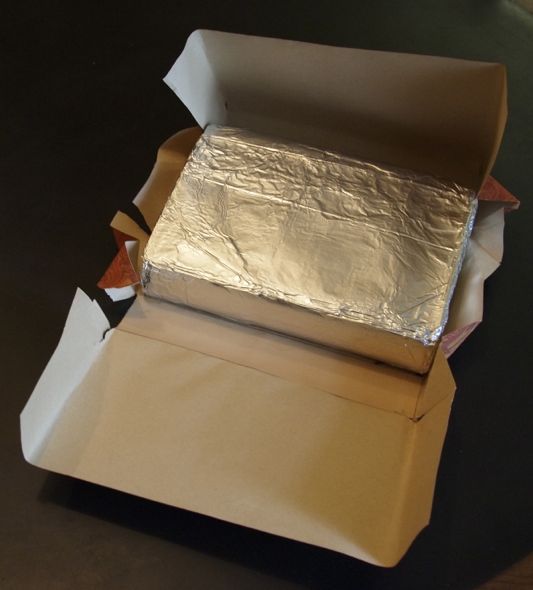
Crazy Housing

The next layer is the big surprise: aluminum foil. At the moment, I can only think of one reason for wrapping a book in foil, to prepare it for baking. I’m not sure what the Interactions between the aluminum and leather might be, but the mechanical problems are quite apparent, since the extra aluminum is rolled up and pushed onto the head and tail of the text block causing uneven stresses when the book is shelved upright. Again, it is unwieldy to unwrap.
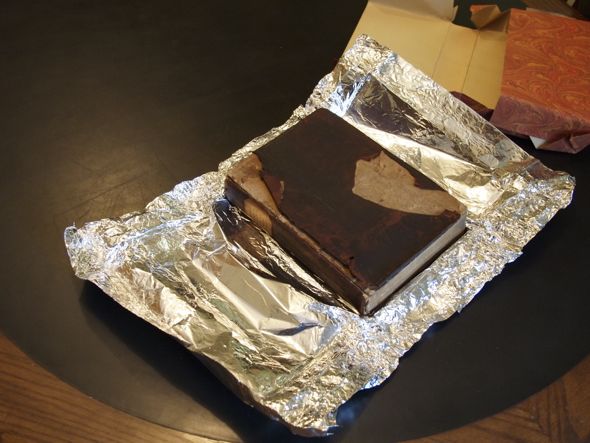
Crazy Housing 3

These books were also given an marinade of potassium lactate according to the treatment records. I think this must have caused some of the blackening and changes to the surface texture of the leather—they do look a little like they have been baked. Potassium lactate is used as an antimicrobial preservative in Hot Dogs.

Putting potassium lactate on leather books is a very bad idea, though. Even though it is discussed in some older book restoration manuals, it has been discontinued because of the damage it can cause. Tom Conroy (in the first comment) dates this treatment to 1984. At least one conservation vendor in the US still sells it, though.

The best way to preserve leather bindings is to put nothing on them. If there is already red rot, you should consult with a book conservator. Pass the ketchup.
Cobden-Sanderson’s Workshop

cobden sanderson workshop

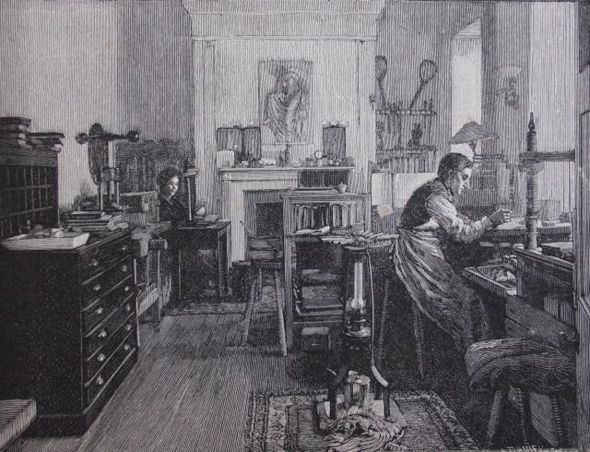
Cobden-Sanderson’s Workshop, Illustrated London News, March 1890, p. 323. My Collection.

Updated 25 Nov. 2013. The above attribution was handwritten on the top of the page the image was on; unfortunately it is incorrect. If anyone knows where this is from please let me know.

The quality of Cobden-Sanderson’s work is perhaps only matched by the size of his ego. In true arts and crafts fashion, he raises handwork—especially his handwork— to almost godlike status. His quasi-religious writings are hard to swallow, but his bindings are really beautiful. I’ve had the opportunity to see many of them and to work on a couple of them as well. They are quite refreshing from much of the trade work of the day. Unfortunately, many of the materials he used are often poor quality. The books I’ve been able to see the structure of have common late nineteenth century structural weaknesses: very thin slips, tissue thin leather jointed endsheets, and overly pared covering leather. Ironically, in the article he wrote to accompany the above illustration, he derided “temporary” bindings, like the cloth case, which have often survived in better condition than his bound books.

The studio or workshop of a craftsman often tantalizing in the details of tools and equipment. Cobden-Sanderson and Anne, his wife (he also took her surname, unusual for the time) work in a domestic interior, an English parlor. There are not many tools or much equipment pictured, a chest of drawers on the left, perhaps for storage, a two-rod nipping press with typically English ball ends on the handle. I think this is sitting on a woodworking bench with a leg vice, not a lying press: only one wood screw handle is visible. Reportedly, Cobden-Sanderson was also quite interested in wood carving around this time. Anne sits in the corner next to the fireplace sewing on a frame that is resting on a small table. It appears a paste pot sits on a stool, next to some books stored on their fore edge (!) on a bookshelf. Other tools and tennis (or squash?) rackets hang on the wall. Cobden Sanderson sits on a high workbench, wearing a very long work apron. Just behind him is a freestanding gas finishing stove. On his right is another sewing frame, with a dedicated stool. The central placement of the finishing stove reflects his emphasis on tooling, which was considered the creative aspect of bookbinding at the time.

Cobden-Sanderson, and the arts and crafts movement in general, tried to wrestle bookbinding away from machines, and machine like hand-work as practiced by the large trade binderies of the day. His workshop suggests a smaller, more intimate surrounding is a way to accomplish this, a return to an idealized medieval past. In Cobden-Sanderson’s workshop, craft is integrated into the life of the craftsman, the workshop and the home united.

______________________________________

The  top illustration is after a photograph reproduced in Marianne Tidcombe The Bookbindings of T.J. Cobden-Sanderson: A Study of His Work, 1884-93, London: The British Library, 1984. In the case of this image, there is little doubt that it accurately describes his workplace.

Scalpel for Book and Paper Conservation

scalpel

In book and paper conservation, there are many times when a substance or material needs to be mechanically removed or scraped off. Standard scalpels with replaceable blades are ok for cutting, but less than ideal—even dangerous—for scraping. The blades are very thin, flex unduly, and are easy to break where they slide into the handle. The blades often stick out wider than the handle, making them uncomfortable if you choke up close to the cutting edge. Older surgical and dissection scalpels are useful, but often are flat or hollow ground which is not great for slicing thin layers and scraping.

scalpel2

This precision instrument has a convex bevel which helps it to skate along the surface of a substrate, lessing the change of digging into it.  The shape of the cutting edge allows it to be comfortably held either at a very low angle or a higher, 45 degree one (similar to holding a pencil). This knife can be used for delicate lifting or separating adhered materials, and is very useful for removing encrusted glue on spines. Depending on the angle you hold the knife, the cutting edge can be a barely above the surface, and the knife rests on the rounded side bevel.

scalpel3

The convex bevel creates a very durable edge that can be used for chipping hard glue, etc. The steel is softer than my paring knives, making it less brittle and easy to strop. The thread wrapped handle and carved hardwood handle make it comfortable for working long periods of time, even if your hands start to sweat.

scalpel7

The sides of the blade are carefully rounded to make it comfortable to hold and well balanced to use. The high carbon steel is hardened to between Rc 50-55, is 1.5 inches long (40mm) and 1/16 inch (1.5mm) the hardwood handle 5.5 inches (140mm) long.  The knife is about .5 inches wide at the widest part. Overall length about 7 inches (180mm) and weighs .7 oz (20g), though the weight varies and depends primarily on the species of the wood handles. The current batch has Lignum vitae handles.

ITEM # WS: $175.00