
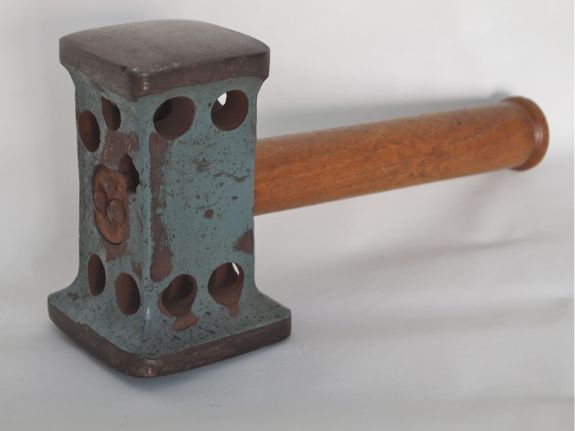
Thanks to a tip from James Tapley, a Florida based bookbinder and winner of the prestigious DeGolyer bookbinding competition, I was able to acquire something I’ve wanted for a long time: a real French beating hammer. Beating hammers were used for pounding signatures before sewing. Early Christmas! But I will wait until Christmas morning to actually smash some paper with it on my beating iron. Seven interminably long days from now….
Anyway, it is typically French with large and small square shaped faces and a cylindrical handle that ends in a bulge. The heads also have a significant amount of ‘belly’, or camber, which I have not seen in images and photographs of other French hammers, though this may or may not be common.
What is not typical about this hammer are the nine holes drilled into it. The only explanation I can think of is that a previous owner wanted to lighten the weight, like I did on the chainrings on my racing bicycle in the 1980’s. Another unusual aspect is a small pin on the side of the hammer that was presumably intended to secure the head, though of course this has loosened. The hammer was used quite—for something— a bit judging from the dings on the faces.
The hammer currently weighs 4.5 lbs with the handle. I’ve calculated that if the nine holes were filled in it would weight about 5.25 lbs. which is the same as my small sized Hickock beating hammer. The large face is roughly 2.5 inches square, the small one 2 inches. Given the relatively small size and (presumably original) green paint, I’d guess a mid-twentieth century date. The handle is 8.5 inches long and 1.25 inches in diameter, and turned on a (copy?) lathe. This is the original length judging from the ends, both marks from a headstock spur center and the tailstock are intact.
Predictably, this hammer arrived a few weeks too late to be included in my forthcoming article about beating hammers, “Beating, Rolling and Pressing: The Compression of Signatures in Bookbinding Prior to Sewing” in Suave Mechanicals: Essays on the History of Bookbinding, which will be published in early 2013 by The Legacy Press. Grrr.


 Peachey Conservation