Board Slotting as a Structure for Artist’s Books

Although board slotting was originally developed as a strong, minimally invasive method of conserving books, I’ve wanted to try it on an artist’s book for a while.  Slotting seemed a great way to firmly attach wooden or alternative material without visually interfering with cover.  Accra Shepp created this artist book titled “Atlas”, in an edition of 12.  It was a perfect candidate for board slotting- the boards were an oversize (18 x 12″) medium density fiberboard, covered with a gorgeous burl veneer that deserved to be unobscured by covering material or interior linings.

A number of the NYC bookarts community worked on this project– Paul Wong, of Dieu Donne  Papermill, made the paper, Edward Fausty printed the collotypes, Earl Kallemeyn printed the polymer plates,  Dikko Faust of Purgatory Pie Press printed the metal type and letterpress and even the leaves came from the NY Botanical Garden.

shepp1


There were some technical challenges- the entire book weighed 5.25 lbs, there were many fragile plants imbedded in the paper and the book included a final signature made up of a single folio!   In keeping with the overall meaning of the book, the artist wanted a simple, unobtrusive, elegant method of binding this book that used natural materials. We decided slotting was the best method of accomplishing this goal, in conjunction with a non-adhesive modified longstich spine.  In keeping with the natural and open nature of this text, I slotted completely through the ends of the board, hoping it to become a decorative element reflecting its visual honesty.

 The binding had to be very flexible, with lots of throw-up and minimal page drape to keep the tissue paper collage elements and actual plant materials from unduly flexing. The spine is a Japanese linen bookcloth that was laminated with PVA to a piece of Strathmore 400.   This not only stiffened the cloth, helping to control the opening and lessen the text block from torsion, but it prevented the sewing holes from opening up excessively and the interior white lining visually lessened the impact of the slight gaps between the signatures.  It was sewn longstich with Best Blake 18/6 unbleached linen thread. The  relatively loose twist in the thread allowed it to be flattened and firmly consolidated in the spine folds, adding a pleasant feeling solidity to this non-adhesive structure.  There were only 5 signatures, and numerous collage elements, so the extra swell helped to keep the boards relatively parallel.  The technical information on how a board slotting machine was modified to accommodate these oversize boards is at the board slotting blog.

It might be possible to devise some kind of endband for this structure, somehow incorporating the slot at the end of the boards, and I’m interested in trying it with alternative materials, such as plexy or metal.  Even the hinge in the slot could be made non-adhesive with some type of treenail, pegging or sewn attachment.  

This structure seems useful when a flat opening, cost effective, non-adhesive, unobtrusive binding style is desired.  I could imagine it being useful on a variety of artist books. To my knowledge, this is the first time board slotting has been used in making a new artist’s book.  


shepp2

Temporary Binding

temporal binding


pin

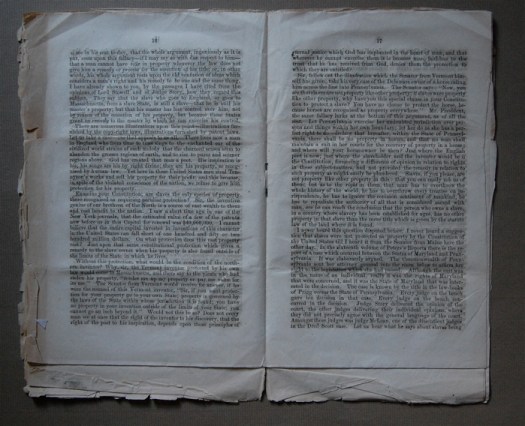
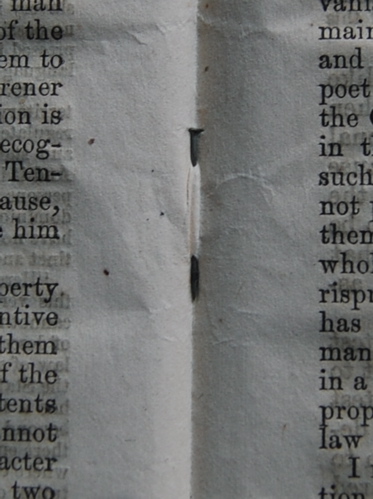
The terminology may be debatable, but I doubt there is a simpler method of “binding” a pamphlet.  These 32 pages were printed  in 1858, and presumably the pin was inserted around that time as well.  A pin may be less damaging than a staple, since the ends of a staple turn in on themselves and often pierce the inner folio.  Both staples and pins are prone to rust, though pins are more easily reversed.  If the head of a pin is too large, it can damage the adjoining pages.  Pamphlets from this time are often side stitched in a figure of eight style, which restricts opening. Some of the horizontal creases in the paper may have happened when the pin was inserted 150 years ago.  Of course, sewing through the fold is the best method of attaching pages together.

In this case, however, the pin was not causing any apparent damage, the owner (thanks for permission to post these images!) and I decided to leave it in place.  Later, I will do some minor surface cleaning, flattening and paper repairs.

Perhaps because pins were on my mind, last weekend I purchased a box of  NOS at the Hell’s Kitchen Flea Market . I was intrigued by the fact that the pins were not described as merely plated, double-plated, triple-plated, but were in fact “Superplated”.  

After opening the box  and seeing them gleam, I decided this is to be a truthful description– well worth the $2 price.

pin box


pins inside

Upcoming Events In June

If you are in the New England area, consider attending the Book Arts Supply Market.

Book Arts Supply Market
June 7th, 2009
12:30-4:30
Arlington Center for the Arts
41 Foster Street
Arlington, MA

I will be there with a full range of tools for sale, including the infamous bargain box, which is quite full right now.

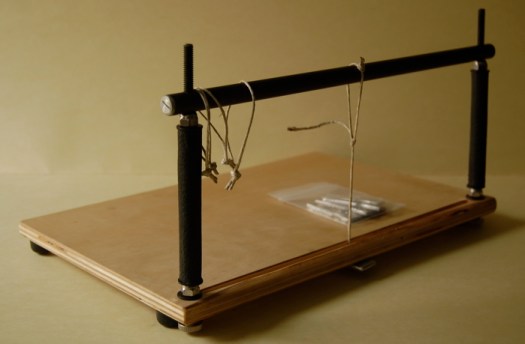
I also have prototypes of some new tools I am working on, for example, a portable, collapsible sewing frame that only weighs 1 lb, 12.4 oz (804 grams) including 5 Al sewing keys.  It is 11 3/8″ (290 mm) between the uprights and packs flat at only 1 1/8″ (30 mm).  Rubber feet keep it from sliding around on the workbench.

portable sewing frame

Also I have a reproduction of the boxed set of knives I made for Abraham Karastovsky, which I wrote about earlier and were featured in the book “Homicide in Hardcover.”

ak knives

Please stop by and say hello!


*******


I will be presenting the following talk in NYC on Sunday, June 21 at 3:00.  Please feel free to repost and contact me if there are any questions.  I also have a half sheet flyer I can email anyone who would like to post it.  I envision this talk as a type of outreach, since it contains information about book history and conservation.    It should be a lot of fun.


THE UNIVERSITY OF TRASH PRESENTS:

THE OBSOLETE MAN AND THE OBSOLETE BOOK?

 Sunday, June 21 at 3:00 pm at SculptureCenter in Long Island City, NYC.

 The Free Skool at the University of Trash announce an Jeffrey S.  Peachey’s presentation titled “The Obsolete Man and the Obsolete Book?” The University of Trash is an experiment in alternative architecture, urbanism, and pedagogy taking place in SculptureCenter’s main space. Throughout the summer there will be a mix of workshops, screenings, and presentations focusing on grass roots, self-organized urbanism, DIY architecture and the evolving aesthetics and politics of public space.

Peachey will screen an original Twilight Zone, “The Obsolete Man”, present a short lecture, then lead a discussion based on some of the issues it raises. Peachey is the owner of a New York City-based studio for the conservation of books.  Because of his experience in examining and treating a wide variety of historic book structures, he is especially interested in how humans have interacted with the physical form of the book over the past 1,600 years, the importance of non-texual information and how the book has acquired such symbolic power.  The images of books in this episode form a locus for a variety of issues—authority, freedom, history, truth, the state, individuality, identity and conformity—that are explored in a classic Serlingesque manner.

 “I am nothing more than a reminder to you that you cannot destroy truth by burning pages.” Romney Wordsworth (Burgess Meredith) declares when the Chancellor (Fritz Weaver) pronounces him obsolete, and then condemns him to death.  Wordsworth, a secret librarian, lives in a room not only surrounded by books, but virtually built out them.  Considering aspects of book conservation, Peachey will deliver a short lecture touching on some of the ideas explored in the film, looking at how books are displayed in Wordsworth’s apartment, commenting on the various book structures portrayed and linking these to themes presented in the episode. Models of several historic book structures will available for handling. Then some more general observations on the value of non-textual elements of books will be made, along with the challenges of conserving these elements.

 This will be followed by an open discussion.  Possible topics include questions about the supposed death of the codex; the importance of non-textual elements in books; books as physical expressions of authority; books as moving, portable hand held sculpture; books as democratic instruments; the display of books as externalized knowledge; hand interaction in reading; and most importantly, how closely is our culture inexorably linked with the history of the book.

 This event is free, and there is a $5 suggested donation to the museum.

 Jeff Peachey:

https://jeffpeachey.wordpress.com/

 SculptureCenter:

http://www.sculpture-center.org/

The University of Trash:

http://www.universityoftrash.org/

 Attendees are encouraged to preview the entire Twilight Zone episode at:

http://www.imdb.com/video/cbs/vi759562265/

 info@universityoftrash.org

bookshevles