
Yours truly is teaching Week 3, Aug. 10-14.
Flights are fairly reasonable right now....
Hope to see you there!

MONTEFIASCONE PROJECT
SUMMER 2009

Montefiascone is a small medieval walled city about 100 k (80 miles)
north of Rome, on Lake Bolsena. Since 1988 conservators and others
interested in books and their history have come together to work, to
learn and to enjoy this special place. The summer 2009 programme is as
follows:

Week 1:  July 27th-31st
Re-creating the medieval Palette
Through illustrated lectures, participants will examine the story of
colour in medieval times. The class will address the history, geography,
chemistry and iconographic importance, and the actual techniques of
colour manufacture, with special reference to manuscript painting. Using
original recipes, participants will make and paint out the colours. No
previous experience is necessary.
Course tutor: Cheryl Porter

Week 2: August 3rd-7th
Multi-quire, wooden boarded codex from Egypt
The multi-quire, wooden boarded codex from Egypt is a small family of
bindings that structurally predate the familiar sewn through the fold,
laced on wooden board, leather covered binding of later eras. The model
made in this class is based on a reconstruction by Charles Lamacraft,
restorer at the British Museum in the early decades of the 20th c. In
1925, a ceramic jar was uncovered in Egypt containing 5 parchment
codices dating to the 6th c. AD.  Two of the five had bare wood boards,
stamped leather spines and multiple leather slips laced through the
boards (with no connection to the unsupported  sewing) leather wrapping
bands terminating in large, decorated bone slips to secure the bands and
a large decorative bookmarker.
Charles Lamacraft studied these early bindings and published an early
analysis and photographs of them.  He made at least 2 models of the book
structure based on the fairly complete but fragmented pieces of the
bindings.  One was for Chester Beatty, who purchased 3 of the ancient
books, and now resides in the Chester Beatty Library and another for
Prof. Kelsey of the University of Michigan who
purchased the other 2 remaining manuscripts in the jar. Kelsey's model
resides in the Rare Book Room of the University of Michigan Library.
Course tutor: Pamela Spitzmueller

Week 3: August 10th-14th
Late 18th century French Binding Structures
Apart from the French Revolution, one of the most exciting aspects of
late 18th C. French culture is the existence of two full-length
bookbinding manuals. This workshop will focus on reconstructing a
typical full calf French structure of this time period, by comparing and
contrasting the descriptions in these manuals and examining extant
bindings.  In some respects, this structure is the end of 1,200 years of
utilitarian leather binding- 50 years later the cloth case begins to
predominate. Some of the interesting features of this style include:
sewing on thin double cords; edges trimmed with a plough in-boards and
colored; double core endbands, vellum “comb” spine liners and
sprinkled cover decoration. Special emphasis will be placed on using
reproductions of period tools, constructed from Dudin and  Diderot’s
Encylopedie (1751-1780).  Participants will learn to use and maintain a
plough, and become fluent in translating written descriptions of
bookbinding into the construction of a model.  Extensive notations (in
English) on Gauffecourt’s Traite de la Relieure des Livres (1763) and
Dudin’s L’Art du Relieur-doreur de Livres (1772) will be provided.
Basic bookbinding skills are a prerequisite and materials will be
supplied at a nominal cost.
Course tutor: Jeff Peachey

Week 4: August 17th-21st
Ethiopian Bindings Workshop
This five day course is aimed at conservators interested in the history
of the book. The course will give an introduction to the history of
Ethiopian Bindings. Through a series of practical demonstrations and
exercises, participants will gain an understanding of the construction
of an Ethiopian binding within a cultural and historical context.
There will be an introductory lecture on Ethiopian Bindings, placing
them in the context of the history and development of book structures.
This will be followed by practical workshops focusing on:
Preparation of text block and wooden boards.
Sewing the text block and boards.
Endband construction and covering in leather.
Embossing leather with replica tools
The making of a traditional leather carrying pouch with camel skin
Participants will be required to bring some hand tools, a list will be
provided following registration. All materials will be supplied at a
nominal cost. Some knowledge of the history of bookbinding would be
desirable but is not essential.
Tutors: John Mumford / Caroline Checkley-Scott

Cheryl Porter is Manager of Conservation and Preservation at the
Thesaurus Islamicus Foundation and Deputy Director of the Project.  She
has been Director of the Montefiascone Project since its inception in
1988. After graduating from Camberwell College of Arts and Crafts, she
worked with the Paintings Analysis Unit at University College London
analysing the use of pigments in manuscripts. From 1992 to 2007 she
worked as a freelance conservator. She has published many articles
concerning colour in manuscripts and has lectured in the USA, Australia
and throughout Europe.

Pamela Spitzmueller is Needham Chief Conservator for Special
Collections at the Weissman Preservation Center in the Harvard
University Libraries.  Pam previously headed Rare Book Conservation at
the University of Iowa Libraries, worked as Book Conservator at the
Library of Congress, and the Newberry Library in Chicago.   She
specializes in historical book structures and book sewing techniques,
and incorporates what she learns into conservation treatments of rare
books and creation of one of a kind artists' books. She has taught many
workshops on these topics.

Jeffrey S. Peachey is the owner of a New York City-based studio for the
conservation of books the maker of conservation tools and machines. He
is a Professional Associate in the American Institute for Conservation
and chair emeritus of the Conservators In Private Practice. For more
than 15 years, he has specialized in the conservation of books and paper
artifacts for institutions and individuals. A consultant to major
libraries and university collections in the New York City region and
nationally, he has been the recipient of numerous grants to support his
work. A well-known teacher, Peachey also provides conservation-focused
guidance to students in art, archives, and bookbinding programs.

John Mumford is the currently head of Manuscript Conservation at the
Thesaurus Islamicus Foundation. He was formally Head of Book
Conservation at the British Library.  John served a five year
apprenticeship at the British Museum and subsequently helped establish
the Rare and Early Book Conservation Studio at the British Library. In
1992 he was appointed manager of the Oriental and India Office Book
Conservation Studio, furthering his study of early Oriental and Eastern
binding structures. In 1998 he became manager of the Oriental and
Eastern Book Conservation Studio at the new British Library at St
Pancras. He has taught frequently in Montefiascone and lectured and run
workshops throughout the UK, Argentina, Patmos and many other European
locations.

Caroline Checkley-Scott is currently head of Collection Care at the
John Ryland’s Library. Caroline, studied printing and bookbinding in
Dublin, Ireland. She was appointed trainee book conservator at the
British Library, London in 1991, where she worked at the House of Lords
in the Palace of Westminster, and the Oriental and India Office Library
and Records. Here she specialised in the conservation of early Christian
manuscripts from the Middle East. Caroline was formally head of
Conservation at the Wellcome Library and organised the planning and
design of the new Wellcome Conservation Studios. She is an accredited
member of the Institute of Paper Conservation. She has lectured both
nationally and internationally in Italy, Slovenia, Argentina and
Brazil.

The cost of the classes is: 445 British pounds  ($640 US, 500 Euro) per
week and includes all tuition(which is in English) and (most) materials.
The Montefiascone Project is a not-for-profit organization, and all
extra monies are used to finance the cataloguing and the conservation
and preservation of the collection.
For further information or to register for one week or more, please
contact Cheryl Porter: chezzaporter(at)yahoo(dot)com . More information is on
the website: www.monteproject.com
Old Books Stink!
Many of my clients talk about the smell of old books as being one of the aspects that attracts them to collecting.
In the 18th Century, M. Dudin in The Art of the Bookbinder and Gilder ends his treatise by recommending that the completed binding be perfumed. “Very few people seek this refinement for their books but there is nothing simpler than perfuming a book.” (86) He explains two methods, one by sponging the pages with perfume, the other leaving the book in a cupboard for a long period of time with an open bottle. Keep those noses going, fellow conservators, I would love to find an example of this.
Now Christopher Brosius, and his store CB I Hate Perfume, has bottled the smell. The scent is named “In The Library”, and here is part of his description.
“I love books, particularly old ones. I cannot pass a second hand bookshop and rarely come away without at least one additional volume. I now have quite a collection! Whenever I read, the start of the journey is always opening the book and breathing deeply. Don’t you find there are few things more wonderful than the smell of a much-loved book? Newly printed books certainly smell very different from older ones. The ink is so crisp. I’ve also noticed that books from different periods & different countries also have very different smells. And then there are the scents of different bindings: leather is marvelous of course but I find a peculiar pleasure in musty worn clothbound books as well. Perhaps just a hint of mildew! The main note in this scent was copied from one of my favorite books – I happened to find a signed first edition of this novel a few years ago in London. I was more than a little excited because there were only ever a hundred in the first place.” (From the CB I Hate Perfume Website)
I purchased a tiny, 2ml vial of this scent for about $12.
I’m not much of a perfume guy– it didn’t smell bad, but it didn’t smell like an old book either.
Sony and Stony
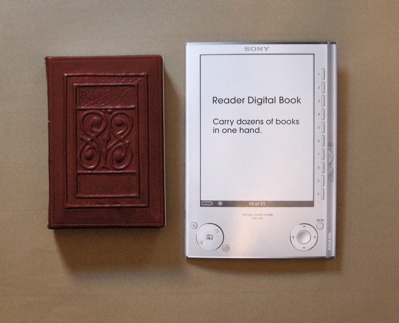
I am struck by how closely the dimensions of the 7th century Stonyhurst Gospel (now renamed as St. Cuthbert’s Gospel of St. John) match the screen size of the Sony Portable Reader System PRS-505. On the left is a model of the Gospel, which is described in the literature as being 134-138mm high, and 90-95mm wide (1:1.49). The screen of the Sony Reader is 124mm high and 92mm wide (1:1.35). Coincidence? Perhaps. But might their dimensions relate to our hand size or comfortable handheld viewing range? These books are separated by 13 centuries!
I played with the Sony last weekend at the Small Press Fair in NYC. I was impressed by the resolution of the eink at any viewing angle, but page turns were agonizingly slow, and accompanied by an epeliptic inducing flash of background reversal– the text would go white, and the “page” black for a split second. I also tried out a prototype of the next version, which has a touch screen interface, but doubt this would be a great advantage when reading.There is a promotion on now at Sony— enter promo code: 10sonyclassic You can get 10 free ebooks to read on your computer or ebook reader from the “classics” collection– think 19th C. standard DWM’s.
I think the Stonyhurst needs a tagline too. How about “The Stonyhurst: Carry the Gospel of St. John in one hand.”
 Peachey Conservation
