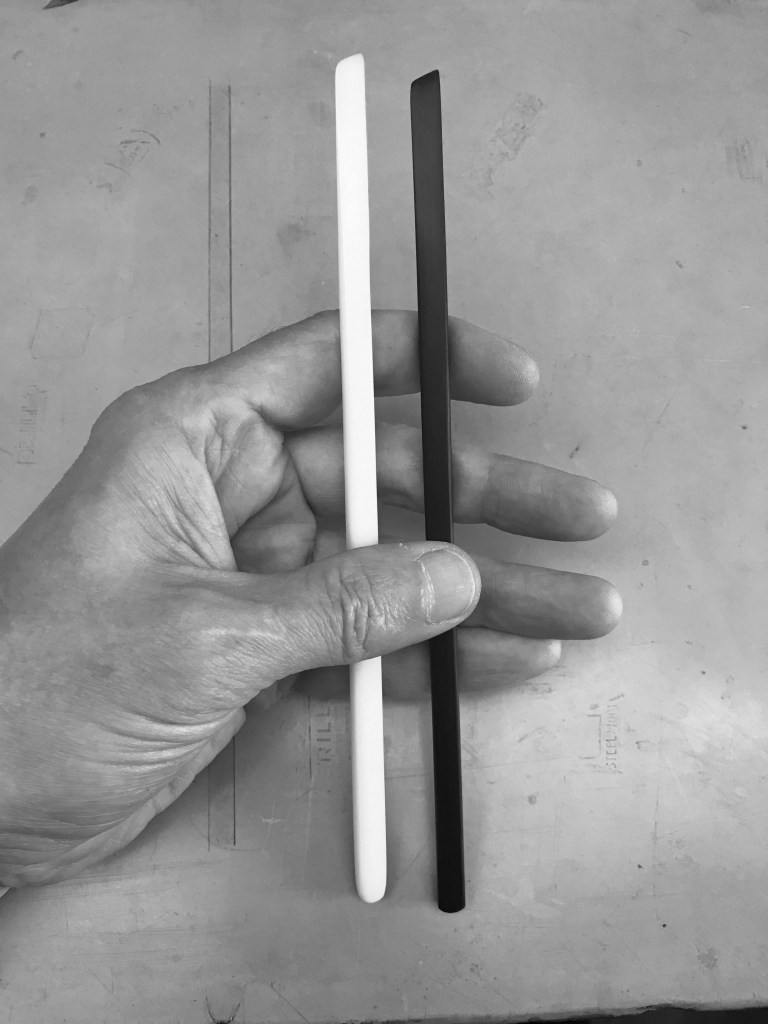
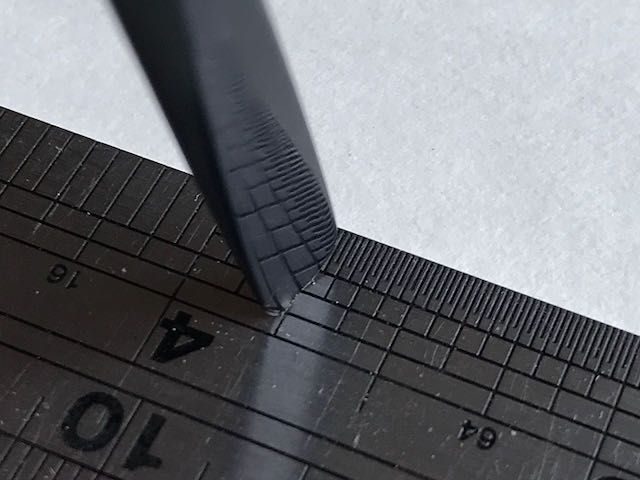
Delrin heras are now available in a black rigid version and a white flexible one.
This is one of my most used tools. It almost always seems to be in my hand while working.
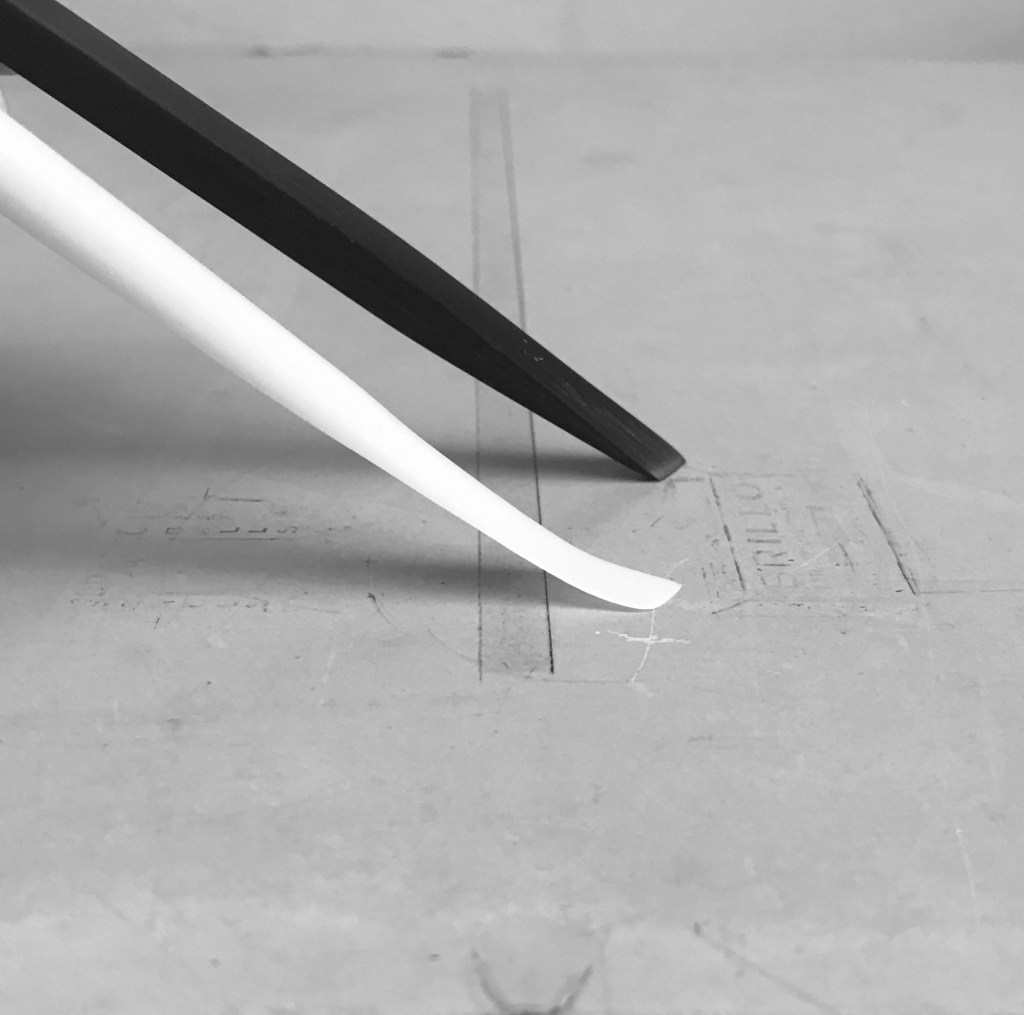
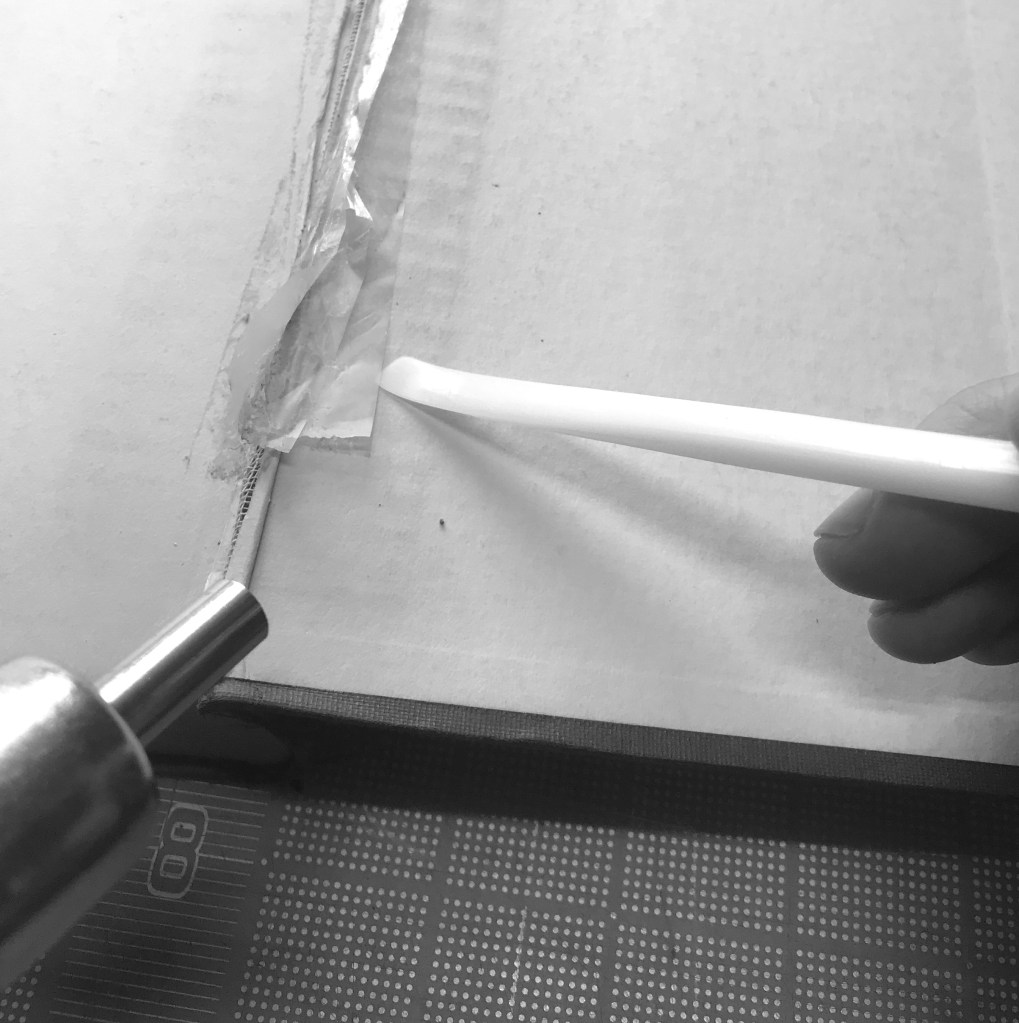
The white version is very flexible at the tip, making it ideal for delicate tasks, lifting fragile materials, pigment consolidation, and pressure sensitive tape removal. The super thin, translucent tip bends to almost 90 degrees, allowing precise control of downward pressure while sliding under the tape carrier. It is also perfect for gently releasing tissue repairs from remay or hollytex.
Warm air + delrin = tape removal blissThe white version is thin enough to be translucent
The black version of Delrin is stiffer than the white, and the tip of this tool is thicker and stronger. It is useful for lifting, inserting adhesive, smoothing repairs, general smooshing, scoring, folding, marking, holding repairs in place, rebacking, etc… . Other uses.
If you can’t decide between the two versions, the only reasonable option is to purchase both. The non-reflective surface is easy to photograph. Delrin does not rust and is food safe. But I doubt it tastes very good. Delrin, approximately 7 x .25 x .25″
NB: if you are interested in learning to make your own tools, we will make both of these (and 8 other tools) in upcoming Delrin and Bamboo Toolmaking workshops. More info here!
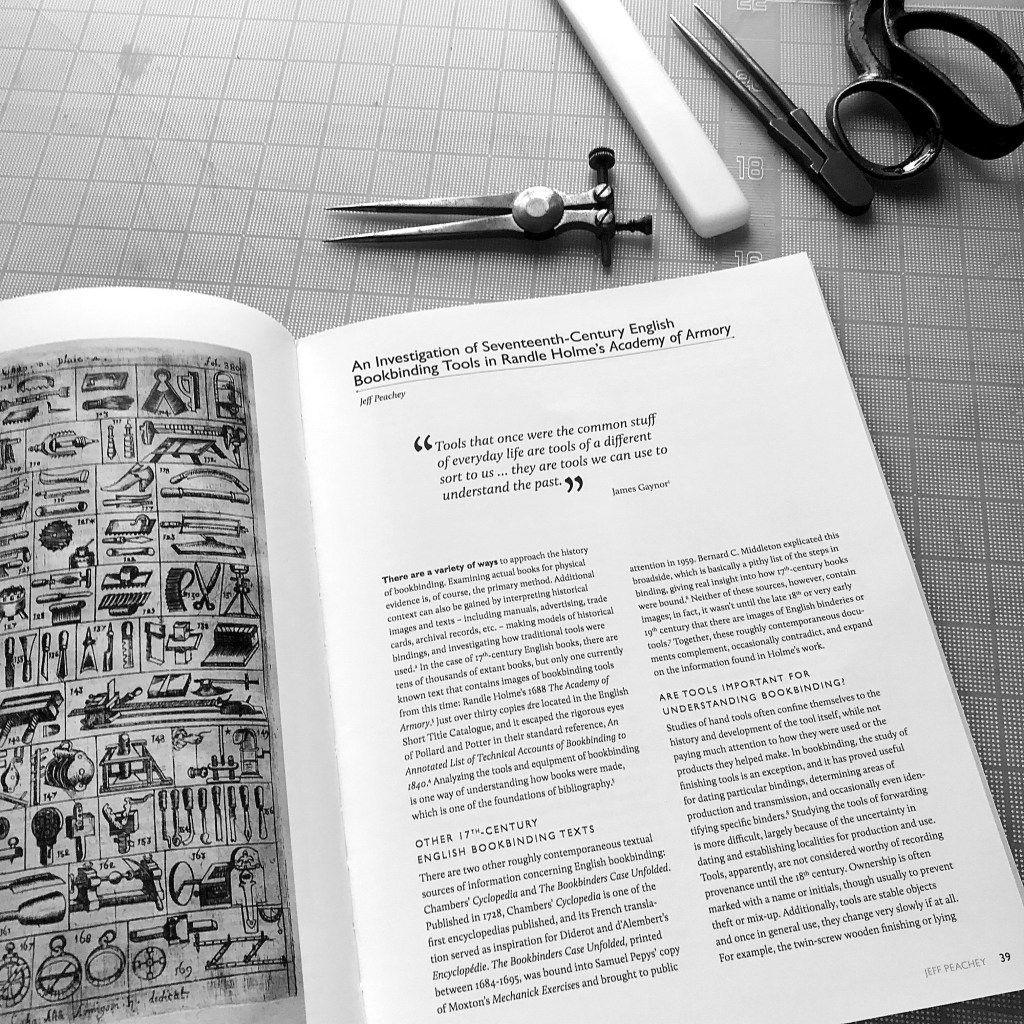
It’s exciting be published in The New Bookbinder 41 with such a beautiful layout and high print quality!
Publishing a blog post is instant gratification compared to a print article. An Instagram post is an even quicker higher-octane endorphin hit. Writing a print article already feels archaic and process of publishing is frustratingly slow: finding a suitable vehicle, researching a topic, writing, gathering images, requesting (and often paying for) reproduction permissions, formatting, incorporating reader’s comments, working with an editor for additional revisions, triple checking everything, and finally approving a final layout. Then waiting for months while it is being printed and shipped. At least in this case, though, the result is deeply rewarding.
Seeing and holding your writing makes it feel like a thing, not just ideas in your head. It implies a permanence and accessibility. But I wonder how long print — at least for non-fiction scholarly articles — will be used, in terms of people reading, using, and citing it. Many papers I read from younger people only cite the online sources. On the other hand, the transparency of online data is rewarding for the author (as well as profit generating for the corporate overlords…) For example, I will know how many of you read this blog post, how many times it is linked to, what links you click on, and where you are from. I have no idea if anyone actually looked at or read the printed article. Anyway, onward!
OVERVIEW
Randle Holme’s little known Academy of Armory contains the only images of seventeenth century English bookbinding tools currently known. Six fundamental tools described in it are analyzed: a folder, a beating hammer, a needle, a sewing frame, a lying press, and a plough. The context of seventeenth century English bookbinding and other contemporaneous sources are investigated. The relationship between the nature of seventeenth century English books and the tools used to make them is also explored.
FIRST PARAGRAPH SNIPPET
“There are a variety of ways of approaching the history of bookbinding. Examining actual books for physical evidence is, of course, the primary method. But additional context can be gained by interpreting historic images and texts — including, manuals, advertising, trade cards, archival records, etc… — making models of historic bindings, and investigating how traditional tools were used. (2) In the case of seventeenth century English books, there are tens of thousands of extant books, but only one currently known text that contains images of bookbinding tools from this time, Randle Holme’s 1688 Academy of Armory. (3) Just over thirty copies are located in the English Short Title Catalogue, and it escaped the rigorous eyes of Pollard and Potter in their standard reference, An Annotated List of Technical Accounts of Bookbinding to 1840. (4) Analyzing the tools and equipment of bookbinding is one way of understanding how books were made, which is one of the foundations of bibliography. (5)”
Jeff Peachey “An Investigation of Seventeenth Century English Bookbinding Tools in Randle Holme’s Academy of Armory“. The New Bookbinder 41 (2021):38-48.
Thanks to OG Joel Moskowitz of Tools for Working Wood for introducing me to this text and allowing reproductions of his copy!
The ability to make and modify tools adds considerably to a conservators’ arsenal.
Making tools is not only engaging and fun, but entirely practical since the result is set of tools you can use daily. Book conservators, photo conservators, paper conservators, bookbinders, and others will find this workshop valuable. Filing, scraping and polishing are meditative activities, no previous experience required. Working Delrin and bamboo is a great way to start toolmaking and we will make folders, lifting tools, microspatulas, hera, creasing tools, tongs and more. This workshop will give you confidence in maintaining and altering your existing tools for specific needs. Give yourself the gift of learning and with some new tools and tool making skills that will keep on giving for the rest of your career! Fair warning: making your own tools is highly addictive!
OVERVIEW : All aspects of making tools with delrin and bamboo will be discussed in detail: design considerations, thinking through working procedures, cutting, filing, rough shaping, final shaping, and polishing. The workshop consists of two 3- hour synchronous zoom sessions with PPTs, videos, discussion of handouts, demonstrations, Q&A chat sessions, and working together. Also included is two week access to the workshop website, which contains information, links, videos and PPTs. The workshop includes a kit with enough materials to make nine tools with a retail value over $300. A set of hand tools to make the tools is also included: a cherry bench hook, scraper, burnisher, a file for plastics, and a variety of sanding and polishing supplies. You need a stable work surface, some time to work, a few basic hand tools, and an interest in making tools.
SCHEDULE: Two 3-hour sessions on Saturdays for each workshop. Three sections of the workshop will be offered three times. February 12 + 19, March 11 + 19, and April 9 + 16. 12-3pm Pacific, 1-4pm Mountain, 2-5pm Central, 3-6pm Eastern, 8-11pm GMT, 9-12 CET, 10 – 1am EET, 5am – 8am (+ 1 day) JST, 6am – 9am ( +1 day) UTC
INTERNATIONAL REGISTRATION: Email me for an invoice to pay by credit card. I will hold your place for 24 hours after sending an invoice. Up to 3 kits can be shipped together for the shipping price of one. I am currently unable to ship to Australia and New Zealand, but contact me if you would like to be on a notification list.
COST: $390 US ($440 Canada, $465 EU and other countries, includes shipping)
CANCELATION POLICY: If you cancel before the kits are shipped there is a $100 fee, and no refunds after kits are shipped.
I hope to see many of you there!
Some possibilities for tools, though students are encouraged to work on their own designs.I never thought I’d really like a plastic, but Delrin is special.