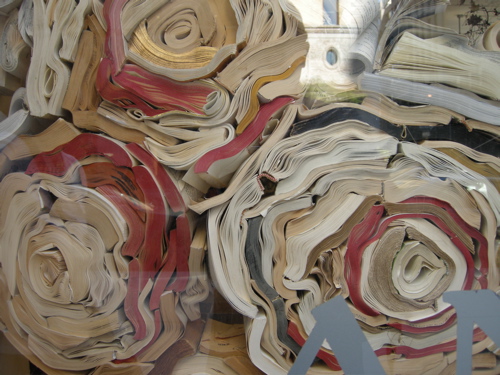
This is not an image of water damage, an art project or a disaster recovery workshop. Instead, it is the current window dressing of the Anthropologie store located at 5th Ave. and 16th St. in New York City. At least a couple of thousand books appear to have been opened 180 degrees, wetted, then rolled into these large cylinders, as if the books were returning to the trees from which they came. This display could be interpreted as an incisive a comment on the relationship between advertising and narrative structure– even a non-functioning narrative (the destroyed book) is powerful enough to be co-opted by advertising. Maybe this display is a political statement on the torturing of physical objects, denying them of their own meaning, forcing them to deliver another message, in this case to sell items in the store. Most likely, however, the relationship between this display and the overpriced crap luxury consumer goods that this store retails wasn’t even considered.
I’m always a bit uneasy when I see books that have been mutilated, whether it is done in the name of art, censorship, vandalism, or commerce. I would have given no pause to this window if it were filled with broken laptop computers or ebook readers, which indicates some fundamental differences between our relationship to virtual and “real” books. It is a sign that book arts have entered the mainstream when designers adopt their techniques– part of the filtering of ideas from “high” art to popular culture. I noticed Brooklyn Public Library and Appleton Public Library (Wisconsin) stamps on some of the tail edges, but all libraries have to deaccession books. Is it better to do a surreptitious run to the landfill or recycling center, or should they “live a second life” as some might argue this display illustrates?
Many librarians subscribe to the broken windows theory — books that are poorly shelved and messy tend to encourage more disorder and damage. And many conservators bemoan the thoughtless handling that many patrons (and sometimes curators!) display when handling a fragile, rare book with the careless aplomb more commonly observed at telephone booths–holding the telephone book precariously in one hand while inserting the change and dialing with the other, for example.
Although this display sets a horrifying example about how books can be handled and stored, what concerns me more is that it represents an insidious cultural trend — specifically a disregard for the physical substrates used to transmit and store information, and generally a de-privileging (perhaps denial?) of human interaction with the physical world.


 Peachey Conservation