Workshop! Knife Making, Sharpening, and Tool Maintenance for Bookbinders and Conservators. In-person at the San Francisco Center for the Book. October 14-16, 2026.

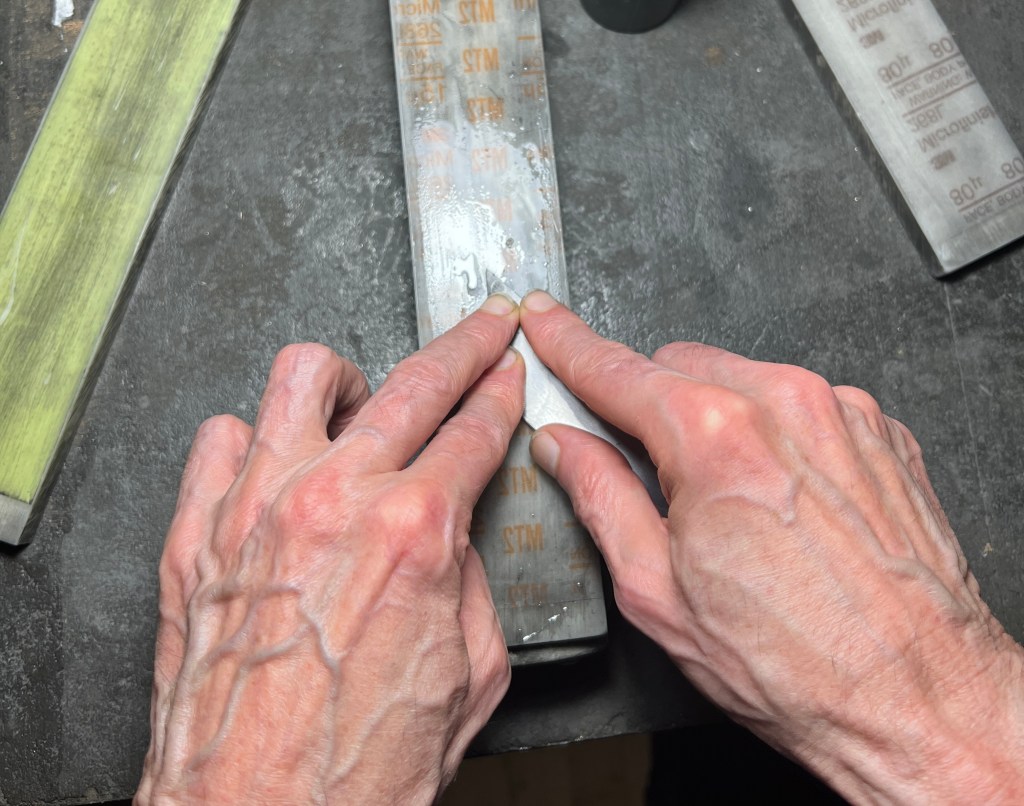
One useful sharpening technique is to assign roles to each hand. Here, the left hand presses the blade to the abrasive while the right moves it up and down.

If you have ever been frustrated when using a knife — and attempts at resharpening result in negligible improvements — then this three day knife making, sharpening and tool maintenance workshop at San Francisco Center for the Book is for you!

With detailed guidance, students will make several knives by hand, using stock reduction, and discuss, sharpen, alter, clean and restore a wide variety of edge tools that participants bring. After making a knife, resharpening usually becomes much easier. Specific attention will be paid to the tools that bookbinders and conservators frequently use: paring knives, lifting knives, spatulas, scissors, hole punches, spokeshaves and board shear blades. Please bring any tools that need attention for discussion, maintenance and rehabilitation. And please bring any unusual or treasured tools you have for the class to gawk at.

Basic principals of steel and blade geometry will be discussed. This class will focus on the techniques of efficient free-hand sharpening, which is applicable to any sharpening system. Participants will use 3M Microfinishing film to make a large A2 paring knife or 01 lifting knife, two small M2 knives of their choosing, a micro-knife, and refurbish and sharpen existing knives. There will also be a ppts, a show and tell of historic tools, and plenty of geeky tool discussions. The goal is to free participants from the plethora of misinformation and mystique that surrounds sharpening and the shaping material using hand tools, and learn fundamental freehand techniques.

Knife Making, Sharpening, and Tool Maintenance for Bookbinders and Conservators. October 14-16, 2026. San Francisco Center for the Book. https://www.sfcb.org/workshops/detail?coursestormCourseId=08a7a3e4814b11f185ff0affe5650d13

If you can’t take the workshop, or if you want some advance reading, here is a blog post with sharpening info: https://jeffpeachey.com/2021/04/20/knife-sharpening-tips-links-advice-and-commandments/
Delrin Toolmaking Workshop. NBSS, Boston, October 4-5, 2025

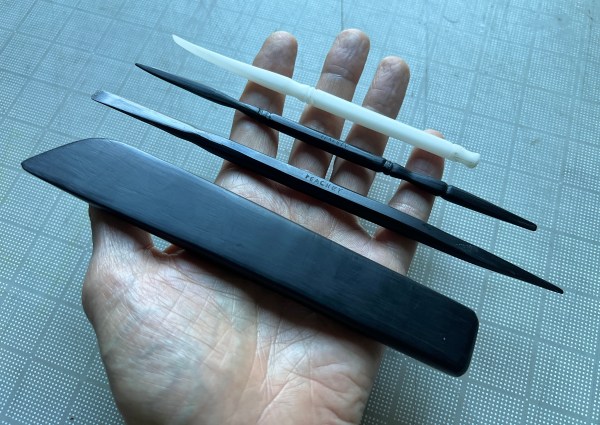
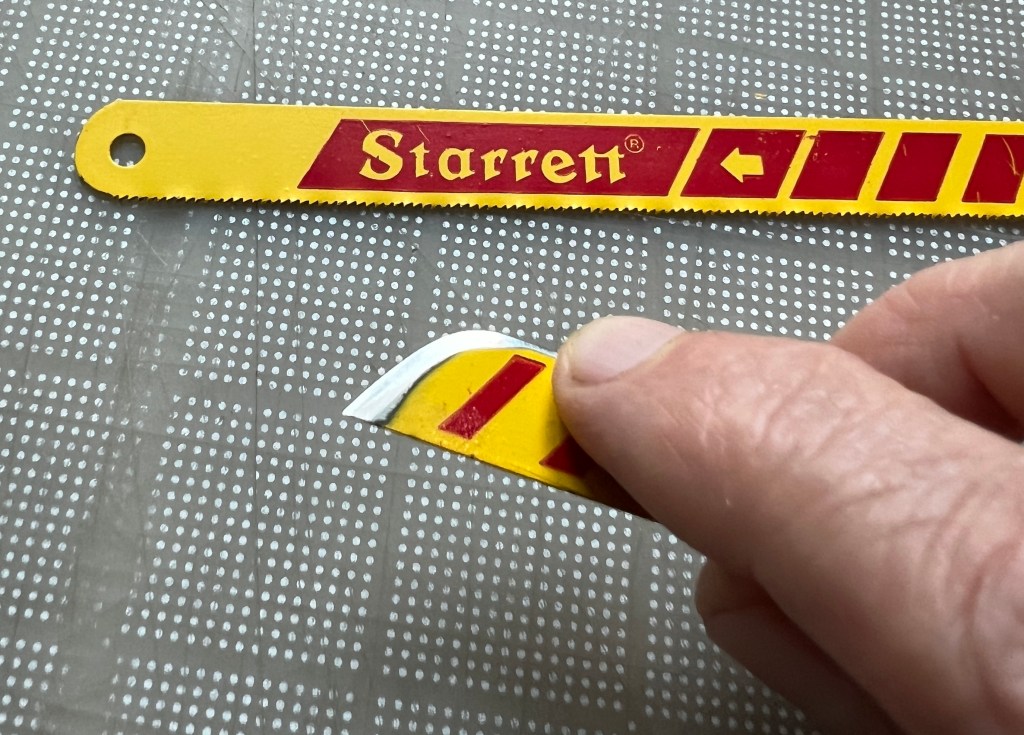
Some tools you can make in this workshop, or design your own.


Making Delrin Tools by Hand for Bookbinders and Conservators. Register here!


This is a rare chance to take a two day Delrin toolmaking workshop. Anyone who needs small hand tools for manipulating, delaminating, spreading adhesive, etc. is welcome. Making tools is engaging, fun, and practical. Delrin is an excellent material for many bookbinding and conservation tools, such as folders, lifting tools, microspatulas, hera, and creasing tools. We will work together designing, roughing out and finishing of several tools. Working Delrin is a meditative activity, no previous experience required. Safe, low dust methods of working Delrin will be emphasized. This workshop is a great opportunity to geek out with other tool lovers. After the workshop you will have some useful new tools, and possess the know-how to alter, maintain, and make more variants. Warning: tool making is highly addictive. 

North Bennett Street School, Boston Mass. October 4-5 2025. Register here!

New Tool! Deluxe Delrin Spatula

Last month I taught a toolmaking class at the University of Cincinnati, and Ashleigh Ferguson — rare book and paper conservator and Co-lab manager — made a beautiful “Griffin” spatula which I coveted. Rather than steal her tool, I developed my own version. Her tool helped me reexamine some long-held negative opinions about double ended tools.

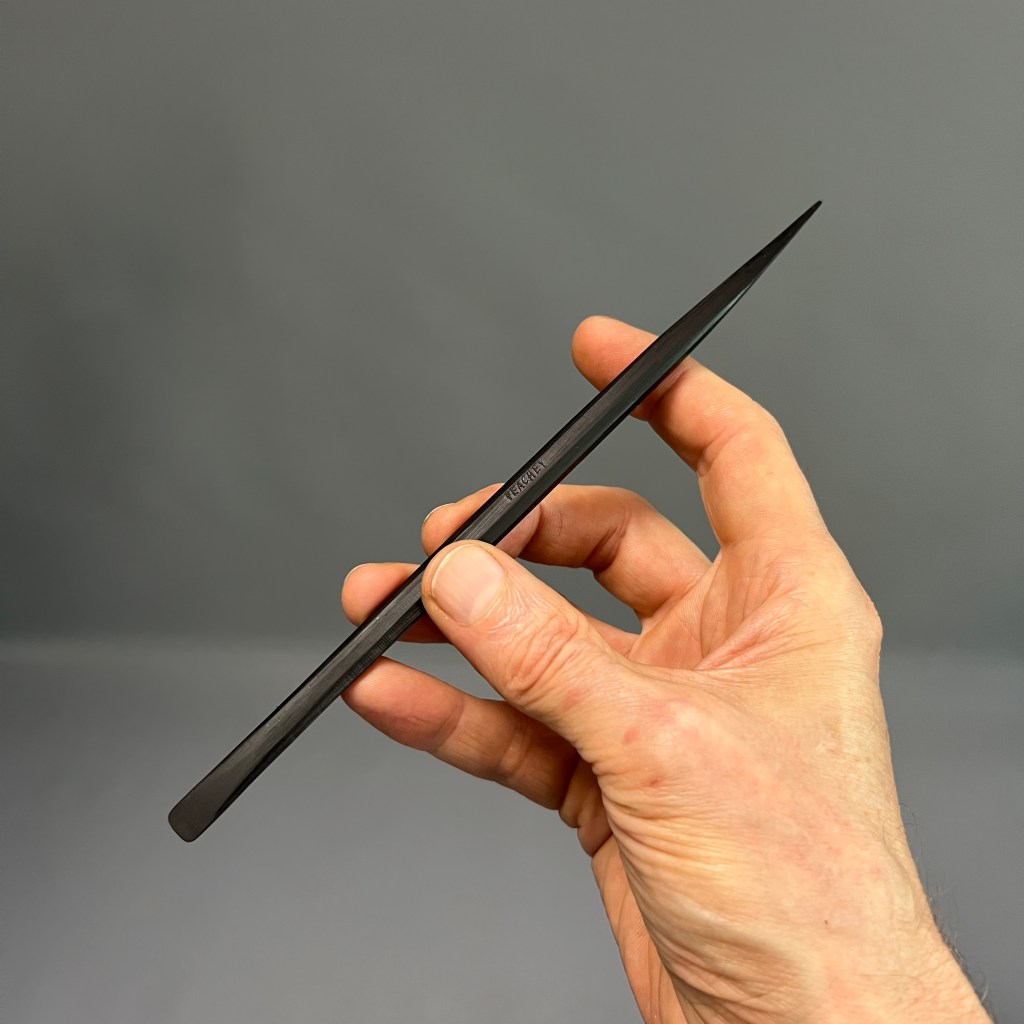
This Deluxe Delrin Spatula is an ideal hand tool for conservators in almost any discipline. Useful for pressure sensitive tape removal, delaminating, paint and emulsion consolidation, applying adhesive under detached layers, controlled pressing, excess adhesive removal, working under magnification, and more.

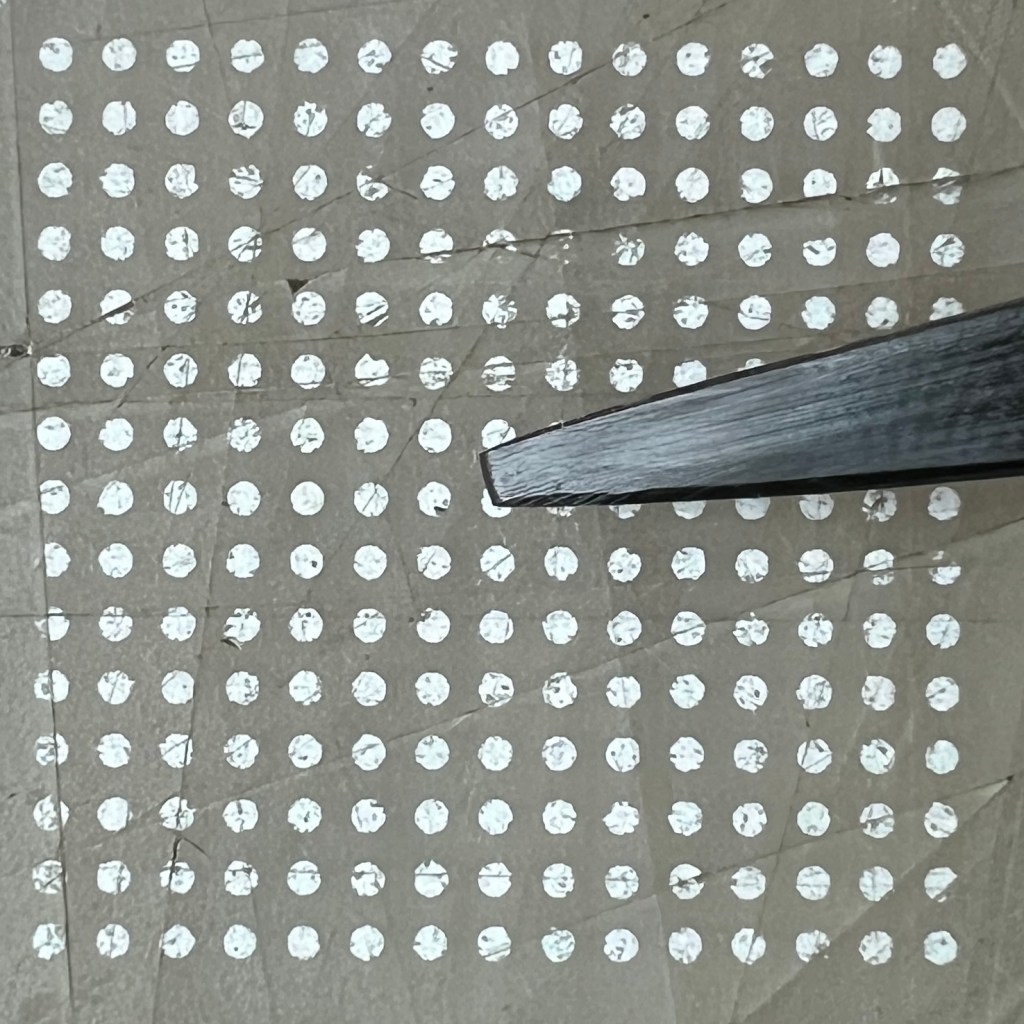
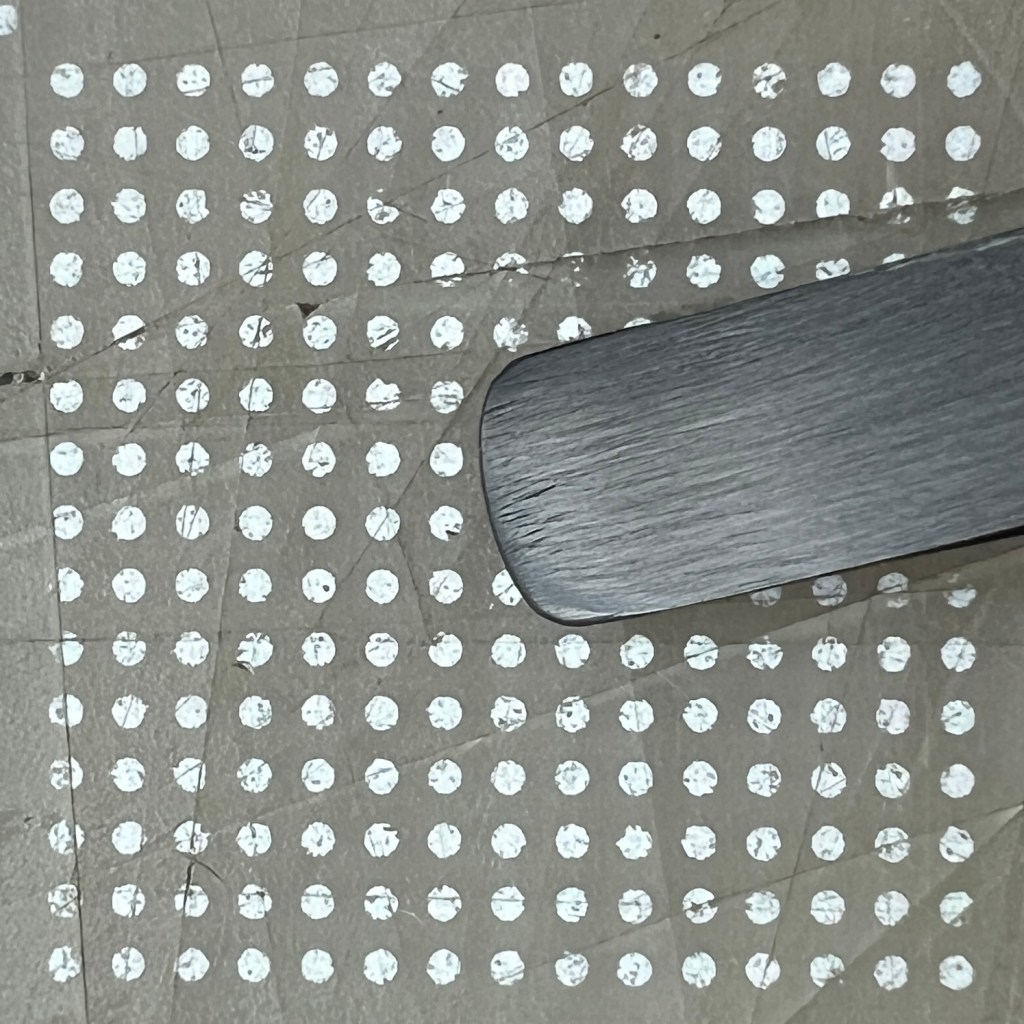
The thin tip — due to the wedge shape in the thickness — is great for applying minute amounts of adhesive. The flexible wide tip (see below) can direct pressure downward, and be used with a twisting motion to help pry off unwanted layers.

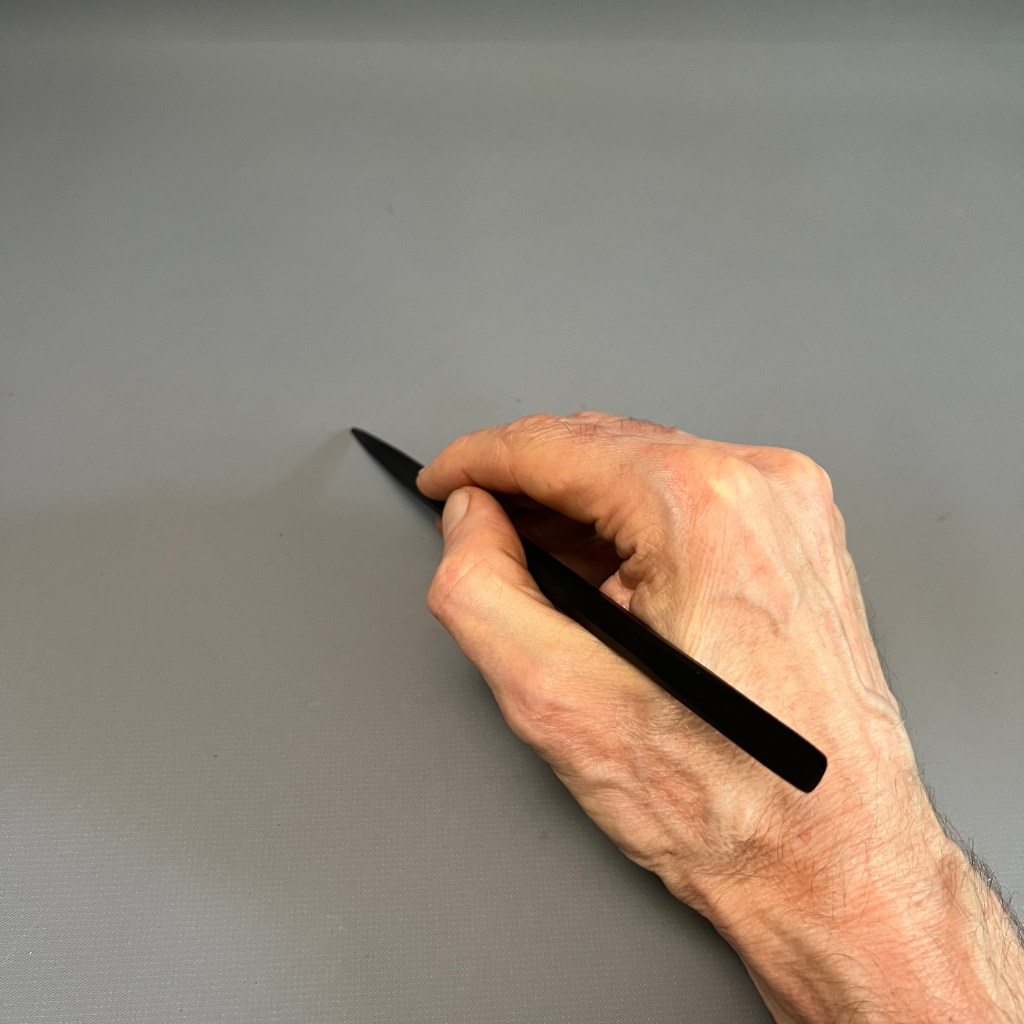
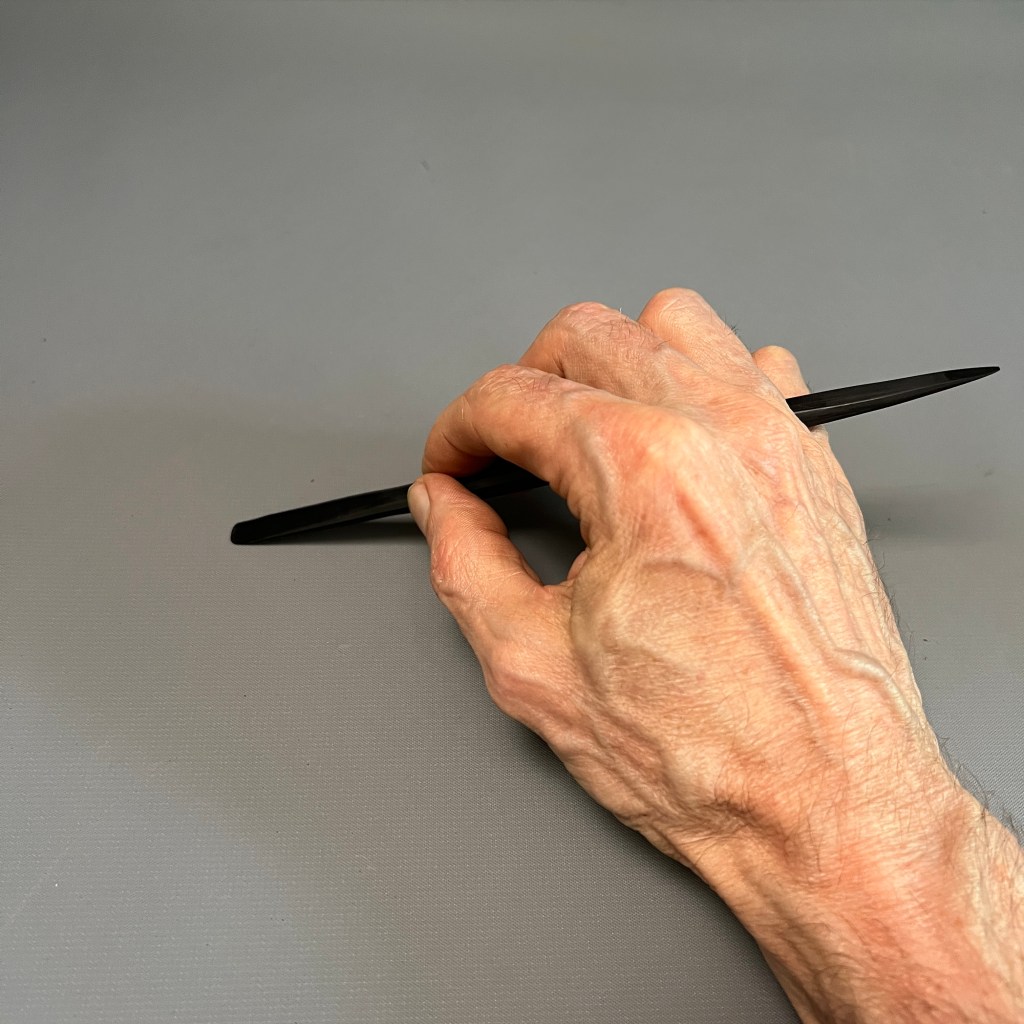
Delrin has a similar coefficient of friction as teflon, but is more abrasion resistant. Black delrin is harder than white delrin, likely due to the carbon, and stays sharp longer. The octagonal handle shape is comfortable in a writing or drawing hand position, and won’t roll off your work surface. Comes with a two stage sharpening kit and instructions to resharpen. The handle may feel familiar to some: it is the same diameter as a Rotring 600 mechanical pencil.

Black Delrin, octagonal handle, approximately 200mm x 8mm. Both tips are slightly flexible, with the small one about 1-2mm wide and blunt. The large tip is straight with sharp round corners, and about .15mm thick at the end.

Purchase here!

Or if you would like to make your own version, join us for a week-long toolmaking workshop at Emory University, October 7 – 11, 2024.