Henry Hebert’s Five Essential Book Conservation Tools

Henry Hebert

Conservator for Special Collections, Duke University Libraries

Preservation Underground Blog


1. A decent laptop with an internet connection: Thinking about the tools I use every day, this one is at the top of the list, because there is so much work that goes into a successful conservation treatment before you even touch the object. There is the research: about the object, about the materials you will use, or about different treatment methods you could potentially employ (and maybe haven’t even done before). There is the communication: with your conservator colleagues, asking for their experiences working on similar objects, with curators to get more information about past and potential use by researchers or students, or sometimes even with the creator of the object. There is the documentation: the written condition report, the treatment proposal, and the lists of treatment procedures and materials you ended up using. In a pinch, you can even use the camera on the device to take photos before, during, and after your treatment.

Henry’s handmade elk bone folder.

2. A bone folder: If I could only have access to one folder, I would probably choose bone over Teflon for rigidity and quality of the edge. Out of the drawer of folders that I have, the one I gravitate toward most is a piece of elk bone which I shaped 10 or so years ago. It’s a little over 8″ long and mimics the shape of a butterknife. One end has a sharper edge that works well for scoring, while the other is wide and flat for compressing sections or consolidating a board corner.
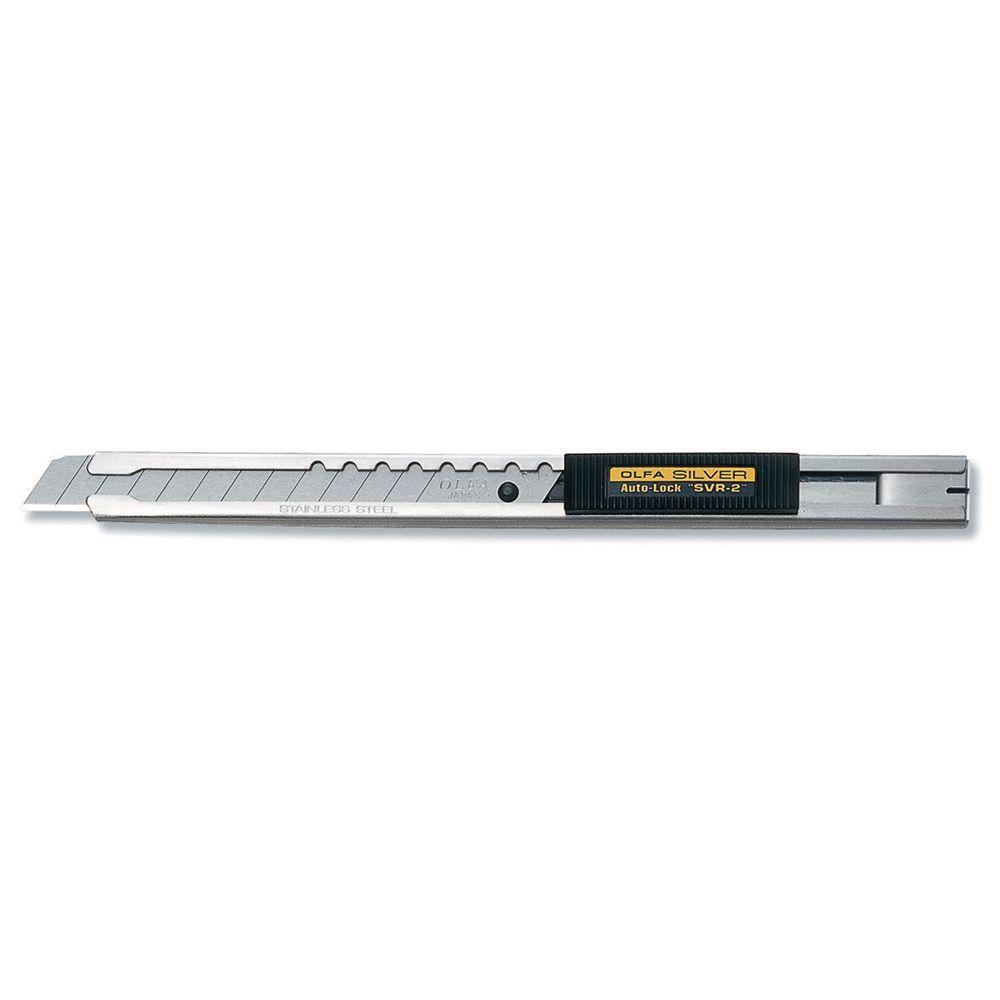
The olfa silver snap blade knife.

3. Olfa 9mm stainless steel slide-lock knife: I probably use this knife the most, because I end up making so many enclosures and the snap-off blades allow for a quick refresh. You can also fully extend the blade to cut through thick ethafoam planks for custom supports. There are so many little design details on this Olfa that I love. The removable endcap serves as both a pocket clip and blade snapping tool. The blade case even includes a small compartment to store old blade fragments. (I get to bring a pack of blades, too… right?)

Customized  #2 Casselli microspatula.

4. Modified #2 Casselli microspatula: The 6 1/8″ Casselli micro-spatula is great for lifting. Two modifications have really improved the working properties of this tool for me: shaping the ends and making the center handle thicker. I’ve added a single bevel to the rounded end to make it more like a blade. The unmodified octagonal handle is fine for quick work, but really becomes tiresome on the pads of my index finger and thumb after lengthy use. I have wrapped the center of mine with Elastack (by Sutton Scientifics) to increase the circumference of the handle and make it more comfortable to hold.

Muji mechanical pencil.

5. Muji “Low Center Gravity” 0.5mm mechanical pencil: I often use a mechanical pencil to make small measurement marks on material that I am cutting or folding. Sometimes it is necessary to number loose pages to keep them in order during treatment, and a mechanical pencil with thin graphite is the best tool for the job. I’ve found this $9 mechanical pencil, with a weighted and knurled aluminum tip, is one of the most comfortable to use and great quality for the price.

There are a number of other tools which I very reluctantly pushed off the list, including: Staedtler Mars white vinyl erasers (because you always have to dry clean first, right?), spring dividers, a Starrett pin vise with insulated octagonal handle, and (of course) a straight edge of some kind would come in handy. I really like my 12″ rigid Starrett rule with both metric and imperial graduation, but I often find myself wishing it were longer.

Todd Pattison’s Five Essential Bookbinding Tools

Todd Pattison’s five essential bookbinding tools.

Todd Pattison

Conservator at the New England Historic Genealogical Society

When Jeff asked me to pick my five most essential tools for bookbinding, I thought about what the most important ones were for making a book and so I chose a needle, a bone folder, scissors, an OLFA knife and a Swiss paring knife.

The needle was pretty obvious when I started to think about some of the first tasks involved with making a binding. You can fold and tear pages by hand to create signatures but page attachment for me involves sewing with a needle. The needle can also be used to poke holes, scratch line, and just generally pick at things (who doesn’t like to do that) so it has some versatility as well.

I use a bone folder for so many bookbinding tasks that it seemed a natural one to include. I’m showing the one that I also use for box-making; one end has been shaped into a 90-degree angle to be able to work in corners. I broke my favorite bone folder about 10 years ago, it was basically the only bone folder that I used, and since losing it I haven’t really found another one that I like that much to replace it.

The scissors and the OLFA knife might be a little redundant as they are both used for cutting but the way I use them is different enough that I decided to keep both. I tend to use them quite a bit and the thought of not having either one at my disposal is a little strange. There was some back and forth about dropping out the scissors and replacing it with a 90-degree triangle, a brush or a ruler, but I eventually decided to keep the scissors instead. I actually do a lot of measurements without a ruler by measuring materials against a book by eye, I can use my fingers or a scrap of board to apply adhesive and I think I can come up with a right angle some other way if I needed to.

Leather is such a beautiful material to cover a book with and I really enjoy working with it so my last tool is a paring knife, it’s kind of a must for me. I’m showing a Swiss version that I purchased in 1983 so it has gotten a lot of use and I like how versatile it is. I also own a right and left English knife but the curve of the Swiss knife kind of combines both so if I’m restricted to just one paring knife, I’ll include it.

I really hope that I’m never limited to only five tools but if that happens those are the ones I would choose.


Tom Conroy’s Five Essential Bookbinding Tools

Tom Conroy asked me an intriguing question.  What are the five most essential bookbinding tools? And why?

I asked a number of bookbinders and conservators to weigh in, and will roll out their answers, one a day, for the next week or so. It is a deceptively intriguing question, as well as being an engrossing distraction. And possibly contentious!

Spoiler alert, if you want to think about this a bit without prejudice, scroll down no further!

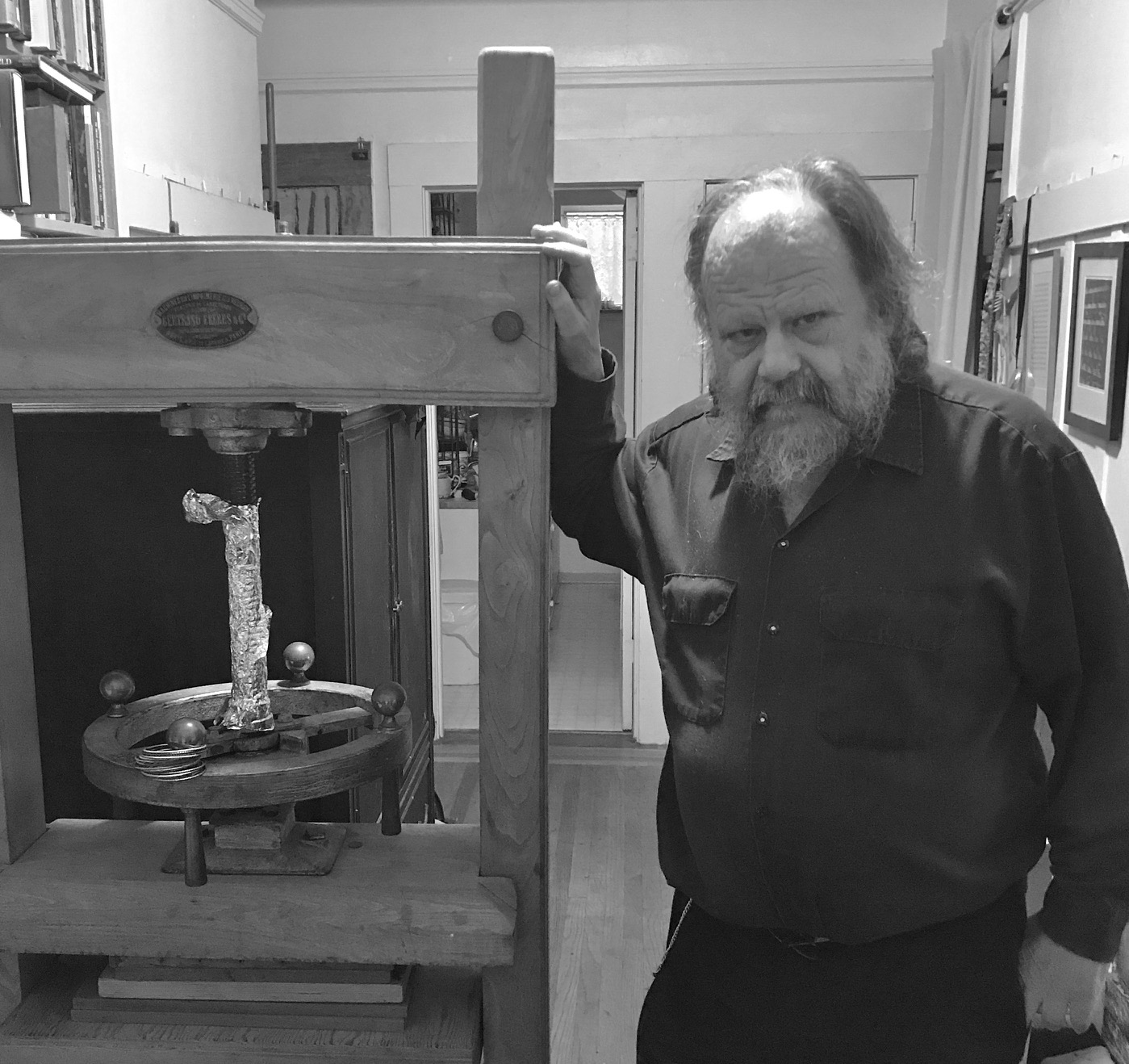
Tom Conroy with his pride and joy: a Bertrand Frères Percussion Press. Note the aluminum foil to protect forearms from getting greased.

Tom Conroy

Bookbinder and Book Historian, Berkely, CA.

Bone folder, of course, first; and then I would say knife and straightedge. Spring dividers. Needle. Its a bit more complex than that, of course. My favorite folder is about six inches long, tapers gradually almost from the butt end, and is strongly curved (when “flat” on the bench the tip is raised by almost 5/8″), and is broadly useful for folding, rubbing down, casemaking, and covering; but it is a bit big for working headcaps, definitely too big or a lot of paper treatment and probing where I like a thin folder, and I avoid creasing with it since creasing wears tips so quickly; so actually, several folders are necessary. Well, the more the better, really. A knife and straightedge normally require a cutting board as well, and a knife requires sharpening equipment (disposable blades are never sharp enough) My preferred bench knife is a “small McKay” used by shoemakers and is perfect for use with a straightedge and for disbinding, generally useful, even for light paring, but it it is too short for slitting paper and too small for serious leather paring. Dividers: almost any will suffice, really bad ones are very rare (though I have seen them), and I can, with a strong grimace, imagine making do with just one pair. My preference, though, is 6″ Starrett “Fay” style, with the screw piercing almost-rectangular legs. Needles: now there’s a essay, good ones haven’t been made for at least half a century now, but some needle is indispensable. It’s hard to stop at five. My first thought, before I remembered needles, I had a paste brush on the list (at least 1-1/8″ diameter, usable for hot glue in desperation, but never for PVA); but then I recalled Bernard Middleton pasting up leather for rebacking by grabbing a handful out of the pot and scrubbing it in with the flat of his hand….I think he did it to shock the young folks, that workshop was full of French-style design binders and newly-minted program conservators, and while Bernard was as gentle and quiet as any man I have ever seen, once in a very great while he would show a touch of teasing, immediately hidden away again. I’d find it hard to do without awls (four main kinds in constant use for binding, and others for leatherworking and woodworking). Long tweezers and needle-nosed pliers would be hard to do without. But, on balance: bone folder, straightedge, knife, dividers, needle.