Sharpening on a Book on Sharpening

Most bookbindings function as protection for the text contained within.  This, however, is a bookbinding that also functions as a strop. I rebound Ron Hock’s The Perfect Edge: The Ultimate Guide to Sharpening for Woodworkers in reverse calf in order to make it work as a not-so-fine binding/ strop.  This book is one of the best on sharpening, containing an excellent overall assortment of information.  It is loaded with practical advice, overviews of the various sharpening systems and informative photos.  I recommend it as a textbook to accompany the sharpening workshops I teach.

Anyway, this was the first time I constructed a reverse calf binding– the paring took a bit more time since most of the strength of the leather (hair side) was cut away, and the caps were a bit tricky to form. The book was sewn on 5 quarter inch linen tapes, the edges decorated with Golden Fluid Acrylics chromium oxide green mixed with airbrush medium and Staedtler Karat water-soluble  pencils, and the endbands simply sewn in purple silk over a cord core.  The front cover was coated with a .5 micron chromium oxide honing compound, for preliminary stropping, the back left bare for a final polish.  It will be interesting to see how it looks in a couple of months when the metal particles start to build up.

Wooden Book Board Lacing Exposed

Above:  The anchoring and lacing pattern on the inner face of a wooden book board from 1453.

Not only is it remarkable that the tight “S” twist double cords are still held tightly by the treenail, but I find the almost casual tool marks from a gouge beautiful.  They look like they were cut yesterday, although they were protected and covered with a vellum pastedown that became detached at some point in the past.  Judging from the splintered wood on the right hand side, it looks as if the hole was drilled first, then the channel cut from left to right. The cuts must have started at the bottom, and worked upwards, ending with what I can imagine was an attempt to clean up the slightly splintered wood. And like most attempts to rectify an error, it only made things worse.  A bookbinders mistake from five centuries ago?  Notice the split in the board is not caused by the treenail or the two iron nails at the top and bottom of the image, which is often the case.

I’m always impressed by any mechanical object that is still intact and functioning after 557 years.

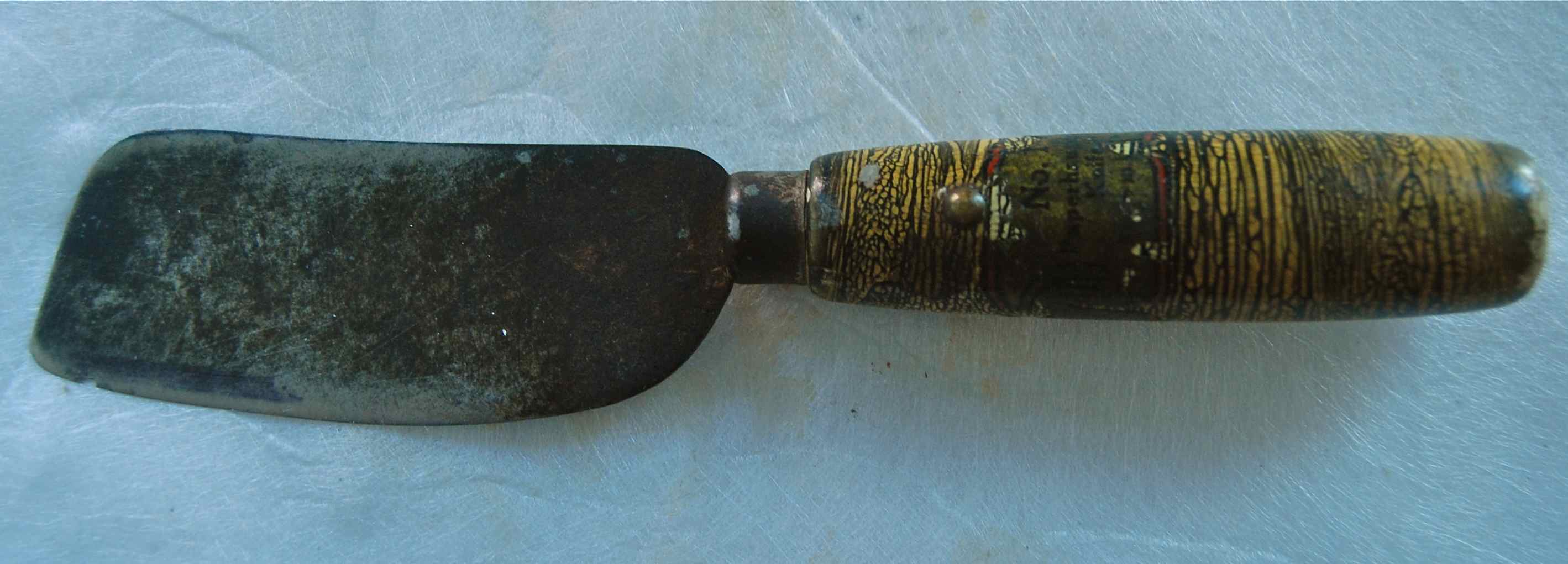
No. 1 Paperhangers Knife

I recently acquired this Knife.  It is 18 cm long, and the faded label appears to read “RIDGEL”, then “No. 1 Paperhangers Knife/ Made in U.S.A.”  The paint decorating the handle is quite spectacular, I’m guessing it is an oil based paint, but am unclear how this complex, tiny pattern was formed – the black paint appears to have been spun or dripped onto a turning handle? Any information is appreciated.