Timothy Ely’s Five Essential Bookbinding Tools

Timothy C. Ely

Artist in private practice – makes books, prints, drawings and the occasional guitar. Instagram

I had enough warning that I could watch over the course of a few days exactly what was used often. These are tools I grab when I am traveling to teach and they find cross over into other areas. Jeff knows this was a challenge as I have many tools inherited, made and gathered over the years. Next challenge should be the most important twenty five.
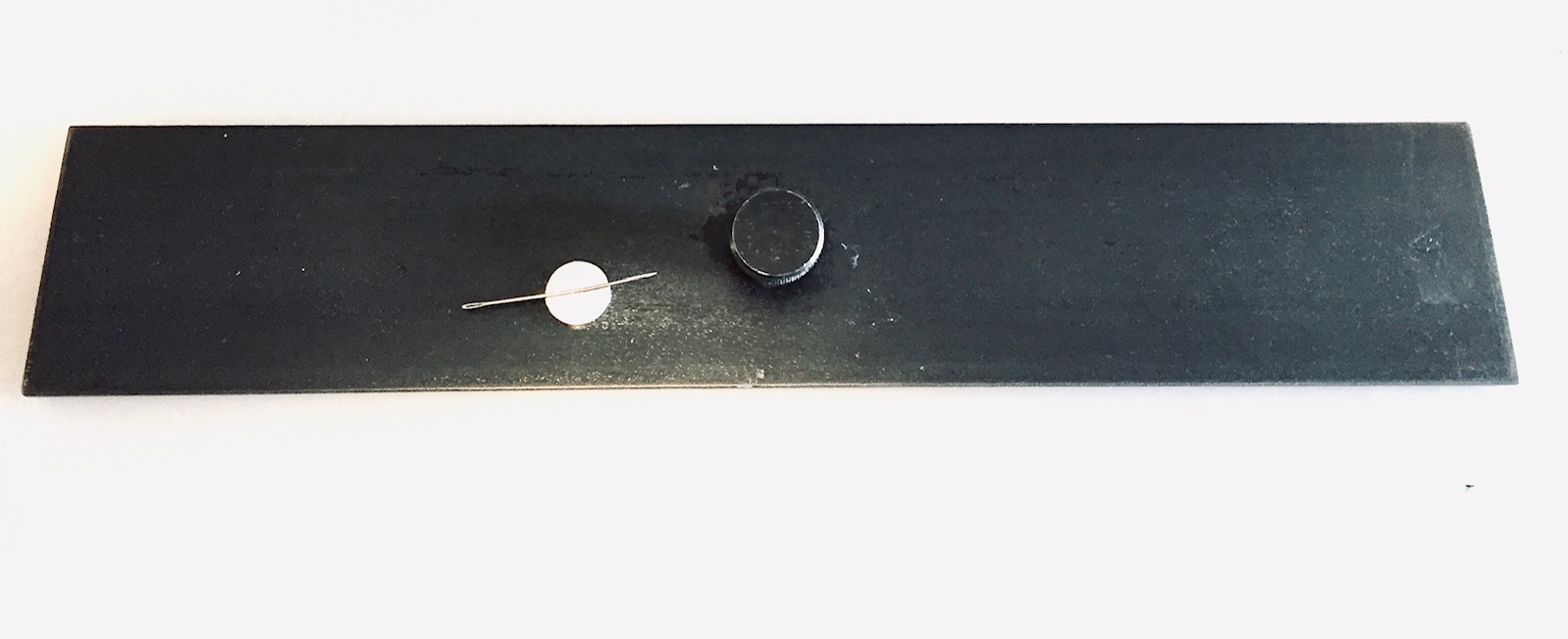
First off, a custom weight made by Randall Hankins of Salt Lake City. I have many weights of Randy’s as well as heavy things found over the years like massive things to hold x-ray machines in place. After making do with essentially the wrong things for decades, Randy and I designed these sixteen inch long weights so that some of the endpapers varieties I make could be selectively weighted or just kept from moving. I have a pair and I could not now work without them. Being steel, magnets can be applied — here is one catching a needle.

I can put you in touch, [contact Tim here] All are custom made.

Cobblers knife from Buck and Ryan [sadly gone] London. Purchased in 1982. Cutting paper and used as a marking knife.
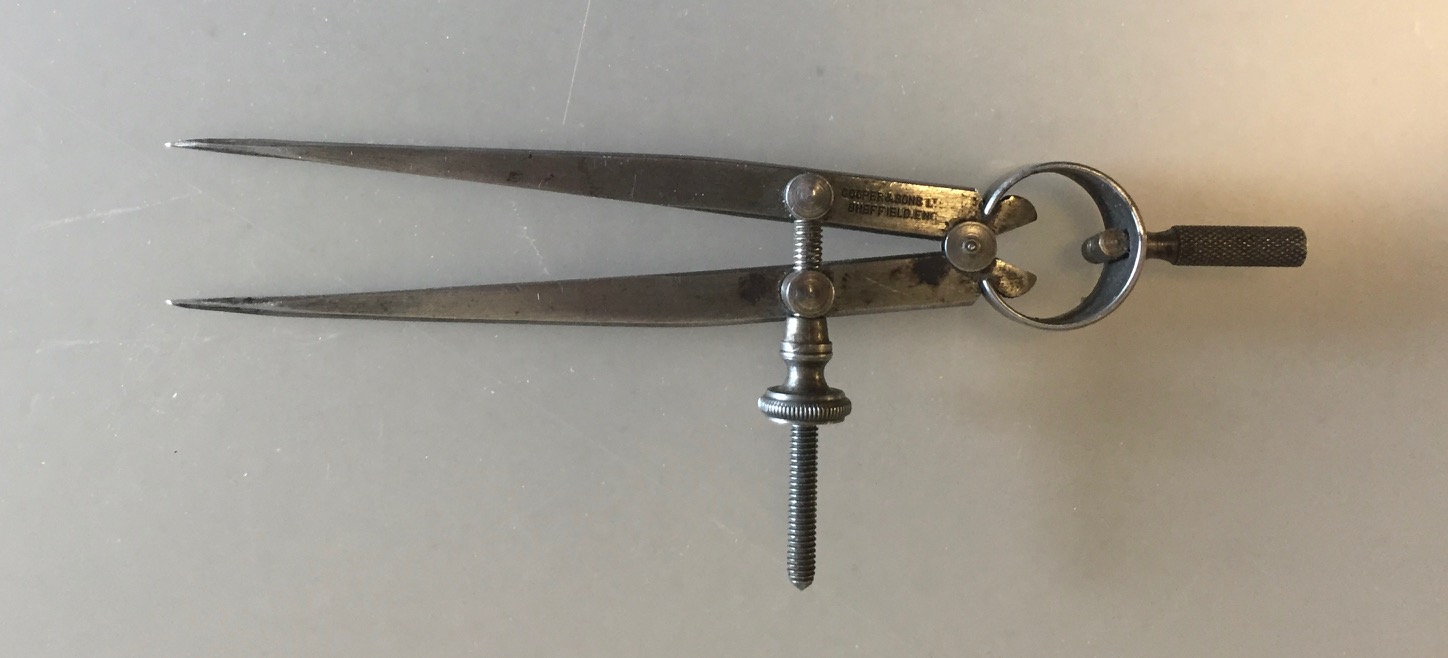
 

Margaret Smith [d.1982] her dividers, about 6 inches long. She was born while Victoria was still alive and bound books with a Victorian sensibility. Very gracious and knew everyone. Studies a bit with S. Cockerel and was full of stories. She made her stone burnisher from flint found at Brighton. I use this tool more than any. No idea how many dividers of all configurations and lengths that I have found.


Triangle for various squaring and metering jobs. This one allows the worker to dial up the amount of focus required for certain jobs.


My first bone folder. It is sharpened on the lower edge, about 3 inches so that I can fold and then cut folds without needing two tools. I have many bone folders, they are sort of talismans to the discipline and are nice. I have a giant folder made from free range mastodon by Jim Croft. This one is balanced for throwing.

Cor Knops’s Five Essential Book Conservation Tools

Cor Knops’s five tools.

Cor Knops

Owner of Knops Boekrestauratie. Book conservator in private practice. Munstergeleen, Netherlands.

These are my five favorite tools for book conservation.

1. Stitch Cutter. This is a Swann-Morton disposable stitch cutter blade mounted in a cheap hobby shop handle. The blade is razor sharp and ideal to cut the sewing of books. You can easily cut the threads without any damage to the paper. The blade is also useful for many other delicate cutting operations. I don’t sharpen these blades: when blunt I mount a new one.

2. Olfa Cutter SA-C 1. This is my favorite snap-off blade knife. The blade angle is 30 degrees instead of the more common 60 degrees. Because of the sharper angle, it cuts delicate paper like Japanese paper without fraying. What I also like is the very slim dimensions of this knife. It’s only 11,5 wide x 4,3 mm thick, and without the blade 136 mm long. Also the non-coated stainless steel finish is very enjoyable to hold.

3. Curved Tweezer. Very fine and precise pointed tweezer. It allows you to pick up the finest things, and you might be surprised what you find in the gutter from books….

4. Curved scissors. This little scissors is only 117 mm long. Not so visible on the picture is that is has curved blades. This makes it ideal to cut in hard to reach places. Also nice is the metal spring which open up the scissors by itself. [Note: these are called “conjunctival scissors” in the US]

5. Dental Pick. I have many, many spatula and all kind of other small tools to ‘fumble’ with. But this miraculous tool is quite unique. It has two identical end tips. But the angles are opposite, so when releasing leather from a leather binding for instance, the funny thing is you can flip the spatula in one movement in your hand and the ‘angle of attack’ changes. It needs some practicing but it helps to work more efficiently.

Vriendelijke groeten,
Cor Knops

Chris Brown’s Five Essential Book Conservation Tools

Chris Brown

As primarily a conservator, the majority of the time, I set a book on the bench for conservation and repair, and immediately gather my primary tools.
In order of reach are:
The bone folder which was gifted to me by my mentor, when I started my apprenticeship. I have since been gathering folders that I like, but are not as married to as this one, so that I may give a bone folder to those I teach, should the time arise. This is tradition for me, more so than an immediate need for the folder in the first part of the conservation work.
Next is the Olfa 9mm, with Ultrasharp black blades. They’re worth the relatively minor increase in cost, as they last far longer than the regular blades, for my work needs. When I switched to the retractable from an X-acto knife, I stopped bleeding by about 90%, per book. I have to have sharp blades, good visibility and dexterity without sacrificing safety, as I disbind a book, open hinges and trim leather to fit.
Third is my my large steel spatula. This assists me with most lifting, as I can feel far greater subtlety in the process of lifting a delicate page, than I can with the lifting knife my sensei taught me to make. When I need good, old-fashioned horse power and material removal, I go to the hacksaw based blade. When I want to feel the difference between lifting paper and the first layer of board, this is what I need.
Fourth, will be the dental scraper/pick. When the proteinaceous glue on the spine, is cantankerous after three applications of wheat paste or Metyl Cellulose, the fourth application of glue removal compound is coupled with detailed work to keep as much of the fold integrity as possible, while removing as much old glue from the crevasses as can be.
Finally, the fifth tool I wouldn’t be without is the Peachey Delrin folder. I chose this shape because I needed to be able to smooth down larger sections of leather or end-papers, fold and manipulate leather and paper and generally be able to work with straight PVA in some areas. The Delrin doesn’t feel as flimsy in my grumpy fingers as does a folder made of Teflon. It also has the tendency to stay out in my hand and not go flying around the table like a watermelon seed violently pinched between thumb and forefinger. From paste to PVA, this folder provides me with the ability to smooth no small range of cloth, leather and papers to provide an aesthetically pleasing finished product for the client.
If I were to add anything to this list, I would add two types of brushes, and a one meter long, non-cork back straight edge, with millimeter gradations.
The two types of brushes: Good natural bristle paste brushes, and a good set of artificial bristle brushes of varying size, for PVA application.
With the first 5 tools, I can conserve most things.