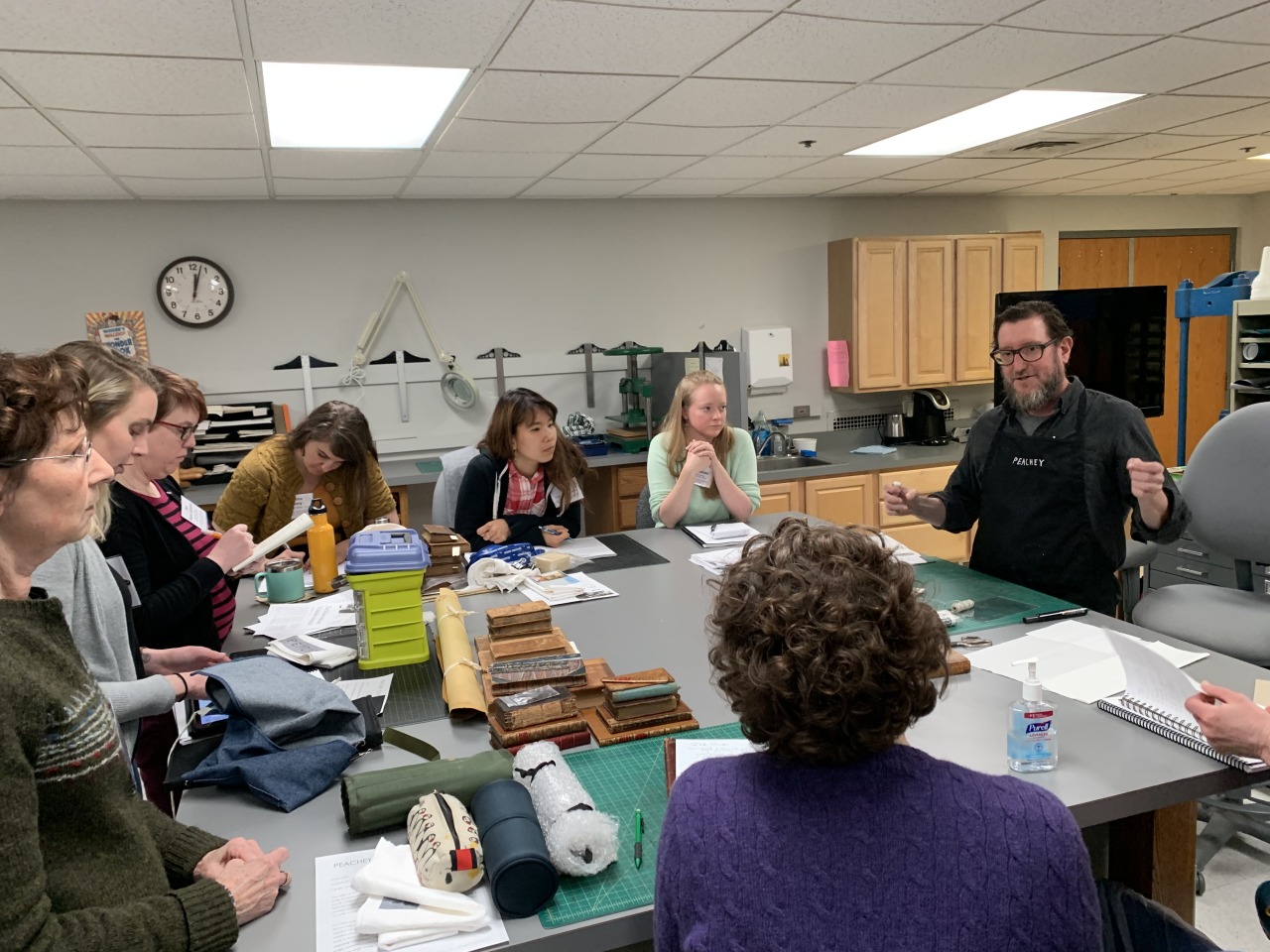
The Conservation lab at Reyniers recently hosted a week-long workshop with Jeff Peachey on the Conservation of Leather Bookbindings, organized by Liz Dube and supported by the American Institute for Conservation. You may remember Jeff from his 2018 presentation in Rare Books and Special Collections on his treatment of Dante’s La Commedia, from 1477.
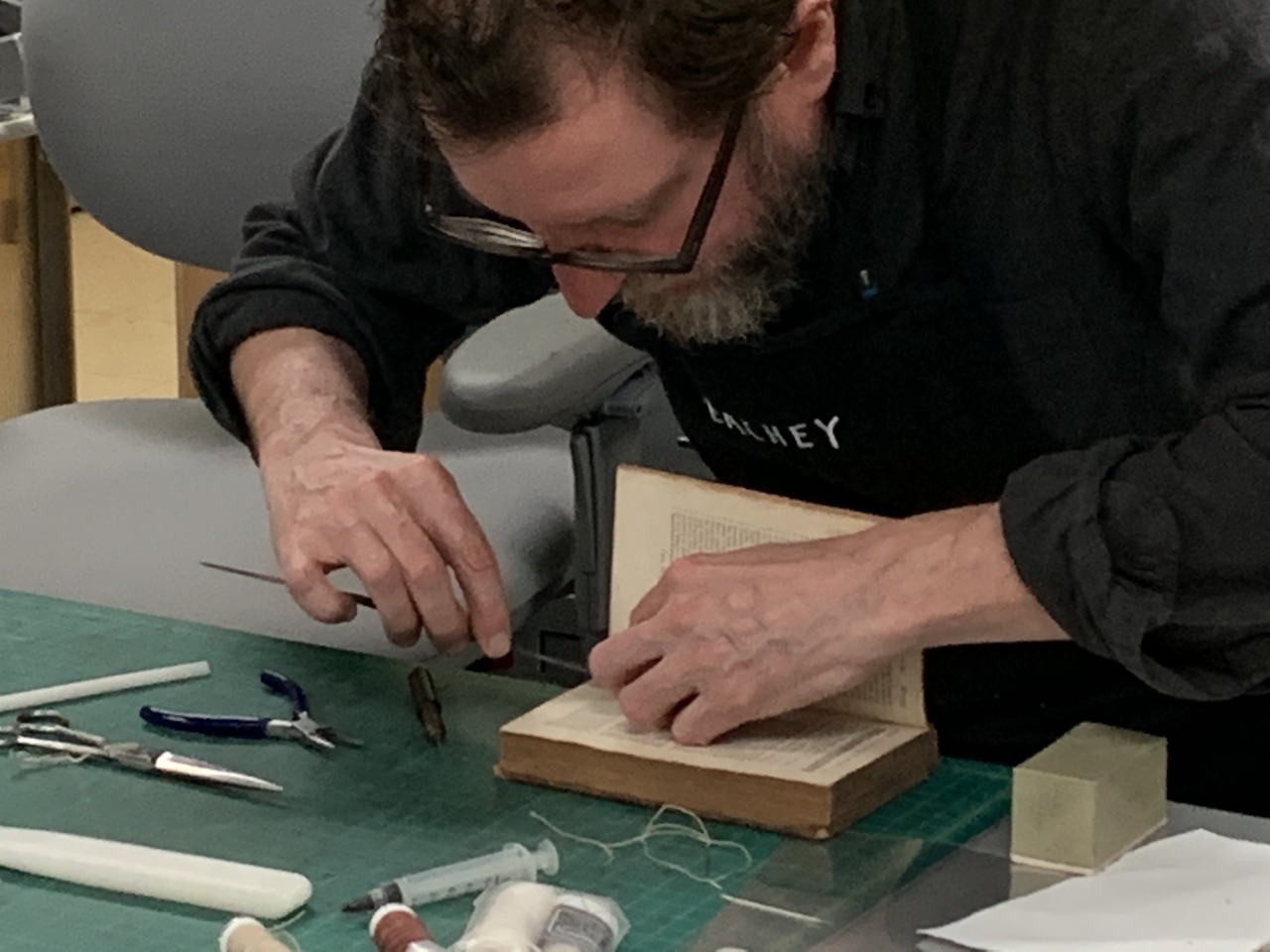
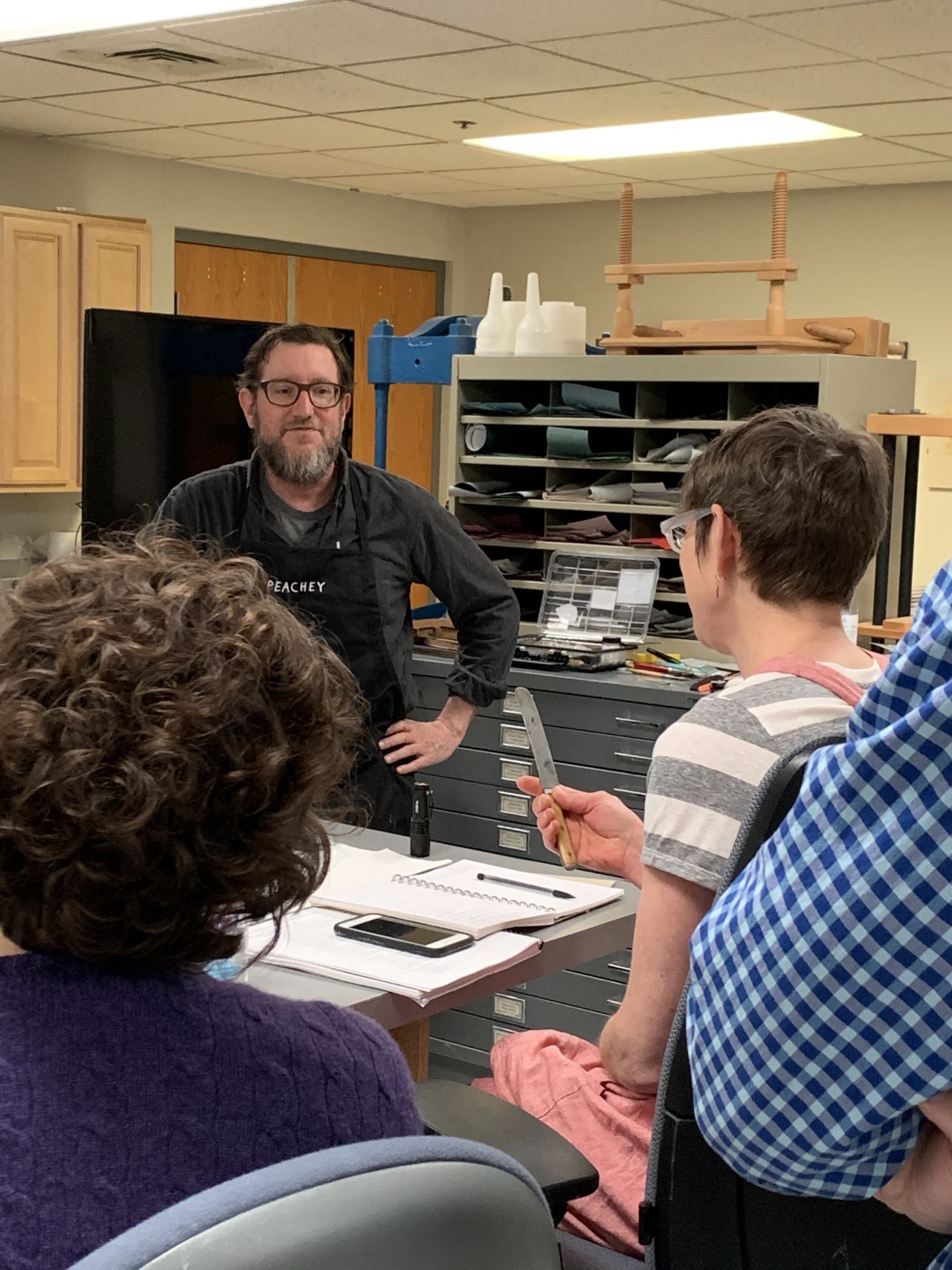
Seven conservators took part in the workshop, in addition to our conservation staff at Reyniers. The hands-on, intensive workshop covered treatment decision-making, various repair techniques, leather working skills, and tool sharpening. Our group took time out to visit RBSC to view the 1477 Dante up close with Jeff and enjoy the exhibits on display. Thanks to Julie Tanaka for hosting our group.
The workshop provided the rare opportunity to learn, practice, and share with colleagues from other institutions. It was a lot of fun! We are grateful to Jeff, and to our colleagues who were able to make it to campus and stay focused during such a challenging week. Special thanks to Tosha McComb, Neil Chase, and Kathy Colbert for their flexibility and support during the workshop.
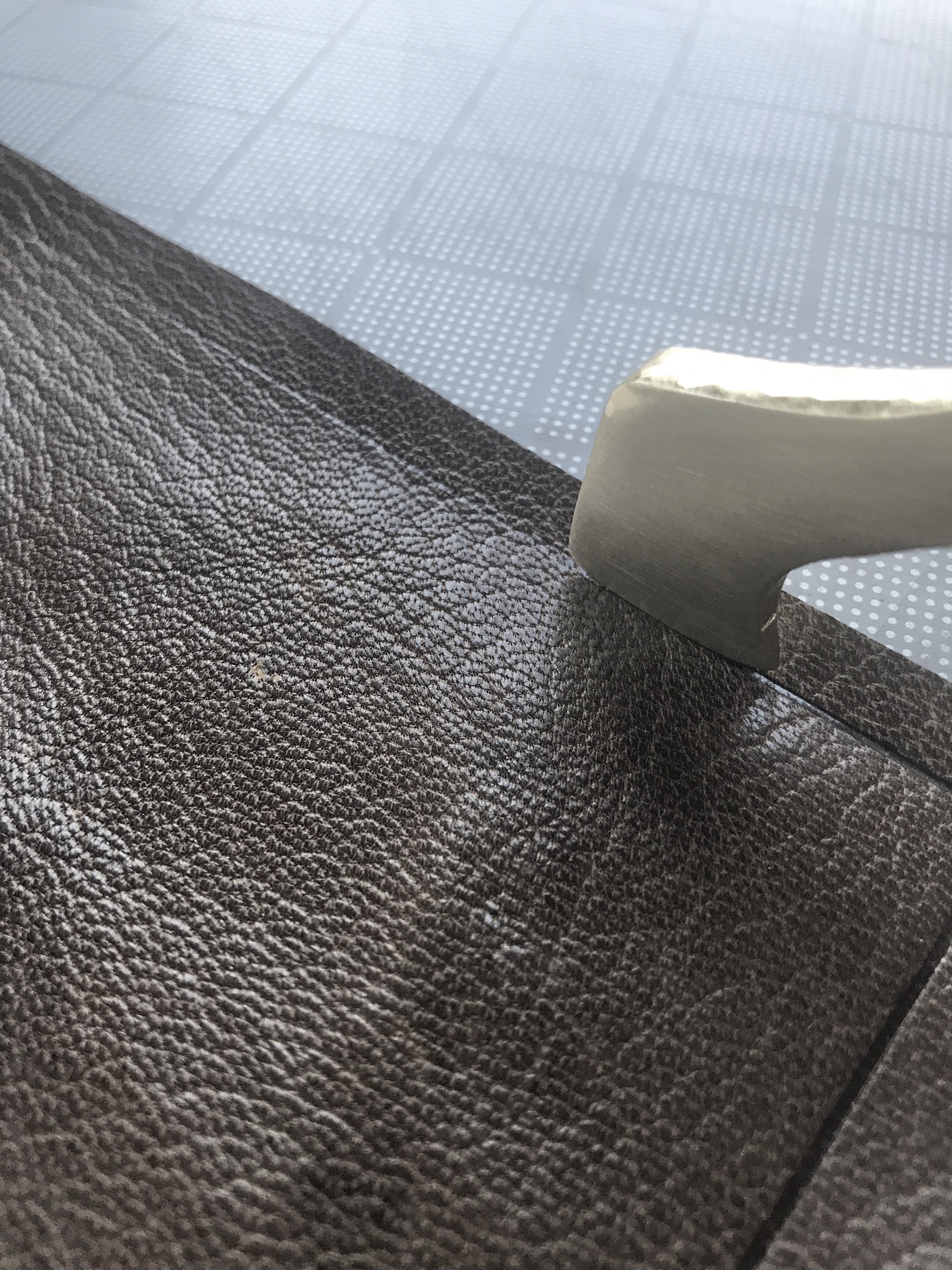
The creaser is making a dark line with a flat bottom even when used at room temperature.
Using a creaser is one of the easiest ways to impress a solid black line in leather. Simply dampen the leather overall, score a line with a bone folder and straightedge, then rub the creaser back and forth. Or some prefer to score a straight line on dry leather, wet the line with a small brush, then use the creaser. The lines I made in the images were done with a room temperature tool, though with some leathers a darker line develops if used warm — but not hot.
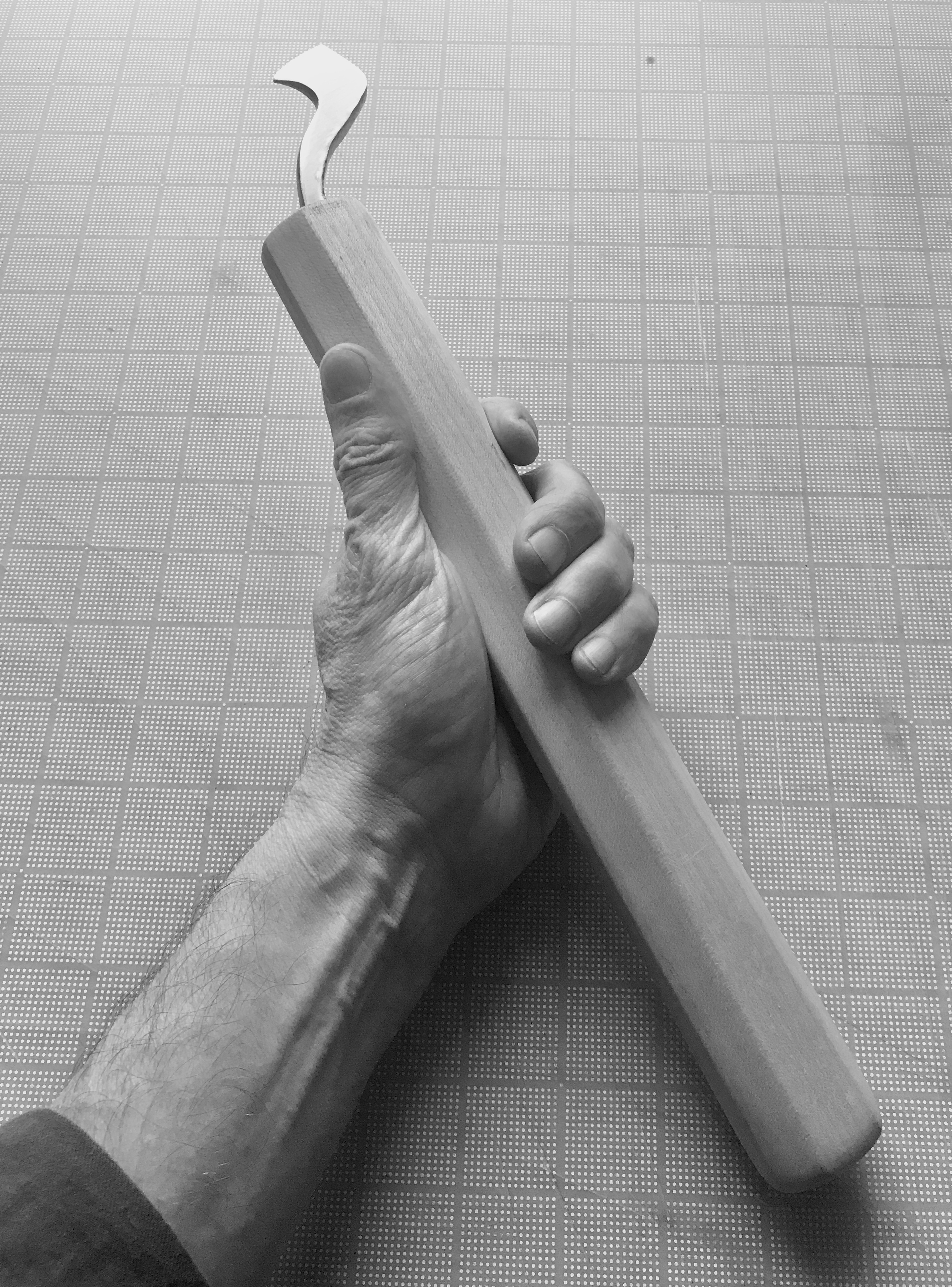
Overall length is about thirteen inches. The maple handle is eleven inches and octagonally shaped.
The design of this creaser is based on an early 20th century Frederick Westpfall tool in my collection. You can burnish the line you make by “jiggering” it back and forth, increasing pressure as it forms a groove. The burnishing gives the dark blind line a sheen. Once a basic depression is formed, the creaser slides like a cross country ski in a groomed track. The length of the handle allows for two-handed use to apply extra pressure, and you can even lean into it a bit with your shoulder.
The resulting blind line is flat on the bottom and reflects light evenly, unlike marking leather with a bone folder or other irregularly shaped object. Since the tool is usually used at ambient temperatures or only slightly warmed, there is no risk of burning the leather.
Top view of the creaser with hammering marks left in place.
The thick maple handle is easy to grasp with one or two hands, and lean into with your shoulder. Overall length is about thirteen inches. Brass head with maple handle.
A collection of handmade rug hooks bought in Prince Edward Island, CA.
I purchased this small collection of rug hooks while on vacation in Prince Edward Island, Canada, this past summer. Most of them have handmade hooks, and the handles are repurposed, altered, or custom carved. There is a compelling beauty to these humble and utilitarian objects.
Not only are they simply constructed, but they are extremely well used, which implies a degree of excellence. A poorly designed or made tool usually does not see much use! They are purely functional, with no decoration or even extra polishing on the hook end. Things that are well used and worn are an increasing rarity in our current culture. I sometimes refer to this as “use value”, but there must be a better term.
A precisely shaped hook at the tip.
They all have a square shaft end where the handle is mounted, and look hand forged. The overall length is almost exactly the same, so that they fit into the palm of a hand and the tip reaches near the end of a slightly bent index finger. Gravers have a similar length, and one of them has what looks to be a graver handle that is missing the ferrule (the second one on in from the left on the bottom).
Several of them have file marks near the hook, indicating they were sharpened, fixed, or altered. The thickness of the shaft in relation to the size of the hook makes perfect sense: I imagine the thick area pushing apart the backing, and the hook small and sharp enough to pull the material efficiently through.
The first one (top row, far left) reminds me of a Jim Croft awl handle, with its comfortable looking hand carved handle, worked just enough to knock any sharp edges, but not going overboard with sandpaper to make it smooth as if it were lathe turned.
Simple and ergonomic handle.
I imagine them gradually being shaped to the hands that used them over a long period of time. None of them seem to have any extra finish applied, so they feel like natural wood and oil from the hands. The shapes of the handles are all different, and likely the most individual choice.
They all demonstrate the two key aspects of successful tool design; the tool fits comfortably in the hand and fits efficiently with the material worked. They all look like they could comfortably jump into your hand and go to work.
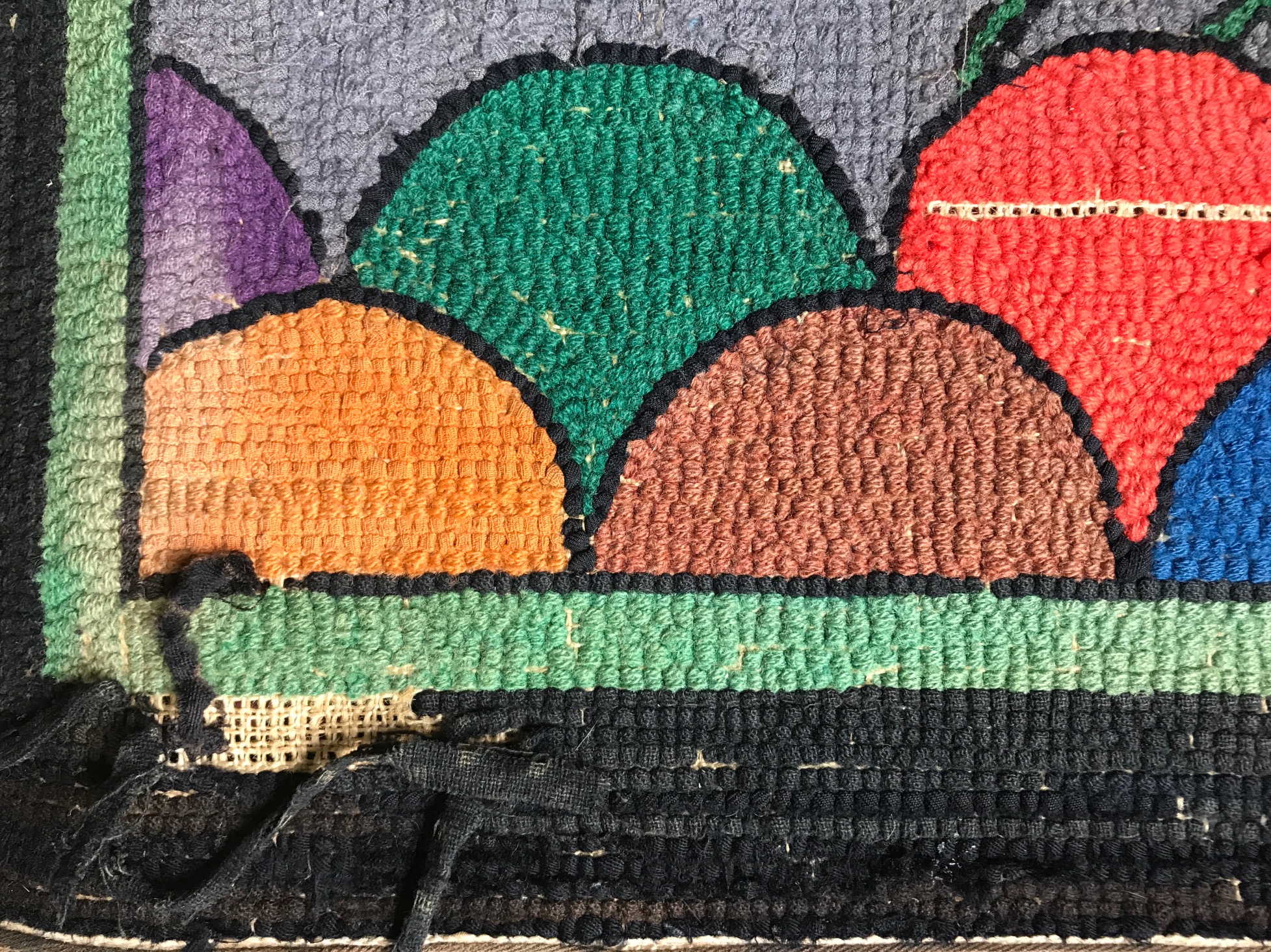
Detail of what a hooked rug looks like. They were often made of strips from worn out clothes.



 Peachey Conservation