Portable Press

portable-press


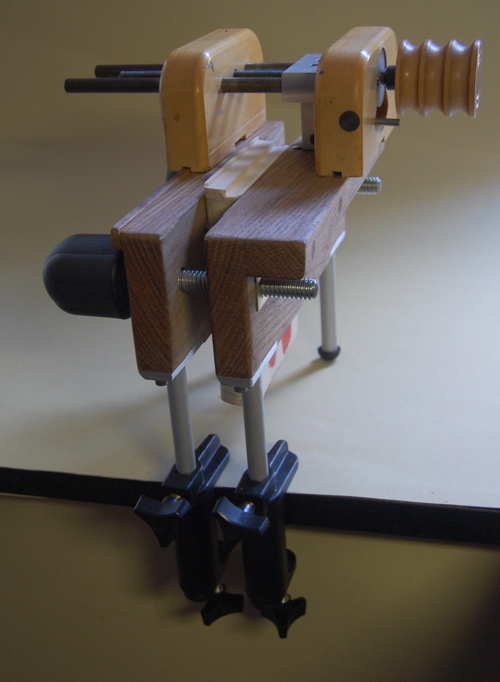
I needed a portable press to travel with.  The challenge was to make it as light as possible, be able to use it without a tub, and make it rigid enough to back books and use a plough on.   The oversize, rubber knobs combined with a 1/2″ acme screw can be tightened by hand, without the need for a press pin.  The aluminum legs can be unscrewed to easily fit into a backpack, and rigidly clamp to a work surface for use.  With the plough, the entire setup weighs in at 6 lbs, 4 oz.


plough-detail

The plough on this press is a circa. late 1980’s Derick Beck model. It is unusual, in that the blade travels independently of the cheek on the right hand side, and the blade is angled downwards, so that the length of the blade doesn’t mar the edge of the textblock after a cut is made.  To advance the blade, the knob is rolled towards you, which is opposite the way standard plough works, and takes a little getting used to. It cuts very cleanly.

Paper Knives

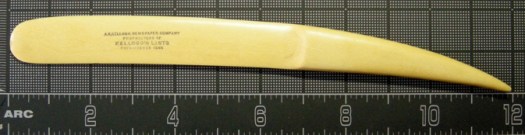
The celluloid paper knife below  is a late 19th or early 20th century and  issued as advertising from the A.N. Kellogg Newspaper Company.  I’m confused about distinctions between paper knives, letter openers, page turners and even bone folders.  Neither Etherington or Glaister define their differences, and a few quick internet searches seem to lead to antique dealers selling Victorian versions.  So here is my first attempt at a definition: a paper knife is a large, special purpose type of bone folder, usually with a distinct handle and sharp blade.  It is often made from wood, bone, ivory or celluloid.  It is shaped to allow the user to rapidly slit paper folds.

The marking on the blade  reads “Proprietors of Kellogg’s lists established 1865″.  Kellogg’s list was a compilation of  ” Family weekly newpapers of a better class”  with price lists for advertising.  The proprietors seem quite savvy with marketing- note the book Google  scanned was donated by the publishers to Harvard College Library in 1897.  The surface of the celluloid contains a grain like structure, presumably in order to resemble bone or horn.  When a new material is introduced, it often contains superficial decoration to make it appear more like the original material, this is called a skeuomorph.  Book structures contain many examples of these as well– artificially grained leather, stuck on endbands, fake raised bands, etc….
 

paper-knife


pear-paper-knife

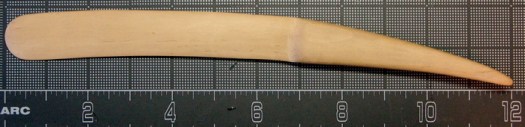
I didn’t want to damage the original, so I made a reasonably accurate reproduction out of Swiss pearwood.  When testing the knife, one feature immediately became apparent due to the gentle curve.  It is possible to use the knife to slit a fold moving towards the left, as illustrated below, or moving it forward with the top edge of the knife. It is not so comfortable for folding, if you are holding the handle, since it is so long and the edges are quite sharp, which also supports my hypothesis that this is a single purpose professional knife, and not a general purpose folder. Whoever used it must have had pre-folded sheets. Given the overall length of 12″, I wondered if it was intended as an in house distribution for the various press rooms that were part of the Kellogg empire.  I am unclear why the end of the handle is so pointed– it seems potentially dangerous– did it have some special purpose, or was it supposed to resemble the end of an horn?  In the original, the handle is chipped at the very tip, possibly it was used to open packages?

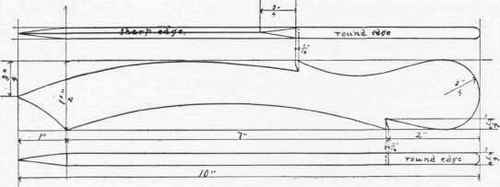
Paper knives must have been fairly popular, an introductory text for woodworking has making one as a project, although it looks rather crude and slightly dangerous, with the sharp angles.
10-paper-knife-119

              Schwartz, Everett. Sloyd Educational Trainning Manual . N.P.:Educational Publishing Company, 1893.

The rounded handle on this model seemed more comfortable than the one I made, but there are similarities in the shape of the curve and overall length and width.  If I am recalling my mechanical drawing class from High School correctly, it seems the sharp edge of the knife is only on the top of the drawing, which suggests it would be used by pushing forward. The text, in six succinct sentences, describes the fabrication of this knife.  I’m always impressed by the level of common sense that is presumed in 19th C. and earlier manuals, and by the familiarity with the full range of woodworking tools, from  axe to scraper. Contrast this with a current Utube video tutorial which demonstrates how to apply beeswax to linen thread!

“Have the pupil cut from a 1-2” board a piece 2″ x 11″. With the use of axe, plane, tenon-saw and knife prepare an oblong 9-32″ x 1 9-16″ x 9 1-8″. Place drawing upon one of the sides and with the use of tenon and turning-saws cut to within 1-16″ of the line. Cut with the knife and file up to lines. Round and sharpen edges according to drawing. Finish with file, scraper and sand-paper.” (Schwartz, Project 10)

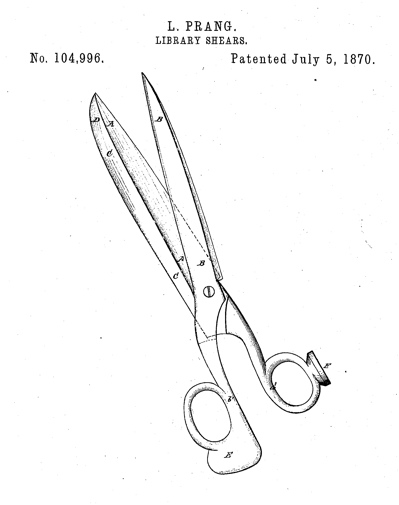
The coolest paper knife I have found is this patented combo paper knife (C), shears, eraser (D), paper folder (E) and seal (F).  This is supposed to combine all the tools a librarian or clerk normally uses into one, convenient package.  Today, we would likely call the “eraser” a scraper.  I can’t see how the paper folder could be used without grasping the sharp edge of “C”, though the patent says all the functions can be used without interfering with the each other.
scissors


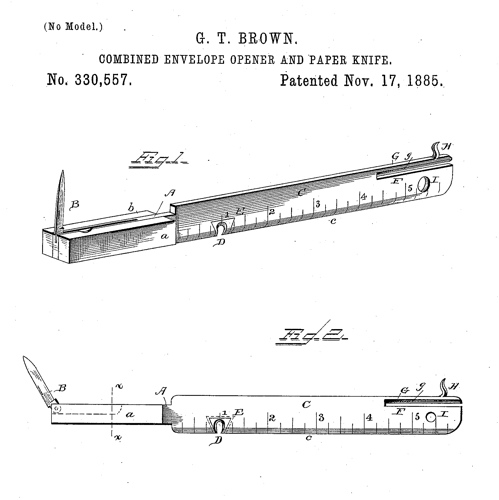
A close second is the combined paper knife (c), ink-eraser (a), rubber or pencil eraser (b), twine cutter (D), ruler (C), envelope opener (G), pen-knife (B), newspaper-wrapper opener (H) and hang hole (I). The patent notes the handle (C) can be made of ivory, bone, metal, wood or any other suitable material.
opener


Any images of other paper knives, or information on how they were used, or images of them in use would be greatly appreciated.

The Craftsman: A Book Review


“Craftsmanship… the desire to do a job well for its own sake.”  

-Richard Sennett


Beginning with this disarmingly simple premise, Richard Sennett proceeds to explore the largely undeveloped, complex world of craft.  This is the first of three  planned volumes, the next dealing with the crafting of rituals that manage aggression and zeal, to be followed by an examination of the skills used in designing and developing sustainable environments. He intends technique to be the theme that unifies these volumes.  Although there have been numerous attempts over the years to examine craft, often from  the viewpoint of anthropology, sociology, personal experience, labor history, technology or phenomenology (see note A), craft  is somewhat resistant to scholarly explication.  Sennett, with one foot in praxis as a trained musician and the other in theory as a professor of sociology at New York University, seems well poised for the task.

This book is divided into three sections–Craftsmen, Craft and Craftsmanship. In the course of 296 engagingly and coherently written pages, the book references a myriad of philosophers and writers. (see note B) Perhaps it is the holistic nature of craft that demands a multidisciplinary approach?  Or is it over-reliance on research assistants?   The first section compares craftsmen and artisans, examines the workshop as the locus of learning and communication, then reviews how craftsmen have dealt with industrialization.  The second looks at craft as a learned and transmitted skill, with emphasis on the hand, hand skills and tools.  The third places craftmanship in the Pragmatic philosophic tradition (the authors orientation as well) and considers the three basic aspects of ability..”to localize, to question and to open up” (277).

This book was written for a general audience, and it is the best single volume that I know of that begins to explain and define what craft is. It investigates the types of knowledge and working methods that craftsmen engage in and presents craft as “a dialogue between concrete practices and thinking; this dialogue evolves into sustaining habits, and these habits establish a rhythm between problem solving and problem finding.” (9)  It encourages non-craftsmen (eg. architect, lab technician, doctor) to adopt some craft methodologies to their fields.  And for the student of craft, there are more than enough nuggets of insightful observations and lucid overviews to commend this book.

Two sections were of particular interest, and could each become complete books.  The first, “The Enlightened Craftsman: Diderot’s Encyclopedia,” reviews some of the philosophy behind presenting manual and mental labor on equal footing then explores the difficulty craftsmen often have in talking about their work. “Among a thousand one will be lucky to find a dozen who are capable of explaining the tools or machinery they use” Diderot writes. (94)  Sennett then examines some of the difficulties in linguistically explaining craft procedures, “…it taxes the powers of the most professional writer to describe precisely how to tie a slipknot.” (95) then points to the limits of language as the cause of this, rather than blame the inarticulate craftsman, as is often the case.  This is the reason for the large number of plates in the Encyclopedia. “The images, in other words, illuminate by clarifying and simplifying movement into a series of clear pictures of the sort the photographer Henri Cartier-Bresson called ‘decisive moments.'” (95)

Chapter six, titled “Expressive Instructions”  is very provocative. By comparing four styles of written recipes on how to bone a chicken (Richard Olney’s precise how-to, Julia Child’s comforting guide approach combined with close-ups, Elizabeth David’s narrative approach and Madame Benshaw’s instruction through metaphors) Sennett queries how language can be used to transmit hand skills and craft information.   Interpreting and comparing how instructional manuals function is an useful and highly informative approach in determining how craft knowledge is preserved, transmitted and learned.

The book ends by discussing the subject of pride in one’s work, which Sennett feels is the reward  for the skill and commitment necessary to gain craft knowledge, and happens when the work transcends the maker. Whatever flaws this book possesses may well be inherent limitations of language, and thankfully this book avoids a common pitfall in writing on craft– the wheel spinning reiteration about “being in the moment” while crafting. The major problem with this book is it’s lack of distinction between craft and technology, which may be crucial to an accurate conceptualization of craft.  And should the subsequent volumes be realized, this might prove a fatal error, since they are currently  organized around the theme of technique.  However, this book  is a major step forward towards developing a coherent philosophy of craft, and how Homo faber interacts with his hands, tools, objects and the world.  I look forward to volumes two and three in this series.


Sennett, Richard.  The Craftsman. New Haven & London: Yale University Press, 2008.  Pb.  $18.00

NOTES:

A.  Kenneth Oakley, Man the Tool-Maker;    David Kingery, Learning from Things;    Edward Luci-Smith, The Story of Craft;    Soetsu Yanage, The Unknown Craftsman;    Martin Heidegger, The Question Concerning Technology and Other Essays;    David Pye, The Nature and Art of Workmanship;    Don Idhe, Technology and the Lifeworld, from Garden to Earth;    Carla Needleman, The Work of Craft;    Bruce Laurie, Artisans into Workers;    Annie Wilcox, A Degree of Mastery;    John Staudenmaier, Technology’s Storytellers;    Frank R. Wilson, The Hand; How Its Use Shapes Brain, Language, and Human Culture;   Carl Bridenbaugh, The Colonial Craftsman;    Reinhard Bendis, Work and Authority in Industry;    Steven Mithen, The Prehistory of the Mind;    Edward Mattil, Meaning in Crafts;    W. J. Rorabaugh, The Craft Apprentice;    James Krenov, A Cabinetmaker’s Notebook;    Mary Helms, Craft and the Kingly Ideal;    Thorstein Veblen, The Instinct of Workmanship, ...

B.  Aristotle, Arendt, Heidegger, Marx, Cellini, Diderot, Kant, Hegel, Ruskin, Plato, Darwin, Merleau-Ponty, Burke, Mumford, Dewey, Bacon, Weber, Wittgenstein, Greetz, Csikszentmihalyi, Simmel, Homer and many, many more.