An Appreciation


The Union Square Greenmarket, NYC,  was strangely quiet on Saturday, especially in the Northwest corner.  A familiar voice was missing, along with tubs of peeled vegetables. Joe Ades, salesman of the Star Swiss vegetable peeler died on Sunday, Feb. 1 at the age of 75.  A unique, eccentric and charismatic human is gone.

At least once a week, I would often pause and watch him, usually in the company of a crowd.   He was an anachronism, a 19th C. peddler existing in the 21st C.   He never had a license to sell goods on the street, and only once did I see the police ask him to move along.  Perhaps they saw in him what I saw;  a professional barker, a fantastic salesman, a gifted street performer and a craftsman with exemplarily hand skills.

In less time than it took to explain the virtues of his peeler–he was the sole importer from Switzerland,  it could make potato chips, it could function as a mandoline, it made three sided french fries that absorbed less oil than four sided ones, it had blades made of surgical steel–he could cross section an entire carrot, holding both the carrott and peeler freehanded.  Try it sometime, it’s not easy.

The New York Times published an obituary on Feb. 2.  Strange that it was published in the N.Y./ Region section, and not with the other obituaries.  Quite possibly Joe was very rich and lived in a fancy apartment.  The article reports he stored his peelers in the maid’s room, frequented pricey Upper East-side restaurants and wore expensive suits. However, he loved hawking on the street, and I would see him out on the coldest days.  I had always thought he was homeless, or close to it. An enigmatic man he was.

One of the functions of a green market is to reintroduce the relationship between producer-food-consumer.

Joe Ades reintroduced the relationship between vendor-tool-user.  

Joe’s patter lives on in my head each time I use his peeler. 


joes-peeler

Cobbler’s Bones


bones

    Hirth & Krause, Dealers in…Leather and Findings. Shoe Store Supplies, etc. Grand Rapids, MI: 1890.( p. 46) 

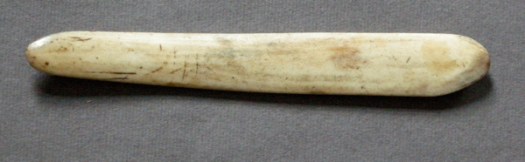
Kevin Driedger , who writes the interesting Library Preservation blog, posted a useful comment a couple of months ago, wondering if I was making an erroneous assumption about how a Turkish bone was used.  I guessed it was used for marking.  Lately while reading a old supply catalogue for the shoemakers I realized it that shoemakers have two distinct types of bones, termed scratch bones and slick bones.  Now I’m convinced that the Turkish cobbler’s bone I wrote about is a scratch bone.  Turkish shoemakers now make European style shoes, not Ottoman.

Judging from the catalog descriptions, it seems the scratch bones (similar to a scratch awl?) were used for marking, and slick bone was used for burnishing or smoothing.  I wonder if the right angles on the left end were also used to scratch a line?  This shape, seems to have served as the template for the most common shape that bookbinders use, with one flat and one rounded or pointed end.

Below is a slick bone that I purchased with some other shoemakers tools.  It is thicker than most of the cow bone folders that are commercially available to now, and has a pleasing natural shape.  The facets of the somewhat crude shape are highly burnished, suggesting it was used with a far amount of force or speed, the accumulation of glue residue and deep scratches give it a gorgeous patina from use.

cobblers-bone

Going Cryogenic


a2logo


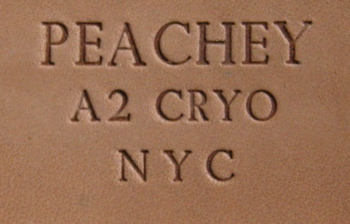
Above is an example of blind stamping, using just water and the heat of the type to create the impression on a piece of vegetable tanned horsebutt leather.  The font is Edinburgh, brass type from P & S Engraving in the UK, the top line 14 point, the bottom two 10.  I’ve had these letters for 20 years, and the wear, especially on the “Y” in “PEACHEY” is evident- time to get some replacement letters!  This is the stamp on the blade cover for the new, A2 knives which has been cryogenically treated.  For more technical information about cryrogenic treatments check out nitrofreeze. Please read more about the new knives in  the new tools page on the right, and the results of testing in the post below which convinced me to use this new steel for leather paring knives.