If You Desire Perfect Fitting Covers; or, the Joint Groove

The International Bookbinder, Vol. 2, No. 4 April 1901.  p. 14

This is an odd looking machine. The stand it is on resembles a typewriter or sewing machine table, which suggests to me it was used while the operator was seated. The foot clamp must open or close the jaws, which were also heated, if it is a gas line coming in from the back. The heat and pressure would soften the animal glue to define the cloth case on the bookblock. I’m not sure if 32 machines in use is impressive, or just a good start, or if any still exist. The cabinets under the table might contain different thickness of jaws for defining the joint groove.

The joint groove is the term Nicholas Pickwoad uses in his Language of Bindings dictionary of bookbinding terminology, and one that I especially like.  It is succinctly descriptive, yet comprehensible to users of older terminology (the French joint, the American groove) without attributing it to a specific nationality or time. It would sound odd to refer to a 17th century Dutch stiffboard parchment binding as having an “American groove”, for example. Reportedly a book based on the Language of Bindings website is forthcoming from Oak Knoll Press.

I recall from a college linguistics class that prescriptive language changes have a poor track record, since language tends to change transactionally and dictionaries usually record usage. Possibly it is different for a very small group of book people using specialized terminology. Will fuzzy language searches and the ease of sharing images negate some of the need for a very strict terminology?  Time will tell.

Images from Zaehnsdorf’s “A Short History of Bookbinding”

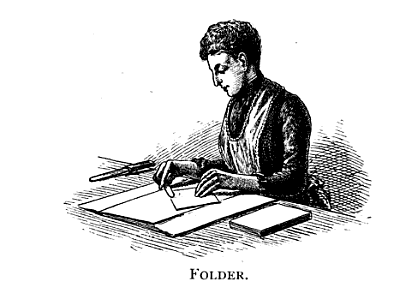
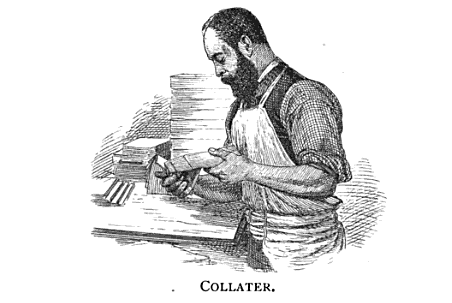
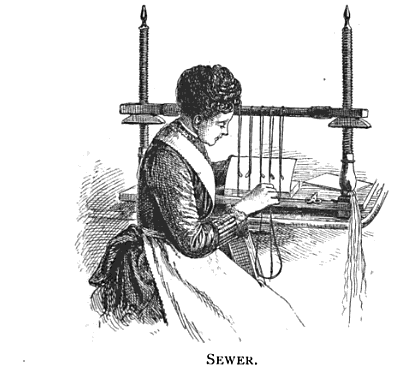
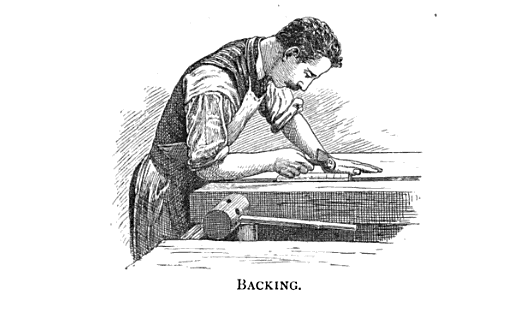
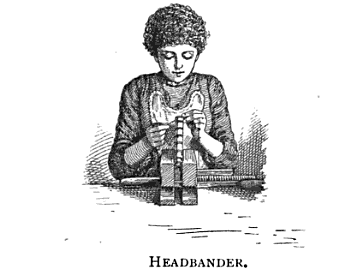
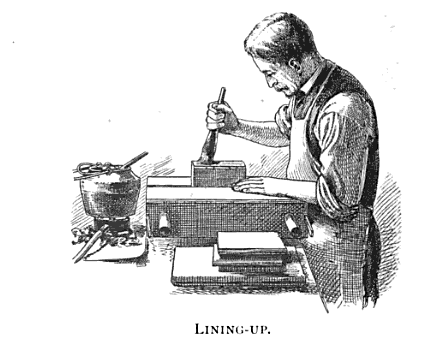
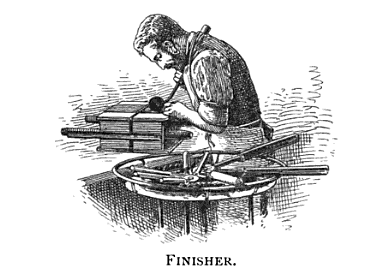
Zaehnsdorf’s A Short History of Bookbinding, originally produced as promotional material, contains some nice images of his premises and details of several steps in binding. Even in these low-res google scans, interesting details can be observed: the headbander using an upside-down plough, the massive finishing press with wood top (replaceable, to protect the press from glue?) used for spine lining and finishing, the sewer working inside the frame, etc….

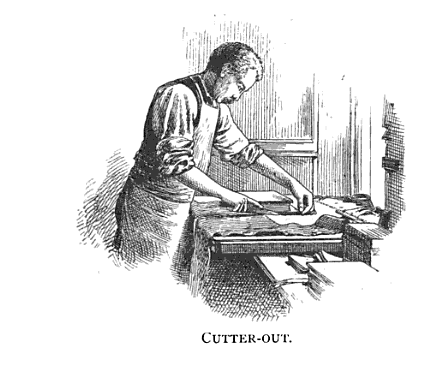
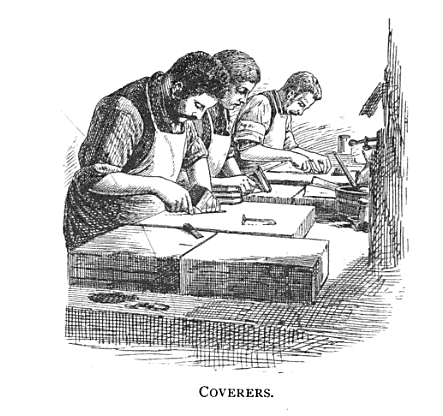
Notably, some of the steps are described as a generic action — “backing” — while some have the specific names for positions — “collater, cutter-out and coverer”. Small clues like this can help to understand the divisions of labor in Zaehnsdorf’s large nineteenth century bindery.


The folder also has a slitting knife to her right.
Interesting a man is doing this, usually I see women doing it. Maybe his great beard got him the job!
Look how long the lay cords are, both to save money on the sewing supports and an indication that only one book at a time was sewn.
Press pin still stuck in the press, indication of the speed of work? It also looks like it either does not go through a hole, or new holes had to be drilled? Usually the holes are drilled completely through at 90 degrees to each other.
Upside down plough. Likely worn out, since the brass holder on many English ploughs would get in the way even if the blade was removed. The women seem to be wearing different aprons, while the mens all look the same.
The rectangular guide rails are on the end of the cheeks of this finishing press, much like Tim Moore does for his modern lying presses. Love the massive cheeks. I want this press! And we know he is using hot animal protein glue, note the pot with a gas line hooked up.
I wonder if he is cutting on a tin, or cutting board. The knife has a handle. In shoemaking, the cutter-out (called the “clicker”) is one of the most skilled and highly paid positions, since they have to decide how to make best use of flaws in the skin. He does have primo bench position, right in front of a window.
I would guess they are covering on litho stones. The man in the foreground is using a sharply angled bone folder to turn in the leather in the cap area, and I suspect supporting the opposite end of the book with his stomach. Are there band nippers also on the stone?
A better view of the same press used earlier. It looks like three sides are covered with extra pieces of wood. I really, really need this press.


***

I also noticed that Zaehnsdorf’s The Art of Bookbinding is available as a 6 hour audio book.  It would be an interesting experiment to listen to his instruction, while following along. I doubt I will do this, but if you do, let me know how it works!

Historic Book Structures for Conservators, 2017

Historic Book Structures for Conservators
The Winterthur Museum, Garden and Library. June 1-30, 2017.

For the third time, I will be teaching Historic Book Structures for Conservators. For the second time, it will be held on the grounds of the Winterthur. The Winterthur is a museum, garden and library consisting of 1,000 acres of rolling meadows, gardens and woodlands. It is also home to the Winterthur-University of Delaware Program in Art Conservation (WUDPAC). The Winterthur is a perfect setting for this class: excellent workshop facilities, a first-class conservation literature library, supportive colleagues, and an atmosphere conducive to sustained and productive learning.

This month long course is designed for conservators to refine bookbinding bench skills in order to understand the craft techniques used to make historic book structures. We will focus on books bound in-boards from the 16th through 19th centuries. The binding of historic models are the basis of the course, although an independent research project will also be required, as well as other assignments. There will be 24/7 studio and library access. There will be field trips; in 2015 this included the Mercer Museum and some tool related flea market exploration. Expect to work at least six days a week. This course is open to anyone passionate about book conservation and intending to make it a career, though I’m hoping there will be a mix of experience levels, from pre-program to mid-career. If a disproportionate amount of your time is spent on administrative duties, this might be an excellent chance to tone your bookbinding muscles.

To apply, please send me the four application requirements listed below. Please submit all of these together in an email attachment, via dropbox, or through a link to your site.

1) A one page personal statement on your interest in book history/ book conservation and how this class will help you in your career.
2) Your resume or cv.
3) A portfolio of bookbinding, book conservation treatments, or other craft activities that exhibit hand skills and attention to detail. You should submit images of two or three books: no more than one or two overall shots and one or two details. Please include no more than a one paragraph description of the book or treatment. Information can include when you did it, how it was made, before and after condition, a treatment summary, materials, techniques, or other information.
4) A letter of recommendation from a professional in the conservation or preservation field, or a teacher who is familiar with your work.

Only complete applications will be considered. After reviewing the above material, finalists will be interviewed by telephone or skype.

The deadline for application is February 15, 2017.

Finalists will be notified March 1, 2017.

Decisions regarding acceptance will be made by March 15, 2017.

The class will be held June 1-30, 2017. You can arrive May 31, and the class will officially begin June 1. The last day of class is June 30, and you will need to vacate the housing on July 1.

Accepted students will receive a full scholarship for tuition costs and be able to live on the grounds of the Winterthur for $550. It is a very beautiful place! Housing includes private bedrooms, wifi, shared kitchen and shared bathrooms. Students will need to pay for their own travel, food, bring a computer, and supply their own basic bookbinding hand tools. Historic equipment and specialized tools — including a paring knife, spokeshave blade — will be provided. There is a materials fee of $425.

This class is a unique and intensive opportunity to geek-out, discuss, explore, and immerse yourself historic bookbinding structures and conservation for an uninterrupted month. If it is anything like previous classes, it will prove to be energizing, exhausting, and unforgettable.

Blog post about the class of 2015.

For questions about applying or the content of the class please contact me.

For other questions please contact Melissa Tedone: mtedone <at> winterthur <dot> org.