Samson Paper Press

The Robert C. Williams Museum of Papermaking in Atlanta has one of the largest — and oldest — papermaking presses I’ve ever seen. Look at the size of the top beam, which is about two feet square!

The entire museum is fantastic. It started at the Massachusetts Institute of Technology in 1939, consisting primarily of Dard Hunter’s papermaking books and artifacts. Then it moved to the Institute of Paper Chemistry in 1954, was added to over the years, and finally landed at Georgia Tech in 2003.

The “Samson Paper Press”, constructed in 1790, was used by Hodgkinson and Co. in Wookey Hole England until the early twentieth century, according to the label. I’m not sure if the name refers to this press in particular, or is a generic term for any massive press.

It has an iron thread which generates much more power than a wooden one, due to the reduction of friction. I’m starting to think that all images of early nineteenth century presses with a ball above the platen also have iron thread.  Samson has a ratchet wheel and pawl mechanism to prevent the platen from backing off when fully tightened.

The tommy bar, or press pin, is lying on the black plinth in front of the press and is about six feet long! Not visible is the iron renforcement on the end of the bar which fits into the four holed iron ball. I imagine Samson securely attached to the ceiling or wall, and three or four men working together to fully tighten it. The daylight is roughly 3.5 feet, which would be about the height of a typical post (a stack of the newly formed sheets and felts). Possibly a century of use might account for the deterioration on the lower wooden platen, or it may have been sunk into the earth under the floor. The uprights are iron faced on the two short sides. A few decades later, by the 1830’s, most presses were made completely or iron or steel, making Samson an interesting transitional press, incorporating both wood and iron.

Around the same time, the French papermaking press depicted in Diderot’s Encyclopédie appears to have wooden threads, but a similar iron ratchet mechanism to prevent it from backing off. I have a hard time believing a small wood pawl could withstand the compression.

Encyclopédie, ou dictionnaire raisonné des sciences, des arts et des métiers, etc., eds. Denis Diderot and Jean le Rond d’Alembert. University of Chicago: ARTFL Encyclopédie Project (Autumn 2017 Edition), Robert Morrissey and Glenn Roe (eds), http://encyclopedie.uchicago.edu/.


If You Desire Perfect Fitting Covers; or, the Joint Groove

The International Bookbinder, Vol. 2, No. 4 April 1901.  p. 14

This is an odd looking machine. The stand it is on resembles a typewriter or sewing machine table, which suggests to me it was used while the operator was seated. The foot clamp must open or close the jaws, which were also heated, if it is a gas line coming in from the back. The heat and pressure would soften the animal glue to define the cloth case on the bookblock. I’m not sure if 32 machines in use is impressive, or just a good start, or if any still exist. The cabinets under the table might contain different thickness of jaws for defining the joint groove.

The joint groove is the term Nicholas Pickwoad uses in his Language of Bindings dictionary of bookbinding terminology, and one that I especially like.  It is succinctly descriptive, yet comprehensible to users of older terminology (the French joint, the American groove) without attributing it to a specific nationality or time. It would sound odd to refer to a 17th century Dutch stiffboard parchment binding as having an “American groove”, for example. Reportedly a book based on the Language of Bindings website is forthcoming from Oak Knoll Press.

I recall from a college linguistics class that prescriptive language changes have a poor track record, since language tends to change transactionally and dictionaries usually record usage. Possibly it is different for a very small group of book people using specialized terminology. Will fuzzy language searches and the ease of sharing images negate some of the need for a very strict terminology?  Time will tell.

Images from Zaehnsdorf’s “A Short History of Bookbinding”

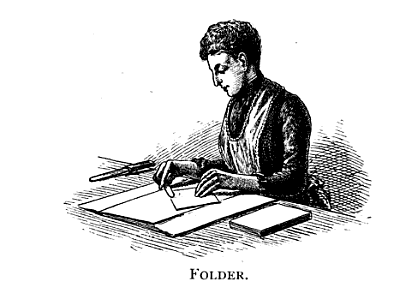
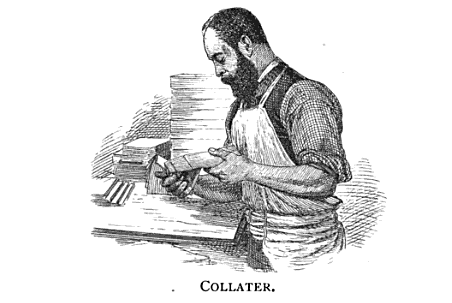
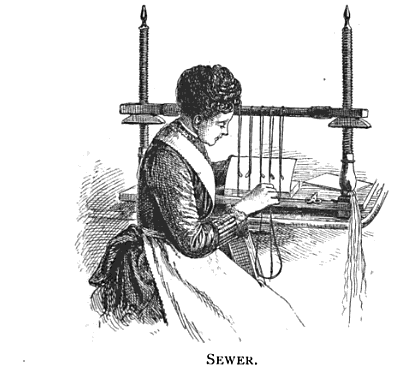
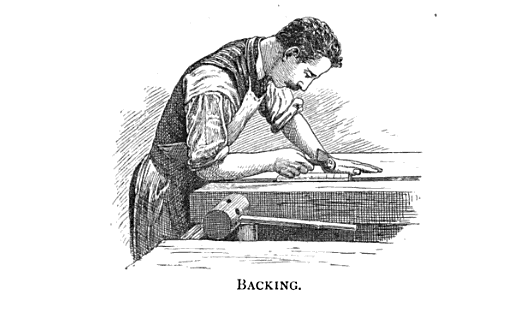
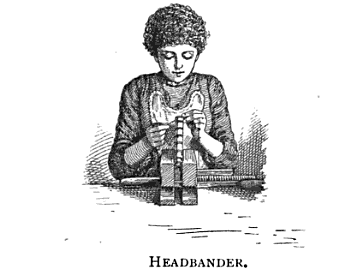
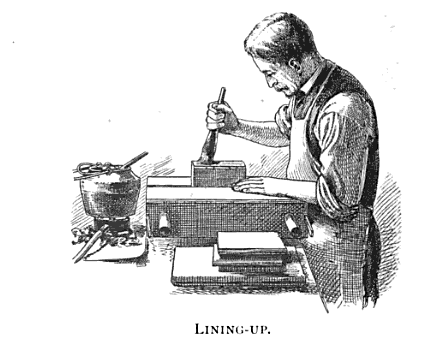
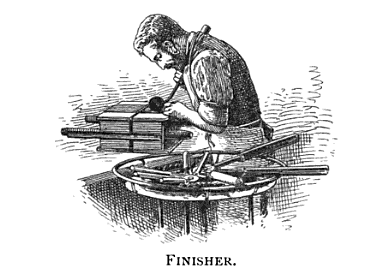
Zaehnsdorf’s A Short History of Bookbinding, originally produced as promotional material, contains some nice images of his premises and details of several steps in binding. Even in these low-res google scans, interesting details can be observed: the headbander using an upside-down plough, the massive finishing press with wood top (replaceable, to protect the press from glue?) used for spine lining and finishing, the sewer working inside the frame, etc….

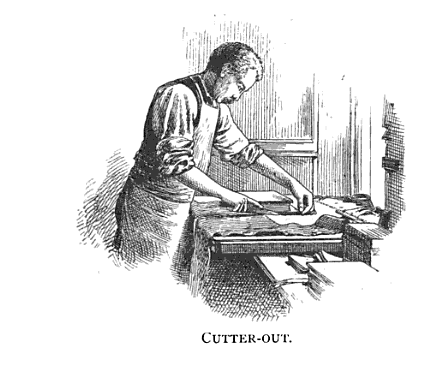
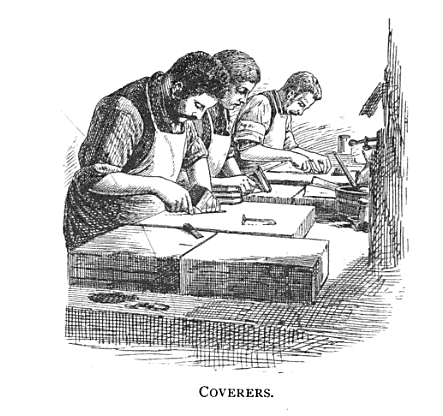
Notably, some of the steps are described as a generic action — “backing” — while some have the specific names for positions — “collater, cutter-out and coverer”. Small clues like this can help to understand the divisions of labor in Zaehnsdorf’s large nineteenth century bindery.


The folder also has a slitting knife to her right.
Interesting a man is doing this, usually I see women doing it. Maybe his great beard got him the job!
Look how long the lay cords are, both to save money on the sewing supports and an indication that only one book at a time was sewn.
Press pin still stuck in the press, indication of the speed of work? It also looks like it either does not go through a hole, or new holes had to be drilled? Usually the holes are drilled completely through at 90 degrees to each other.
Upside down plough. Likely worn out, since the brass holder on many English ploughs would get in the way even if the blade was removed. The women seem to be wearing different aprons, while the mens all look the same.
The rectangular guide rails are on the end of the cheeks of this finishing press, much like Tim Moore does for his modern lying presses. Love the massive cheeks. I want this press! And we know he is using hot animal protein glue, note the pot with a gas line hooked up.
I wonder if he is cutting on a tin, or cutting board. The knife has a handle. In shoemaking, the cutter-out (called the “clicker”) is one of the most skilled and highly paid positions, since they have to decide how to make best use of flaws in the skin. He does have primo bench position, right in front of a window.
I would guess they are covering on litho stones. The man in the foreground is using a sharply angled bone folder to turn in the leather in the cap area, and I suspect supporting the opposite end of the book with his stomach. Are there band nippers also on the stone?
A better view of the same press used earlier. It looks like three sides are covered with extra pieces of wood. I really, really need this press.


***

I also noticed that Zaehnsdorf’s The Art of Bookbinding is available as a 6 hour audio book.  It would be an interesting experiment to listen to his instruction, while following along. I doubt I will do this, but if you do, let me know how it works!