I’ve made three significant improvements to the aluminum plate sharpening system. First, the plates themselves are now a half of an inch thick, rather than a quarter. This aids in their stability if used without the holder. Secondly, the plates are now machined with a flycutter, which results in a flat surface and regular pattern. Thirdly, the plate holder has been redesigned. Now, a knurled adjustment knob allows quick and easy flipping and switching of the plates without tools. It now only takes 3 seconds, even if you work slow. The stand is all aluminum with stainless steel screws so there is nothing to rust.
These plates are used the same as any sharpening stones. The plate holder has four rubber feet to keep it from sliding around. I generally use water as a lubricant to keep the metal particles from glazing over.
This is the system I use to make and sharpen all of my knives. People often ask how long each abrasive sheet lasts, and although there are many variables, I’d guess I can generally sharpen about 10 knives on each one. Of course, if you are trying to reshape a bevel angle or repair a major chip you might use up an entire sheet. When a sheet is exhausted, simply peel it off and stick a new one one. You must trim the edges of the edges of the finishing film when you put a new sheet on, so that it does not overhang the edges. Otherwise it may give you one of the nastiest, dirtiest, slow-healing cuts you have ever had, DAMHIKT. 80 micron replacement sheets are available from Rio Grande; the 40, 15 and 5 micron from Tools for Working Wood.
I’m convinced it is the easiest, quickest, and most convenient way to resharpen and keep all your knives and edge tools in peak condition, from scalpels to scimitars. This system is a lightweight, easy to store and unbreakable. Perfect for travel and classroom use.
The system comes with four 11 x 2″ strips each of 80, 40, 15 and 5 micron #3M PSA micro finishing film, a 12 x 2″ Genuine Horsebutt Strop, and 1 oz. bar of green chromium oxide buffing compound. The entire system is 13 x 3 x 2.5″, 3 lbs. 4 oz.
ITEM #SS2: Introductory price $225.00
Tips on sharpening are located here, and tips on stropping here.
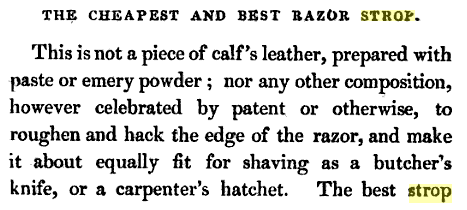
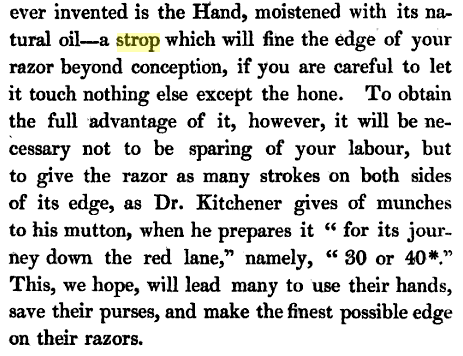
Before you try this, think of the way your strop gets to torn up in use! I have tried hand stropping—very carefully—but didn’t notice much difference in the sharpness of the blade as compared to stropping on an undressed vegetable tanned hair side skin, to be honest. Hand oils may give the steel a bit more resistance to rusting. Needless to say, hand stropping is performed slowly. I still prefer a Horse butt strop, available here.
Hand stropping lives on in various guises, however. Shaving enthusiasts have a thread titled Hand Stropping Really WORKS!. A youtube video demonstrates the stropping of a single edge razor blade. Bill Carter, a plane maker from the UK hand strops a plane blades. To be clear, he is pulling the blade away from his hand.
Stropping is a motion which pulls the cutting edge away from a substrate—leather, paper, wood, etc.—perpendicular to the cutting edge, with or without additional compounds. Stropping not only produces a very sharp final edge after sharpening, but it is an easy way to renew a slightly dull edge without having to go through the entire resharpening process. I tend to strop my knives whenever they feel a bit dull, or I have to apply excess pressure when using it, or when edge paring very thin leather. I find stropping the quickest, easiest way to keep the knives used for leather paring sharp.
.
TECHNIQUE
The above video illustrates the technique I use in stropping, using the materials I will discuss below. I strop all the knives I sell using this method, and use it to keep my own knives in shape. There are two key aspects. First, always draw the blade away from the cutting edge to avoid digging into the leather, which is sometimes called a “trailing stroke”. Second, it is paramount to hold the knife at the exact bevel angle it was made, and keep this angle consistant throughout the stroke. If you raise the angle, even a few degrees, the cutting angle will rapidly become too obtuse and you will have to resharpen or possibly even regrind it. Similarly, the back needs to be kept flat.
I find a strop that is 12-15 inch long and 2 or 3 inches wide ideal. If it is shorter you will have to reposition the knife an inordinate number of times, which slows the process and may introduce more errors. If the strop is too long it is difficult to maintain a consistent angle on the blade throughout the length of the stroke. If the knife is slightly wider than your strop, just angle it a bit so it fits.
I count the number of strokes I do on each side to keep them even, 12-15 times on each side is a reasonable starting place. If the knife is still not sharp, strop some more. If it still is not cutting well, it may need to be resharpened or reground. Although you are *just* rubbing a knife on a piece of leather, don’t be fooled that you are not doing anything: all the black marks are metal that have come off the blade.
Eventually, however, even careful stropping will gradually create an obtuse cutting edge. It may look sharp and have a mirror shine, but it will need to be resharpened using your preferred sharpening system.
MATERIAL FOR THE STROP
I prefer a two stage stropping. First I strop on the flesh side of horsebutt, which is dressed with a .5 micron green honing compound. Horsebutt strops available here. Then I do a secondary, final, stropping on undressed flesh side of calf. This is why I flip the strop over in the video. I find it gives an excellent final “bite” when paring leather, though some people prefer just the hair side of the horse butt, others skip this step completly. Other substrates for strops are wood, MDF, binders board, cowhide, mat board, etc. Anything firm and flat can work, although a material that compresses too much will round over the cutting edge more quickly. I prefer horsebutt over cowhide because the surface lasts longer, it is firmer, and it is a traditional material for high quality strops.
I generally use the strop on a hard flat surface but some people mount them to wood or other flat material. Since I use mine two sided I find it easer to just flip it over. The speed that you strop at does not seem to make much of a difference, as long as a consistent angle is maintained. There are also a variety of leather belts and discs to attach to power machinery, but I find it is too easy to round an edge using these, and it is not really much of a time savings since stropping does not take much time by hand.
COMPOUNDS FOR THE STROP
My preferred stropping compound is a .5 micron green chromium oxide buffing compound. I now sell a convenient 1 oz. bars of them, and my sharpening system also now comes with them. I like the edge this compound gives to the knife, and it does remove metal fairly quickly. Chromoglanz is another popular option among bookbinders, though I don’t know how precisely the abrasive is sized, and I personally don’t like the way it feels when you are stropping—it is very slippery. It seems to be better at polishing than establishing a cutting edge. There are other types of powders and honing compounds available as well, jewelry suppliers often have a wide variety. Quarter and half micron diamond paste is an expensive, but addictively fast cutting strop dressing and a real joy to use.
Careful stropping can keep an edge tool cutting well for a long time.

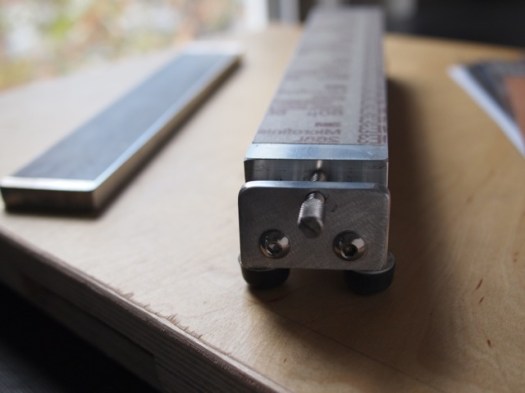
 I’ve made three significant improvements to the aluminum plate sharpening system. First, the plates themselves are now a half of an inch thick, rather than a quarter. This aids in their stability if used without the holder. Secondly, the plates are now machined with a flycutter, which results in a flat surface and regular pattern. Thirdly, the plate holder has been redesigned. Now, a knurled adjustment knob allows quick and easy flipping and switching of the plates without tools. It now only takes 3 seconds, even if you work slow. The stand is all aluminum with stainless steel screws so there is nothing to rust.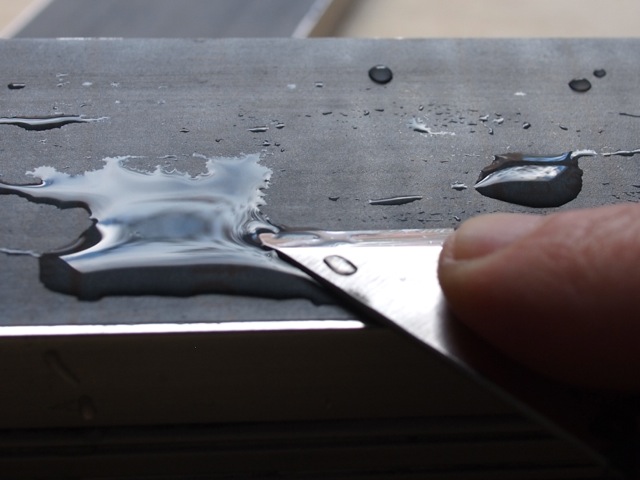


 Peachey Conservation