Using a Cigar Press for Bookbinding

Cigar presses are usually smaller than book presses, and often just half-arch, rather than full-arch.  As such, they cannot generate as much pressure as a real book press. The one I purchased seems to have the compressional force of a typical copy press, which is adequate for the most common bookbinding tasks: firm adhesion of pastedowns, casing-in, and tray attachment when boxmaking. It wouldn’t be too difficult to modify a large C – clamp to make something similar.

Since they are lightweight, this one is about 30 lbs, they are great for teaching and travel.  They usually have much more daylight than copy presses, again, useful when teaching, or for a secondary press. The main disadvantage is they only can be used for small format books.

Since cigar presses were originally used for pressing hand rolled cigars in long wooden molds, they often don’t have a top platen.  I made a 7 x 9.5 inch aluminum one for this machine.  Will I end up in conservation purgatory for drilling two holes in a historic machine?

Unmarked half-arch cigar press. I mounted a 7 x 9.5 inch aluminum platen on it.

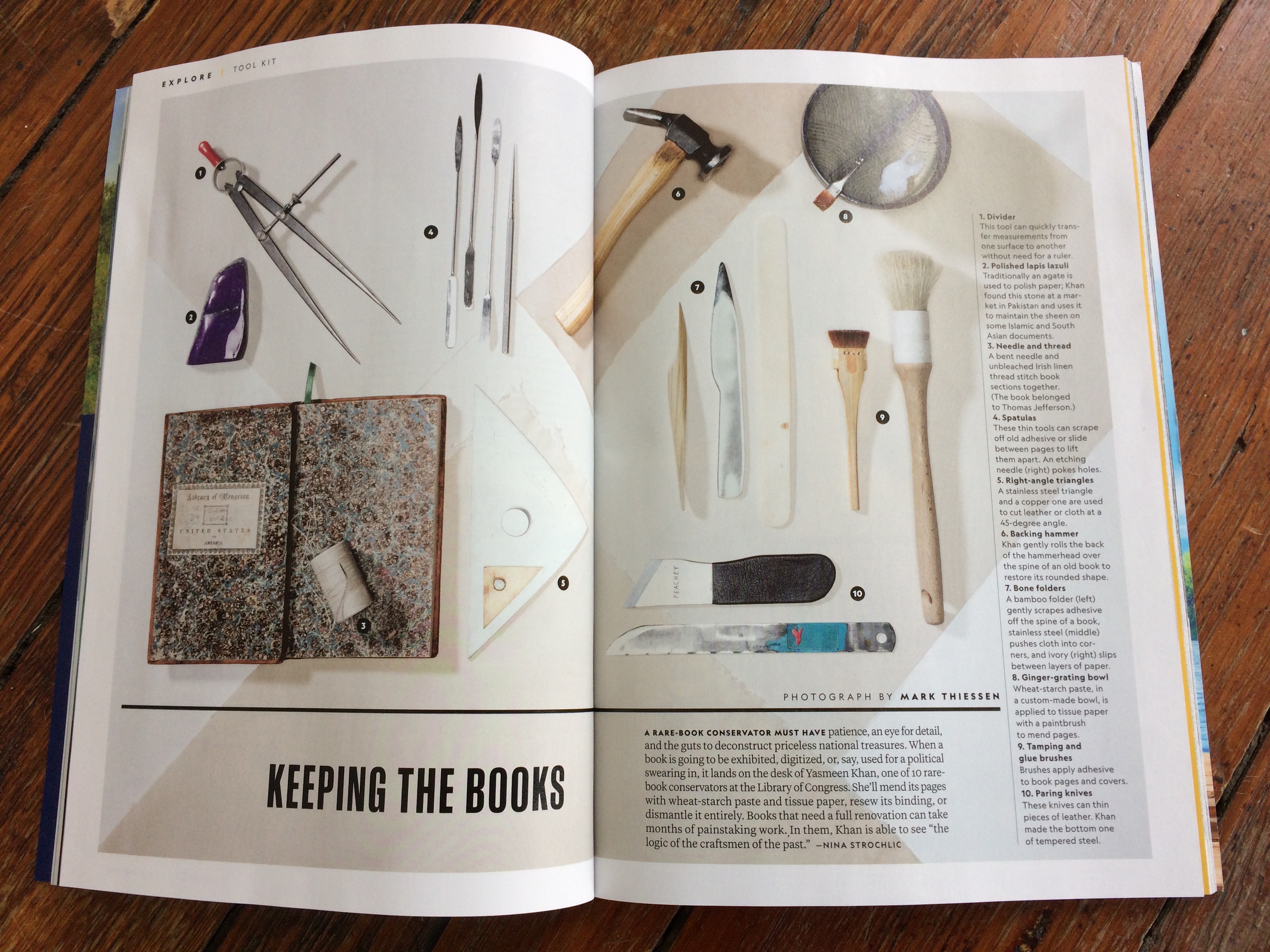
Peachey Tools in May 2018 National Geographic

National Geographic, May 2018. “Explore” section.

The May 2018 National Geographic Magazine “Explore” section has a gorgeous two page spread of Yasmeen Kahn’s book conservation tools. Kahn is a rare book conservator at the Library of Congress. Both my  A2 leather handle paring knife  (#10) and  two inch brass triangle (#5) are included!

Many of her tools are quite interesting. She mentions the unusually shaped bamboo tool (#7) is useful for cleaning spines. Was it originally intended to be some kind of pen? I can easily imagine how the chunk of Lapis Lazuli (#2) would fit into my hand for burnishing. This also explains why the majority of Islamic manuscripts at LC have blue streaks on the repair paper (just kidding!!!). She made a very nice looking paring knife out of a hacksaw blade (#10). I’m really into this hybrid blade shape.

Depicting tools out of their working context by carefully arranging them emphasizes their aesthetic qualities. This begins ca. 1690 in bookbinding with the engravings that ended up in Dudin’s Art du Relieur. Some of my own tool collection hangs on a wall in my studio, again, for the aesthetics. But they are easily removable in case duty calls, mounted with magnets or between finishing nails.

Can you identify these tools? Hint: most are not bookbinding tools, and I won’t argue if someone opines #1 is not technically a tool.

The Origins of Marbling: Glass?

Most of us think of marbling as paint or ink applied to a sized bath, usually manipulated somehow, then transferred onto a sheet of paper. This is essentially the definition put forward by Richard J. Wolfe, in his magnum opus, Marbled Paper: Its History, Techniques, and Patterns. His book is an invaluable resource, tracing the history of European marbling. The extensive plates dating particular patterns alone justify the price.

But what if we think of marbling not primarily as the transfer of colors, but the technique of using a stylus — or a number of them in a row, i.e. a rake — to manipulate strips or blobs of color into patterns? Visually, this is where most of the beauty and magic happens. And Egyptians were doing this as early as the 6th century BCE in glass.

Egyptian Alabastron and Flasks, 6th – 3rd century BCE. Corning Museum of Glass.

Recently I visited the Corning Museum of Glass,  which has some very early glass containers that look marbled. The museum catalog describes the center container as having the, “entire surface decorated with alternating registers of fine trails [thin threads of colored glass] wound ten to twelve times before changing color; all threads have been marvered in and dragged alternately up and down sixteen times to form an elaborate and delicate festooned or feathered pattern….” ( 55.1.61)

Instead of colors applied to a viscous bath, glass trails are wound around a container. Then they are manipulated with a point or stylus. The alternating up and down stylus movement at regular intervals is quite similar to how many styles of marbling are done even today.

Does specialization in the decorative arts cause us to overlook a fundamental cross-disciplinary technique like this one? Or, is this a common decorative technique that it is continually independently rediscovered. If so, are there other examples?