The Antiques Garage Flea Market

If you think everything in Manhattan is overpriced, overhyped, trendy, useless, distracting and a disgusting display of conspicuous consumption, you are partially correct. However, there are three great flea markets in Manhattan that I regularly visit.  The Antiques Garage, West 25th Street Market, and the Hells Kitchen Flea Market are open all year on weekends, 9:00 to 5:00. Last weekends haul—

die

13 pound die. Flea Market price: $10 

First, a 13 pound die that was originally used to stamp medallions or belt buckles for the 1991 Daytona Bike Week.  This is a great heavy weight, a nice compliment to the smaller dies I use for paper repair. All of these are hand carved out of steel and the vendor thought it was something in the “D” series. Drawback: I had to carry it home, a 3 mile walk. Bonus: If my conservation work dries up, I could do a second stamping of these (possibly) collectible belt buckles.
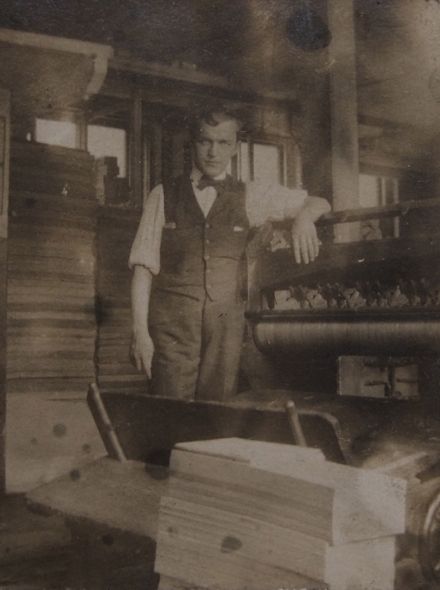
worker

19th century photograph of a worker, but in what trade? Flea market price: $4

I also picked up this photograph.  Some type of conveyer belt and height adjustment?  Is it a stack a papers or thin wood in the foreground? Plywood manufacture?
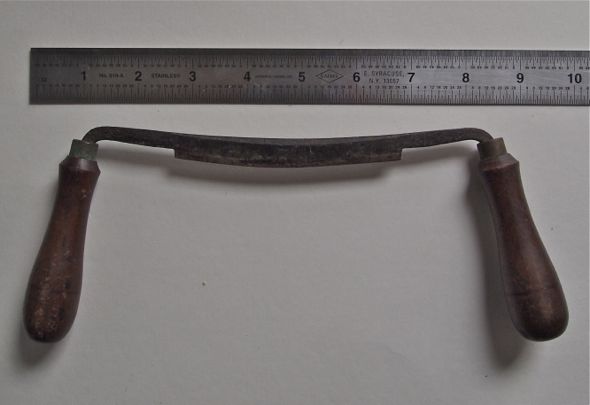
drawknife

A Charles Buck 4″ mini drawknife. Flea market price: $20

This will be perfect for shaping tool handles.  Given its rust, I relunctly plunked down $20 because this knife will take two or three hours of work to get it into useable condition.  However, after a little research at home, I found pristine collector example selling for $130. The Davistown Museum indicates while Charles Buck was part of the Buck Brothers, who still make edge tools today. Charles had a falling out with the other brothers and also made tools under his own name. Reportedly, his were of better quality than the others. Apparently tools marked with his name were made between 1872 and 1915.

Flea markets—another reason to come visit NYC.

Big Bamboo Folders

Finally, the perfectly shaped bamboo folder?!?

Hand tools, in particular, need to be tested and evaluated by using them. A poor design aspect quickly becomes apparent. The simpler the tool, the more critical each aspect is. And tools don’t get much simpler than a smooth bone or wood folder.

Folders are used by bookbinders to fold paper, smooth covering materials, shape leather, and evenly adhere various covering materials. Bone, ivory, teflon, and sometimes wood, are the usual materials for western style folders.  Teflon has an extremely low coefficient of friction, making it ideal when you want to slide the tool over a surface that you don’t want to mark. Bone has a density and feels—for lack of a better term—traditional. I especially recommend the higher quality ones made by Jim Croft from wild elk and deer. Bamboo has been used in the east for many purposes. It has a higher coefficient of friction to it which makes it useful for pulling a covering material. A light touch or protective covering sheet must be used if marking is suspected to be a problem.

Bone folders —like most tools— have become smaller over time (technically known as ‘dinkification’).  Evidence from the eighteenth century France suggests folders, commonly wood at this time, may have been 12 -18 inches long.  The bamboo folders I’ve been experimenting with are a more modest  9-10 inches, though.

I keep tweaking and altering small aspects of these folders with successive iterations. The long straight sides can be used like a case folder, for turning- in. The flat areas at the pointed end are useful for pressing and forming headcaps. The angled tip useful in box making. The rounded end handy when defining joints or adhering board edges. The relatively long length makes them more comfortable to hold. This is the theory, at least. Quite likely there is no ideal shape, but what we prefer and use changes with our working habits. Or we choose tools to break us out of habituated working methods.

Bamboo is quite easy to shape and fun to work with.  I’ve written up some tips on working with it in an earlier post. If you discover the perfect shape, please let me know. I’ve already started on the next one, which will certainly be the absolutely most perfect….

For Sale! Wide Round Knife With a Secondary Bevel

The cutting edge of this knife is slightly wider than the narrow Swiss and French knife that I currently make, but the length of the blade is wedge shaped so the area that is gripped is still comfortably narrow.  Also, it has a secondary bevel, which accounts for the strange looking, extremely acute 8 degree primary bevel.  The advantage of a secondary bevel is that there is much less metal to remove when resharpening or stropping. This is especially the case with a thick and wide knife like this. The primary bevel is fairly roughly ground: only half a millimeter of the secondary bevel, which is the cutting edge, is fully sharpened and polished. In a normal knife of this thickness, the length of the bevel would be about ten times this amount. Although I don’t think the time spent sharpening the bevel corresponds one to one, it does take significantly less time.

The drawback of a secondary bevel is that there is not really enough metal to feel it resting on your sharpening system, so this knife is recommended to those that have some experience in sharpening.  This wide cutting edge is useful for hogging off leather for edge paring and also used in a scraping manner for headcap and spine areas. The slight wedge shape on the leather handled knife, and the rounded thumb holds on the wood version provide excellent control.

A2 cryogenically quenched steel, HRC 62. Length: 6.75 inches (171mm).  Width: 1.875 inches (48mm) at cutting edge, tapering to 1.375 inches (35 mm). Thickness: .094 inches (2.4mm). Weight: about 5 oz (142 g). Primary Bevel: 8 degrees. Secondary  Bevel 13 degrees.

ITEM# WRKL: Leather Handle $125.00

ITEM# WRKW: Wood Handle $225.00