Edith Diehl’s “Bookbinding: Its Background and Technique”, thanks in part to an inexpensive and ubiquitous Dover reprint, is perhaps one of the most common introductory bookbinding manuals. Although frequently maligned for propagating innacuracies, especially the historical section, the practical section is informative and well done. I use her sequence of leather covering steps when teaching– it is a clear, calm list of what needs to be done. Panicking students, covering their first full leather binding, often find it reassuring. Her diagrams in general are concise and present the relevant information in an easy to follow manner.

This hammer came from her studio, via Gerard Charrier, who purchased many of her tools. It is a large London pattern cramping hammer and according to Salaman, Barnsley’s 1890 catalog of cobblers tools lists six sizes of them, this one is a “No. 1”. It is similar to a French hammer and is used to paning the sole edge, heel breast and waists of shoes. He also notes that this style of hammer was already going out of fashion by 1839! The head is quite large, 55mm, so I don’t use it for binding- more often to tenderize pork when making tonkatsu, or in place of a proper beating hammer. Even though I don’t use it for binding, the feeling of using historic tools remains somewhat inexpressible. Touching the smooth worn areas at the end of handle, examining dirt near the head, or polished areas around the cheeks, gives me direct tactile and visual information about how Diehl held it. The makers mark is fragmentary, but it starts “CHAMMO…” with “CAST STEEL” stamped underneath. This hammer must have been the one she copied for the illustration below, unless she had more than one of them. The illustration is from page 143 of the Dover edition.
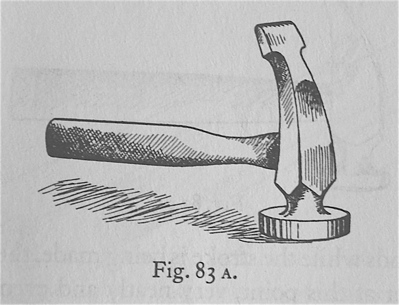
Diehl likes a large and heavy hammer, feeling they are less likely to damage signatures by leaving small indentations in the spine. She also makes the point that when using a heavy hammer, its weight does most of the work, so there is less danger of forcing it and damaging the signatures. She specifically recommends that the hammer should be weighted so that the face balances even if no one is holding the handle, as both the photo and figure clearly show. I find it a bit odd, given the attention to detail in most of her diagrams, that she didn’t depict the eye in this one. There are two photographs of students using a similar London pattern hammer in Palmer’s 1927 manual “A Course on Bookbinding for Vocational Occupation”, found on the frontispiece and on page 38. One is using the face to back a book, the other the peen.
I also have a book from Diehl’s library. Her gold stamped book plate is quite lovely. It only measures 35mm high and 27mm wide and I assume it is St. Jerome.

.


 Peachey Conservation