Labels

hot-wash-stick


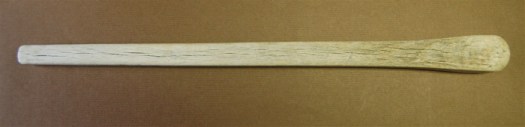
I bought this stick a couple of weeks ago at an antique store.  It is about 12 inches long and the squared end on the right is about 1 inch thick.  I didn’t know what it was, but liked the smooth, worn surface and seemingly intentional shaping.  As I paid my three dollars, the mother of the owner of the store, who was 85, asked me if I knew what it was.  I replied that I didn’t.  “It’s a hot wash stick,” she said.  “I used to use one like this when I was a girl.  When we had really dirty cloths, we would bleach and boil them on a stovetop. We would use a stick like this to lift them out.” Then she demonstrated how she would hold the knob on the right, while poking in the pot with the other end. 

Suddenly this old stick was transformed into a useful tool- desiccated from being repeatedly dipped in hot water, the left side bleached  and the handle darkened from hand oils.  Although simple, the squared handle is quite comfortable to grasp, and could easily be used to stir the pot as well.  Without this verbal labeling, this tool most likely would have spent the rest of its life as an odd shaped stick.It is similar to another tool, called a spurtle, which is a traditional Scottish wood rod used to stir stews. 

Usually, I analyze the material makeup of objects, the technologies used to create them and examine evidence of use to theorize about what an object is.  Here, however, information not directly contained in object gives it context and meaning.

How many other extant objects have lost their labels?

One Year Anniversary

Today is the one year anniversary of this blog. I’ve noticed a number of people celebrate the anniversary of their blog.  Besides birthdays and my wedding anniversary (which both my wife and I often forget!) I can’t think of any other anniversaries I celebrate. Why do I feel like doing one for this blog?  I’ve noticed other bloggers have similar feelings.

I’ve really enjoyed the discipline of writing a post roughly once a week, it has given me a chance to investigate and think about things that are slightly outside the usual scope of conservation discourse.  And it has helped improve, I think, both the speed and quality of my writing, which I hope will become manifest in some other projects.  Tags are a useful tool to organize and build on previous posts–hopefully they will lead to a larger, more coherent whole down the road.  A special thanks to all readers who have submitted comments; there are some valuable, original ideas expressed.

But there are some downsides to blogging.  I really dislike the quantification and statistical nature of the “dashboard”, but it is hard to ignore.  (FYI: This blog has had 19,761 visits, 60 posts, 118 comments and 7,840 rejected spam comments. The most popular post is the tool catalog, with 1,507 visits.)  It can easily become creating popularity for its own sake, as Lee Siegel points out in his book.  Even more distressing is Siegel’s observation that the web 2.0 is in some regards the apotheoses of capitalism– we have become the producers as well as the consumers.  And the plethora of information leads to powerlessness, not empowerment.  Since Communism has collapsed, and Capitalism is on the brink, Marx is becoming more and more appealing.  A great introduction are 13 video lectures by David Harvey,  distinguished professor at the City University of New York, which can be downloaded as video or audio podcasts, or streamed online.  Harvey  has taught Marx’s Capital Volume I for over 40 years– the breadth of his knowledge is amazing and the class is uncannily relevant to our current situation.  


NOTES

Siegel, Lee.  Against the Machine: Being Human in the Age of the Electronic Mob.  New York: Spiegel & Grau, 2008.

Thin Profile Suction Platen

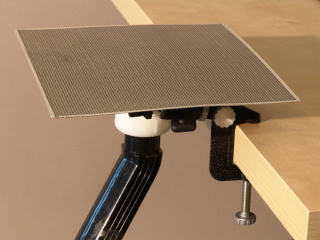
Robert Proctor has invented and manufactures a “Thin Profile Suction Platen” which I haven’t tried, but it looks incredibly useful and is very reasonably priced.  It is less than 1/6″ thick which would make it great for in situ textblock treatments close to the spinePlease contact him with questions.  

He describes the platen:

“About 12 years ago, dissatisfied with the suction platens available at the time, I decided to build one more to better fit my own needs. Encouraged by others who liked my design, I put together 20 platens, the majority of which I sold out of the trunk of my car at the 1997 AIC meeting in San Diego.Instructions for building this platen were published in the Sept 1997 WAAC Newsletter. This generated many phone calls from people asking “won’t you just make one for me?”  Since I considered my time better spent restoring paintings rather than building and selling suction platens, I offered these plans to a manufacturer of conservation equipment, free of charge. While they do produce a platen and continue to market it using my name, much to my  dissatisfaction, it differs considerably from my design. In the interim I made another run of 20 with an improved mounting device.

Unique to my platen is an easy to use light weight design with a combination of: an ultra thin profile; an interior baffle made of solvent resistant materials that maintains even suction across the entire surface of the plenum; construction that allows for the platen to be easily opened for periodic cleaning; and new to the design is a fully articulated a mini ball head mount that enables the platen to be attached to a tri-pod, camera boom or to the included clamp allowing the platen to be easily attached to an easel or table edge.  The platen sells for $425.00 including shipping and handling”   

Contact:
Robert Proctor
Whitten & Proctor Fine Art Conservation
1236 Studewood Street
Houston, TX 77008
Phone/Fax: 713-426-0191
www.whittenandproctor.com


dsca9064
dsca9063
dsca9065