Board Shear Blade: Up or Down

Perhaps on of the most ingrained and contentious habits of bookbinders and conservators is if the leave the blade of the board shear up or down.  Once you are in the habit of leaving it one way of the other, it is virtually impossible to change.  So if you use a board shear please take a second to fill out the poll below and the results will be immediately calculated.  I realize this is perhaps not the most important topic I could be thinking about, but the new poll option was introduced this week on wordpress, so I guess this is a good example of how technology drives and influences content.

THE ARGUMENT FOR LEAVING THE BLADE UP

I confess I fall into this camp.  I find it much faster, when approaching the board shear to be able to immediately able place the material to be cut under the fence, and slide it into place without having to lift the blade first.  Also, when the blade is up, it sticks out less, so there is less of a chance of running into the handle or counterweight, which is a more common injury than cutting yourself on the blade.

THE ARGUMENT FOR LEAVING THE BLADE DOWN

It is dangerous to leave the blade up for two reasons. First, although the blade has a fairly obtuse angle, it is still possible to cut yourself on it, and it just looks dangerous, this long blade sticking up in the air. Second it is more likely that the counterweight could slide off the end (especially if you haven’t drilled through the bar and inserted a bolt) and the weight of the blade would come crashing down on whatever happens to be under it.
Turkish Bone Folder

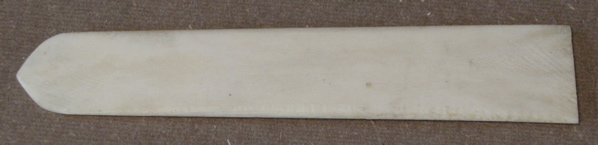
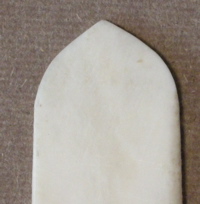
It’s hard to imagine a simpler and more utilitarian tool than a bone folder, but shape of the folder below is unmistakably Islamic or Turkish looking.  I’ve never seen a tip like this on a European or American bone. It amazes me that such a simple shape can embody the complexities of national identity.  It closely resembles a minaret or arch.  This one was purchased from a cobblers supply store in Istanbul, is made from a fairly dense (cow?) bone, rapidly fabricated with many deep scratches. 


Whatsit #2

I picked up this odd tool for $1.00.  I have no clue at all what it is for.  It feels very sturdy, and the metal that the shaft is made from is six sided like an allen key, and looks a bit like that metal as well, with a black coating.  The shaft runs through the handle and is attached to a washer at the end.  The regularity in manufacture suggests it was modified or pieced together from a manufactured tool and not owner made.  The dealer I bought it from thought the end was hammered flat from the tool, like a fishtail chisel, but to me it looks like there is almost too much metal on the flattened area for this to have happened. There are a few faint file marks on the sides of the flattened area, and the shape is a smooth curve.  I might use it as a back scratcher or fireplace poker, but would be very interested to find out what it really was for.

After looking at this some more, and playing around with it, I wonder if it is for stuffing a sofa or bed or something.

On 2 September 2008 Thomas Conroy added:

Looks like a stuffer to me too. My first thought was “golf ball,” then “horse collar.” It took a bushel of feathers to make one golf ball in the days before gutta-percha replaced “featheries.” Stuffing kits are sometimes shown in books on golf antiques, I think. For horse collar stuffers, I would start by trying Salaman’s “Encyclopedia of Leatherworking Tools.”

I looked, and there is a page of stuffers, mostly for horse collars.  There are some similar shapes, but all of the ones pictured have serrated tips, not smooth like this one.  I imagine the serrated tips would be important if you were trying to manipulate stuffing material.