Mr. McGuire: I just want to say one word to you. Just one word.
Benjamin: Yes, sir.
Mr. McGuire: Are you listening?
Benjamin: Yes, I am.
Mr. McGuire: Plastics.
Benjamin: Exactly how do you mean?
-The Graduate (1967)
Bookbinders have used a variety of materials for folders. Wood, bone, and ivory are common traditional materials. The Excelsior metal folder, made from aluminum bronze, is an oddball patent from 1889. Nylon, bakelite, carbon fiber, Teflon and sometimes even steel have been used more recently. Today, most bookbinders and book conservators use bone and Teflon. Each material has its advantages.
Earlier this summer, senior rare book conservator at Harvard Library, Alan Puglia, showed me a small spatula for pigment consolidation, which he made out of Delrin. Delrin is a plastic which was invented by Du Pont in 1960. Alan mentioned several advantages of this material, including its low coefficient of friction and rigidity. The material seemed ideal not only for spatulas, but folders.
After making a folder and test driving it for a while, I became a devotee. It is a great material for a folder ( apologies Jim Croft ) combining advantages of both bone and teflon, while not feeling plasticky and soft like Teflon. It can be shaped with hand tools. It is food compliant and impact resistant. It is used for the stock of the M16 rifle. Du Pont’s informational Delrin booklet.
Delrin is much stiffer than Teflon, and twice as hard, yet has about the same coefficient of friction. The hardness of Delrin is 120 on the Rockwell R scale, Teflon is 58. Delrin has a dynamic coefficient of friction of .35, and Teflon about .2. More technical specifications of Delrin and Teflon. I had a lot of trouble finding technical specifications on dried bone, possibly because they can vary so much, but this article, “The Mechanical Properties of Bone” , is somewhat useful. There is a dust hazard in working Delrin, MSDS here. Because of its slipperiness, all adhesives I’ve tried are easily wiped off, even if dried. Delrin is not quite as dense as Teflon. Teflon is 2.2 grams per cubic centimeter, Delrin 1.41 grams per cubic centimeter. Searching for “Bone Density” leads to entirely different results.
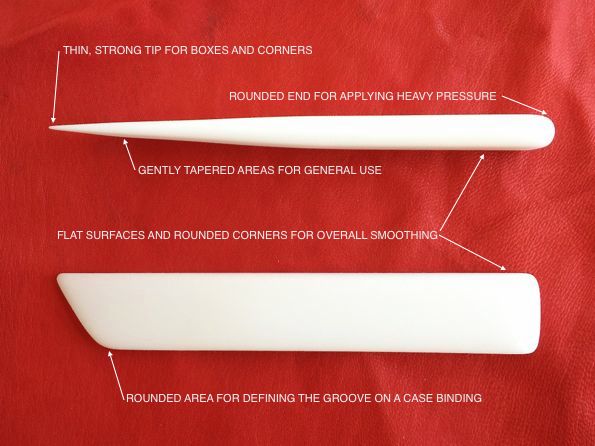
Plastics, unlike natural bone, can be made in almost any shape or size. This gives the maker a wide range of possibilities in designing a folder, since there are essentially no limitations on the shape. I decided on this shape began by examining how I use folders and the various ways I hold them. I notice I often used a Teflon folder flat, as a burnisher, so needed it to be fairly thick and have smoothly rounded corners. Unlike Teflon, Delrin is that a folder can have large gently rounded, non-marring areas and fairly thin, knife like sharp areas that don’t distort like Teflon.
I am a firm believer in the importance of learning how to make and modify your own tools. Next week I will share some DIY tips for making Delrin folders. I’m almost embarrassed how much I enjoy working it by using hand tools. It has no grain, so can be attacked from any angle, and it is very clean, so tools stay sharp a very long time. Like most plastics, it doesn’t have a “mind” of its own but is consistently compliant with the tools and wishes of the maker. Benjamin?
*****
DELRIN FOLDER
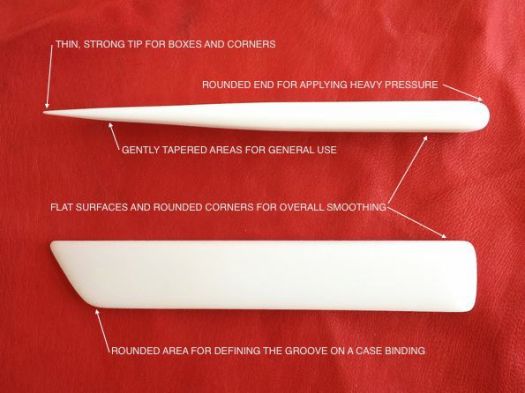

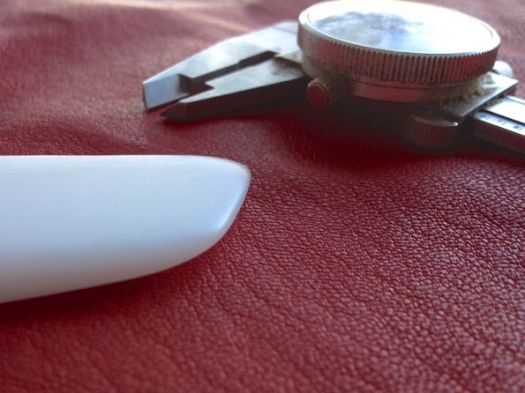
This folder is carefully designed to accomplish all the general uses a bookbinder or conservator has: scoring, folding, turning-in, applying non-marring local pressure, large scale smoothing. The small rounded tip area is shipped slightly blunt, but it can be sharpened if you prefer. Delrin is hard and stiff like bone, but has a coefficient of friction similar to Teflon. It can hold a much thinner and sharper edge than Teflon. It has a nice, non-plasticy feel. I saw, file, scrape and polish these from a solid block of Delrin.
Delrin Folder: 6.5 x 1 x .375 inch. $65.00




 Peachey Conservation