Chris Brown’s Five Essential Book Conservation Tools

Chris Brown

As primarily a conservator, the majority of the time, I set a book on the bench for conservation and repair, and immediately gather my primary tools.
In order of reach are:
The bone folder which was gifted to me by my mentor, when I started my apprenticeship. I have since been gathering folders that I like, but are not as married to as this one, so that I may give a bone folder to those I teach, should the time arise. This is tradition for me, more so than an immediate need for the folder in the first part of the conservation work.
Next is the Olfa 9mm, with Ultrasharp black blades. They’re worth the relatively minor increase in cost, as they last far longer than the regular blades, for my work needs. When I switched to the retractable from an X-acto knife, I stopped bleeding by about 90%, per book. I have to have sharp blades, good visibility and dexterity without sacrificing safety, as I disbind a book, open hinges and trim leather to fit.
Third is my my large steel spatula. This assists me with most lifting, as I can feel far greater subtlety in the process of lifting a delicate page, than I can with the lifting knife my sensei taught me to make. When I need good, old-fashioned horse power and material removal, I go to the hacksaw based blade. When I want to feel the difference between lifting paper and the first layer of board, this is what I need.
Fourth, will be the dental scraper/pick. When the proteinaceous glue on the spine, is cantankerous after three applications of wheat paste or Metyl Cellulose, the fourth application of glue removal compound is coupled with detailed work to keep as much of the fold integrity as possible, while removing as much old glue from the crevasses as can be.
Finally, the fifth tool I wouldn’t be without is the Peachey Delrin folder. I chose this shape because I needed to be able to smooth down larger sections of leather or end-papers, fold and manipulate leather and paper and generally be able to work with straight PVA in some areas. The Delrin doesn’t feel as flimsy in my grumpy fingers as does a folder made of Teflon. It also has the tendency to stay out in my hand and not go flying around the table like a watermelon seed violently pinched between thumb and forefinger. From paste to PVA, this folder provides me with the ability to smooth no small range of cloth, leather and papers to provide an aesthetically pleasing finished product for the client.
If I were to add anything to this list, I would add two types of brushes, and a one meter long, non-cork back straight edge, with millimeter gradations.
The two types of brushes: Good natural bristle paste brushes, and a good set of artificial bristle brushes of varying size, for PVA application.
With the first 5 tools, I can conserve most things.

Cathryn Miller’s Five Essential Tools for a Book Artist

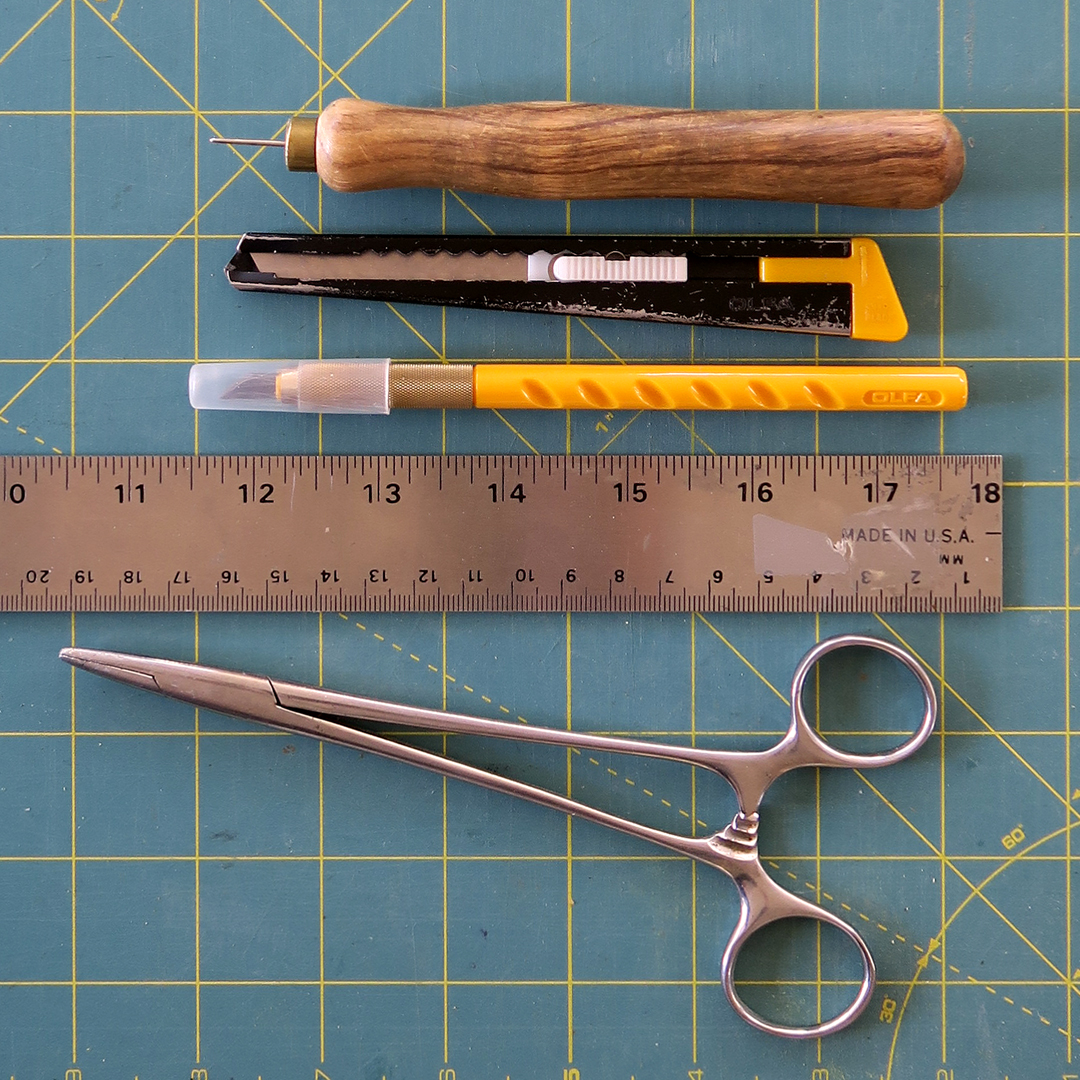
Top to Bottom: a custom scribing tool, well used Olfa Model 5001, Olfa swivel cutter with scalpel blade, ruler, and hemostat

Cathryn Miller

Book Artist. Byopia Press, Blog, Instagram

In my practice I create artist’s books and content-sensitive altered book works. I rarely use the sewn codex as a format, so I did not include an awl —I have three lovely ones in different sizes made for me by my partner David— or a needle. My two most used tools in any project are a home-made scoring/scribing tool and an Olfa snap-off-blade knife. I also use a scalpel when cutting, especially curves. The eighteen inch steel rule is absolutely essential. The surgical forceps would not have made my list under normal circumstances, but I discovered that they were the only tool I own that would enable me to assemble my most recent artist’s book.

The tools I would miss most:

Bone folders (four at this point)
Glue brushes (though I have been known to use my fingers)
Swivel knife and Circle Tool
Set of graduated width steel rules
Kutrimmer 1080


Erin Fletcher’s Five Essential Bookbinding Tools

Erin’s five essential tools. Since she is locked out of her studio, she had to draw some of them from memory!

Erin Fletcher

Hand bookbinder specializing in embroidered bindings

Herringbone Bindery

1. My oldest tool: a classic bone folder
I reach for this tool every day in the studio to assist in many aspects of my work. I’ve definitely developed an attachment to this specific bone folder and experience a mini panic attack if I can’t find it.
2. Pin Vise
I find my pin vise essential for both my bookbinding and embroidery work. As opposed to an awl, I appreciate the versatility of a pin vise. Switching out the size of the needle based on the work offers me more control. I talk up this tool every chance I get during workshops.
3. Embroidery Scissors
These small, slender scissors that cut to the point are great for snipping small stitches and getting me out of a bind when I make an error. Plus embroidery scissors come in a wide range of colors and designs, so they’re great for collecting.

4. Tracing Paper
After drafting the design for a binding, I reach for the tracing paper to use throughout the design and binding process. It’s perfect for determining the layers of a design. I also use tracing paper to place onlays and pre-punch for embroidery. And it comes in handy for tooling.

5. Olfa Snap-Off Blade Cutter
I think it’s important to use tools that feel comfortable in your hand. This particular style of Olfa knife is my absolute favorite. It’s slim and wide, but not too slim or too wide. I bought several replacements during a trip to Tokyo!