Peachey Tools in May 2018 National Geographic

National Geographic, May 2018. “Explore” section.

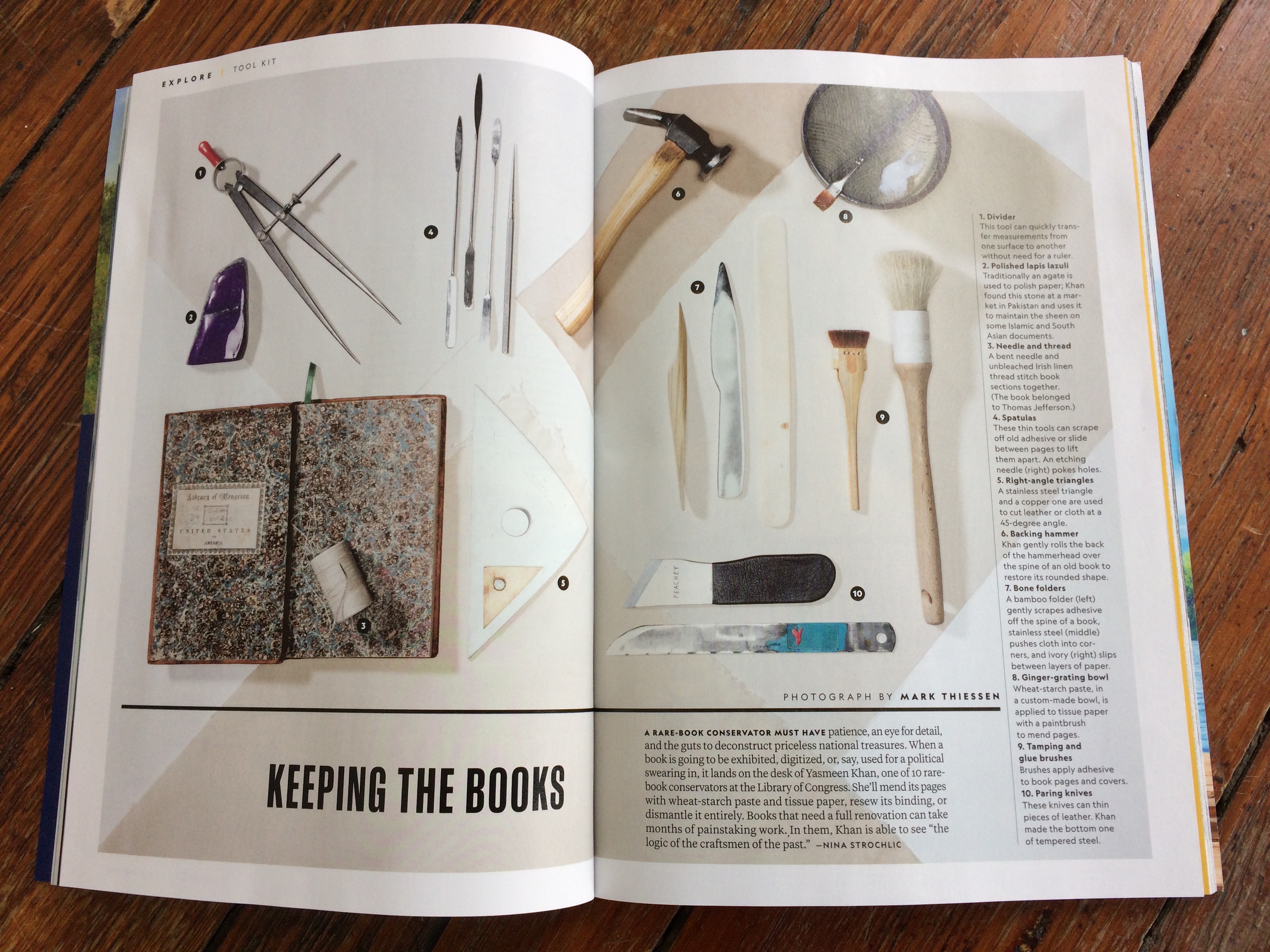
The May 2018 National Geographic Magazine “Explore” section has a gorgeous two page spread of Yasmeen Kahn’s book conservation tools. Kahn is a rare book conservator at the Library of Congress. Both my  A2 leather handle paring knife  (#10) and  two inch brass triangle (#5) are included!

Many of her tools are quite interesting. She mentions the unusually shaped bamboo tool (#7) is useful for cleaning spines. Was it originally intended to be some kind of pen? I can easily imagine how the chunk of Lapis Lazuli (#2) would fit into my hand for burnishing. This also explains why the majority of Islamic manuscripts at LC have blue streaks on the repair paper (just kidding!!!). She made a very nice looking paring knife out of a hacksaw blade (#10). I’m really into this hybrid blade shape.

Depicting tools out of their working context by carefully arranging them emphasizes their aesthetic qualities. This begins ca. 1690 in bookbinding with the engravings that ended up in Dudin’s Art du Relieur. Some of my own tool collection hangs on a wall in my studio, again, for the aesthetics. But they are easily removable in case duty calls, mounted with magnets or between finishing nails.

Can you identify these tools? Hint: most are not bookbinding tools, and I won’t argue if someone opines #1 is not technically a tool.

A Japanese Burnisher

This week I am guest blogging on the The Book and Paper Gathering, a site which delivers conservation information in a light-hearted, easy-to-digest manor.  A conservation magazine, rather than a peer reviewed journal. It is well worth spending some time reviewing their previous posts.

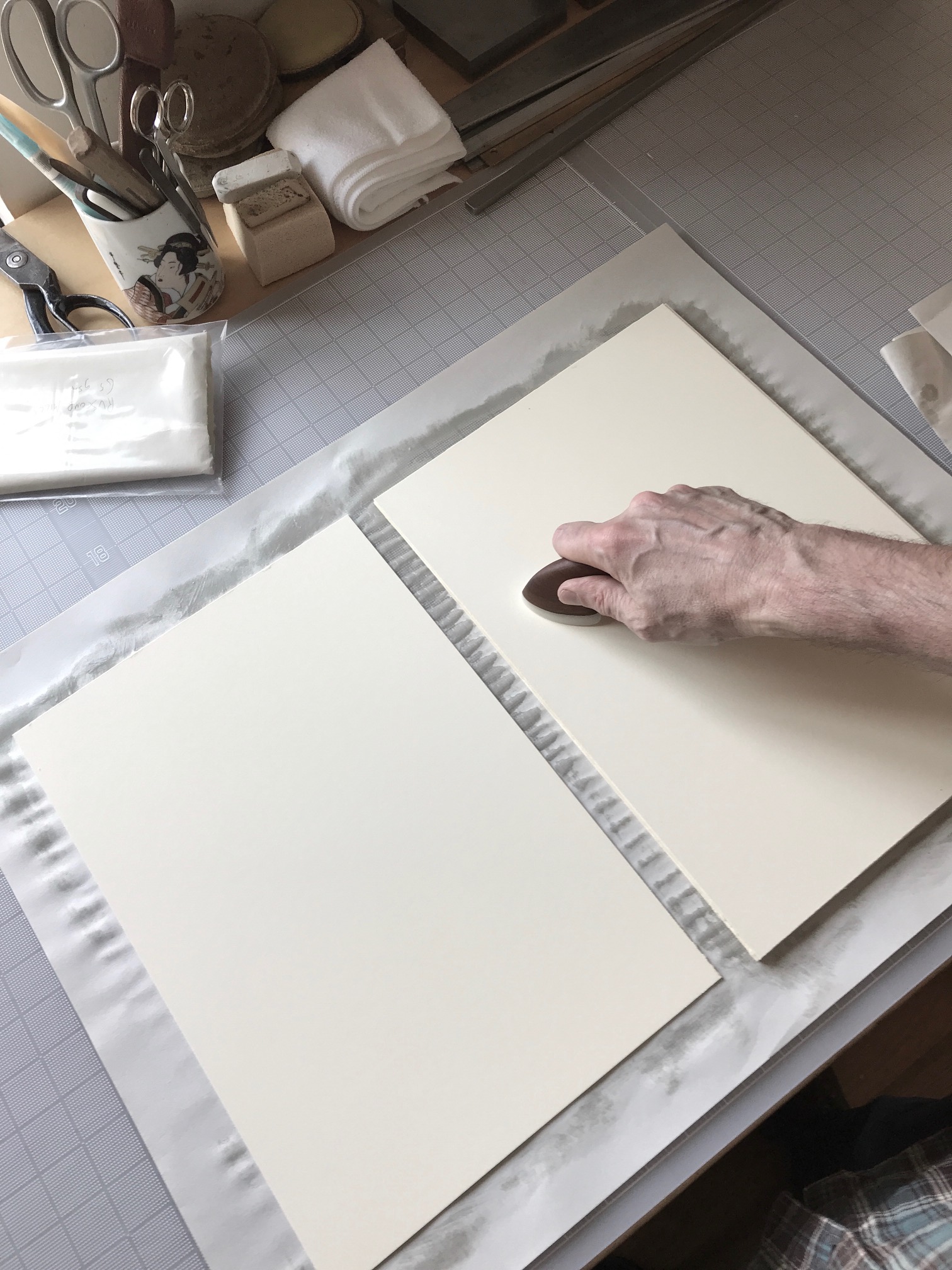
The Most Beautiful Tool in the World: A Japanese Burnisher

Exactly twice in my life I’ve seen a tool and immediately felt such a keen a desire to possess it that my secular observance of the eighth commandment was severely tested.

Drooling over Robert Minte’s collection of Japanese hera at the Bodelian Library in 2010 was the first time. They were so elegant, simple, beautiful — perfect tools, I thought. It was the longest flight of my life back to New York City, my fingers itching to make some for myself. Over time, I learned more about bamboo, shaping bamboo, and continue to keep making them today

The object of desire the second time was also a Japanese tool, though in this case a burnisher, and…  READ THE REST AT THE GATHERING


New Tool For Sale! The M2 Hybrid Paring Knife

Traditionally, leather paring knives either have round or straight cutting edges.  I discuss the advantages and disadvantages of each in this post. I usually use an English style straight blade, but became tired of the fact it could only be used for edge paring. Partially inspired by the rounded corners of a spokeshave blade, I made a couple of other modifications to a standard M2 English style knife so that it can be used for more than edge paring.

A slightly curved cutting edge on essentially an English style knife allows it to scoop out leather, necessary for the spine area, headcaps, and decorative work. The blade is oriented at a 45 degree angle, like an English knife, so right and left handers need to purchase different knives. The corners of the knife are rounded so that the tip or heal will not cut through the skin while performing this scooping action. The tiny secondary bevel allows quick resharpening.

This knife can be used for all types of paring necessary in bookbinding: edge paring, reducing spine and caps, paring deep into a skin (similar to a spokeshave’s action) and even for overall scraping, if you are into that.

M2 Hybrid Knife. Around 8 – 9 inches long, and 1 inch wide. Since the grind marks on the primary bevel go along the length of the blade, the primary bevel is not apparent when looking at the top of the knife. The exact curve of the cutting edge varies a bit from knife to knife.

A lower angle primary bevel cuts down on the amount of time it takes to resharpen the blade, since there is less metal to remove. The 13 degree cutting edge is only a millimeter or two. The disadvantage is that there is not a large enough bevel that you can feel when you put your knife on the sharpening substrate; you have to trust your hands and the angle you are holding it at. This is quite similar to sharpening a kitchen knife by hand. Another advantage of the small secondary bevel is that it can be stropped back into shape very quickly, again because not much metal has to be removed. This is a perfect blade for sub-micron stropping. M2 steel seems easier to strop than A2, for some reason.

Cross section of primary and secondary bevels.

The slightly curved blade creates more opportunity to find a sharp area as the knife dulls, so it can be used longer. Straight blades, as they become dull, don’t seem to bite the leather enough to get started with a cut. The disadvantage is you can’t just rub it back and forth like a standard straight edged knife when resharpening. Stropping takes a slight twist of the wrist, to keep parts of the cutting edge in contact with the strop throughout the stroke.

The rounded areas allow you to work into a skin, for headcaps and the spine. But the shape also allows you to use it like a standard English style knife for edge paring.

The third change is that the tip and heel of the cutting edge are rounded.  This prevents the knife from cutting through the skin when you are working away from the edge, similar to how a spokeshave blade works. In practice, I don’t miss having a pointed, sharp tip. A rounded tip also makes it less likely to dig into your paring surface.

The M2 Hybrid used like a standard English knife for edge paring.

All of these aspects combine to make a sensitive and versatile knife intended for professionals. An analogy for cyclists might be this is more like a track bike than a road bike. This knife, in addition to edge paring, can do most of what a spokeshave can do, albeit with more “workmanship of risk”. If you want the most versatile knife on the market, look no further.

Close up of a piece of goatskin feather pared,, so that the valleys of the grain are cut through. The middle of the blade was used for this, almost parallel to the edge of the leather..
Progressively paring towards the center. The rounded edges keep the blade from cutting through the leather as it stretches.

M2 Hybrid Paring knife. M2 Steel. The handle is hand carved wood, covered with vegetable tanned goatskin, and ergonomically shaped. The metal is .040″ thick, the handle around 5/8″ at the thickest point. It is about 1 inch wide and around 8-9″ in overall length. The secondary bevel is 13 degrees.  Hand sharpened to .1 micron.

The M2 Hybrid Paring Knife.  $250.00.  Order here.

Small M2 Hybrid knife. The best knife for onlays and intricate leather decorations. Also great for paring paper. M2 Steel. The metal is .025″ thick, about 5/8″ wide and 6-7″ long. Leather covered wood handle. The  secondary bevel is 13 degrees. Hand sharpened to .1 micron.

The Small M2 Hybrid Paring Knife.  $150.00.  Order here.

Small M2 Hybrid knife bottom left, regular size next to it.