Carbon Fiber Lifter

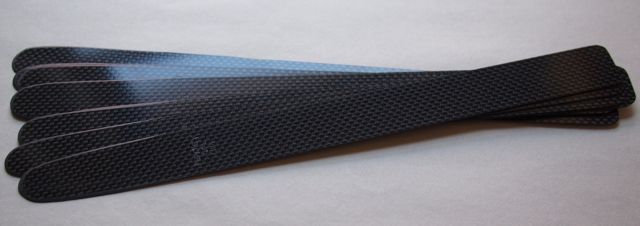
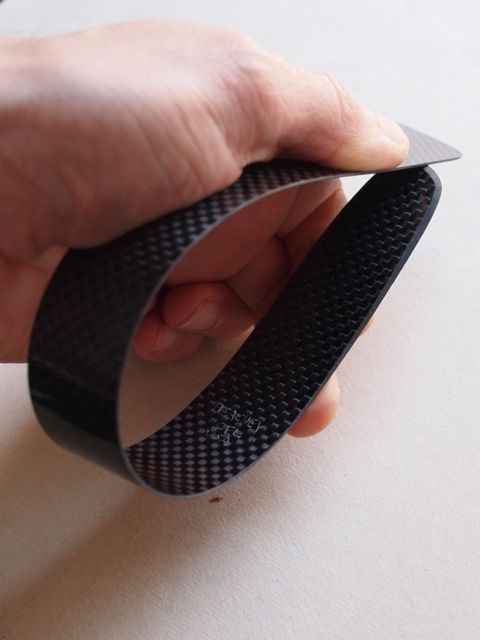
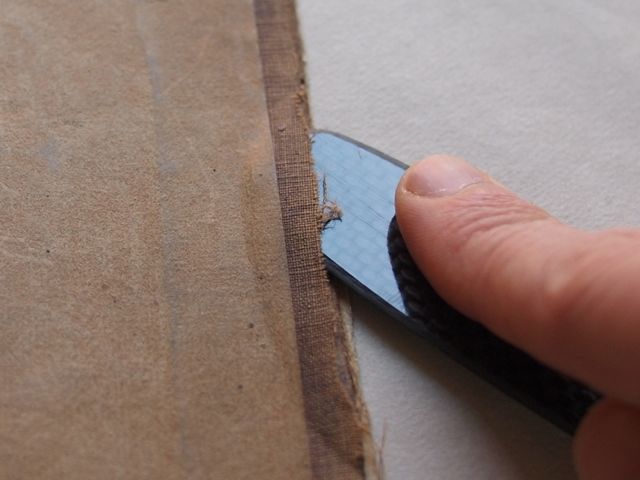
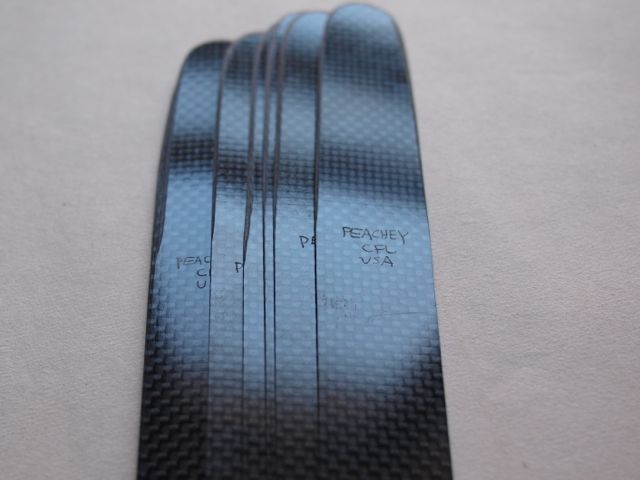
The carbon fiber lifter is a new tool to aid a conservator when mechanically lifting covering material, pastedowns and general delaminating.  Lifting knives, teflon tools, micro spatulas, teflon coated tools, and bamboo hera all have their place in a conservator’s arsenal. The carbon fiber lifter is between a teflon folder and bamboo in feel: much thinner and more rigid than teflon, stronger than bamboo and it slides easier. Very strong and flexible, though not indestructable. Great for paper, weak cloth, heavily embossed cloth, and lumpy, uneven boards.  It is flexible, yet provides unparalleled control even when it is in deep.  It is designed to slide between and separate adhered materials, but the blade is not really strong enough to split a board, like a knife can do.  The carbon fiber lifter is designed for sliding and prying lifting techniques.  I’ve also found it useful for reversing previous “repairs” like gluing a cloth case spine to the text block, given its thinness and long length. The cutting edge is rounded and extends about 2.5 inches (63 mm.)  The edge can be easily sanded to alter or repair the bevel, but I strongly recommend respiratory protection and gloves.  Here is the Material Safety Data Sheet MSDS. Additionally, the carbon fiber looks very cool. Materials: Woven carbon fiber embedded in epoxy.

Weight: .3 oz (8 grams)  Size: 1 x 12 x .030 inches (25 x 300 x .75mm)

ITEM #: CFL  Introductory price  $25.00   CURRENT PRICE $35.00

.

.

.

Sewing a Book: 1902 and 1946

Above: Douglas Cockerell,  Bookbinding, and the Care of Books

(New York: D. Appleton and Co., 1902), 104.

.

Above: Edith Diehl, Bookbinding: Its Background and Technique

(New York: Rinehart & Co., Inc., 1946), 123.

.

It is interesting how much bookbinding has changed in the 50 odd years from 1900 to 1950. The skirts and hairstyles are much shorter. The stool you sit on also looks to be metal, rather than wood. Thanks to the sharp eyes of the John Townsend (aka. Anonymous Bookbinder) for bringing this to my attention and supplying these images. John has noticed that 23 illustrations originally done by Noel Rooke (Cockerell’s illustrator)  are highly likely to be redrawn by Mrs. Edna Kaula (Diehl’s illustrator).

George Barnsley and Sons lLd. Factory Images

Many, if not most, English trained bookbinders of a certain age cut their teeth using Geo. Barnsley leather paring knives. Barnsley made numerous tools for butchers, saddle makers, shoemakers and others, from the early 19th century until the 1990’s.  Below are great images of how one factory looks now, from the UK UE Urbex Urban Exploration Forums.  There are many more photos on this site from several members. Admittedly, propagating images like these raises some concerns and issues, including trespassing, vandalism, safety, ethics, preservation, conservation, and more.  But these images are already ‘out’, and in this case, I felt the informational value for the people who use and research the history of leather-working tools outweighs these other concerns.  These aren’t just neat photos of a cool old rundown factory, these are valuable documentation.

.

A wonderfully intact painted sign on a gate. Graffiti seems to have been removed or covered over in the grey areas. The piece of unpainted wood, either covering or replacing a hinge, seems to indicate at least someone is repairing or maintaining the premises? Image: The UK UE Urbex Urban Exploration Forums

.

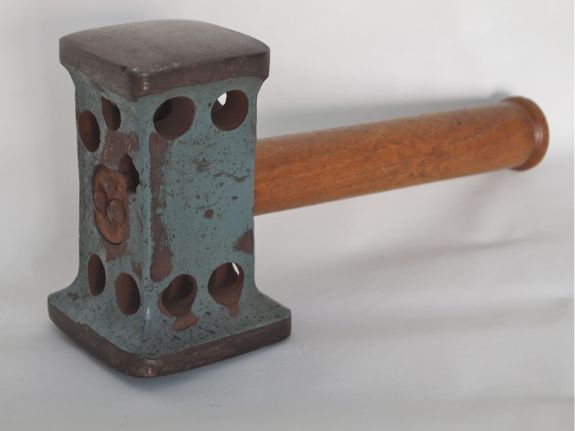
Very rusty cobbler’s hammer with a broken neck. To me this photograph looks staged, although of course all photographs, in a fundamental sense, are staged. The cleaned off area on and around the handle seems inconsistent with the regular deposits of debris on most surfaces. The very rusty and broken hammer head seems incongruous with the essentially intact handle. But it is a nice image of nature overcoming technology. Image: The UK UE Urbex Urban Exploration Forums

.

Storage shelves for knives. Lace knives are used to cut leather laces, and  could be stuck into the bench, and the leather spun around in a circle to cut long lengths from a relatively small piece of leather.  A butt knife is similar to a linoleum knife. Some butt knives have a mysterious nib, or hump,  on the back of the blade, and its purpose is unknown. There are similar nibs on some 19th and 20th century  handsaws for wood and 18th century french saws for sawing in book spines. Image: The UK UE Urbex Urban Exploration Forums
.

Indenture for an apprentice knife or toolmaker. Date: June 4, 1823. Seven years, two hundred seventy one days in length and signed by George Barnsley.   It is hard to believe this is still lying around the factory. Traditionally indentures were cut in irregular patterns on the top edge so that the master and apprentice copies would fit together.  It is a fairly small image and hard to read, but several lines jump out: “Fornication he shall not commit”  and “his [master’s] lawful secrets he shall keep.”  Image: The UK UE Urbex Urban Exploration Forums

.

Price list for various pattern Butcher’s knifes.  Note that beech handles were cheaper than redwood and the large variety of sizes availiable. I’m unclear what the bottom style knife with “one brass screw” is. Image: The UK UE Urbex Urban Exploration Forums

.

Large grinding wheel.  Ashley Iles reports that in 1950’s Sheffield, most workers only respiratory protection was a pint of ale to wash down the dust. [1]   The hinged wood cover hinges down to protect the stone. Image: The UK UE Urbex Urban Exploration Forums

.

Various knives from a catalog plate?  Small and large wooden body spokeshaves on the right, “Saddlers Spokeshaves”  In the middle is a plough gauge (aka. Strap cutting gauge), which is used to cut long strips of leather to an even width. [2] On the bottom, in the middle is a saddler’s head knife; it is easy to image grasping it with your thumb on the slight curve and forefinger fitting into the severe curve on the left side. Image: The UK UE Urbex Urban Exploration Forums

Notes

______________________

1. Ashley Iles, Memories of a Sheffield Tool Maker. Mendham, N.J.: Astragal Press, 1993. (p. 64)

2.  R. A. Salaman, Dictionary of Leather-Working Tools c. 1700-1950. London: George Allen & Unwin, 1986. (p. 263) Contains a good illustration of how they are used.