Big Bamboo Folders

Finally, the perfectly shaped bamboo folder?!?

Hand tools, in particular, need to be tested and evaluated by using them. A poor design aspect quickly becomes apparent. The simpler the tool, the more critical each aspect is. And tools don’t get much simpler than a smooth bone or wood folder.

Folders are used by bookbinders to fold paper, smooth covering materials, shape leather, and evenly adhere various covering materials. Bone, ivory, teflon, and sometimes wood, are the usual materials for western style folders.  Teflon has an extremely low coefficient of friction, making it ideal when you want to slide the tool over a surface that you don’t want to mark. Bone has a density and feels—for lack of a better term—traditional. I especially recommend the higher quality ones made by Jim Croft from wild elk and deer. Bamboo has been used in the east for many purposes. It has a higher coefficient of friction to it which makes it useful for pulling a covering material. A light touch or protective covering sheet must be used if marking is suspected to be a problem.

Bone folders —like most tools— have become smaller over time (technically known as ‘dinkification’).  Evidence from the eighteenth century France suggests folders, commonly wood at this time, may have been 12 -18 inches long.  The bamboo folders I’ve been experimenting with are a more modest  9-10 inches, though.

I keep tweaking and altering small aspects of these folders with successive iterations. The long straight sides can be used like a case folder, for turning- in. The flat areas at the pointed end are useful for pressing and forming headcaps. The angled tip useful in box making. The rounded end handy when defining joints or adhering board edges. The relatively long length makes them more comfortable to hold. This is the theory, at least. Quite likely there is no ideal shape, but what we prefer and use changes with our working habits. Or we choose tools to break us out of habituated working methods.

Bamboo is quite easy to shape and fun to work with.  I’ve written up some tips on working with it in an earlier post. If you discover the perfect shape, please let me know. I’ve already started on the next one, which will certainly be the absolutely most perfect….
A French Beating Hammer

french beating hammer

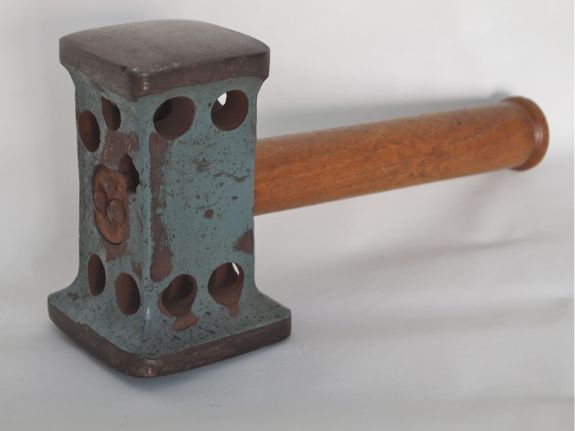
Thanks to a tip from James Tapley, a Florida based bookbinder and winner of the prestigious DeGolyer bookbinding competition, I was able to acquire something I’ve wanted for a long time: a real French beating hammer. Beating hammers were used for pounding signatures before sewing. Early Christmas! But I will wait until Christmas morning to actually smash some paper with it on my beating iron. Seven interminably long days from now….

Anyway, it is typically French with large and small square shaped faces and a cylindrical handle that ends in a bulge. The heads also have a significant amount of ‘belly’, or camber, which I have not seen in images and photographs of other French hammers, though this may or may not be common.

What is not typical about this hammer are the nine holes drilled into it. The only explanation I can think of is that a previous owner wanted to lighten the weight, like I did on the chainrings on my racing bicycle in the 1980’s. Another unusual aspect is a small pin on the side of the hammer that was presumably intended to secure the head, though of course this has loosened.  The hammer was used quite—for something— a bit judging from the dings on the faces.

The hammer currently weighs 4.5 lbs with the handle. I’ve calculated that if the nine holes were filled in it would weight about 5.25 lbs. which is the same as my small sized Hickock beating hammer.  The large face is roughly 2.5 inches square, the small one 2 inches. Given the relatively small size and (presumably original) green paint, I’d guess a mid-twentieth century date. The handle is 8.5 inches long and 1.25 inches in diameter, and turned on a (copy?) lathe. This is the original length judging from the ends, both marks from a headstock spur center and the tailstock are intact.

Predictably, this hammer arrived a few weeks too late to be included in my forthcoming article about beating hammers, “Beating, Rolling and Pressing: The Compression of Signatures in Bookbinding Prior to Sewing” in Suave Mechanicals: Essays on the History of Bookbinding, which will be published in early 2013 by The Legacy Press. Grrr.

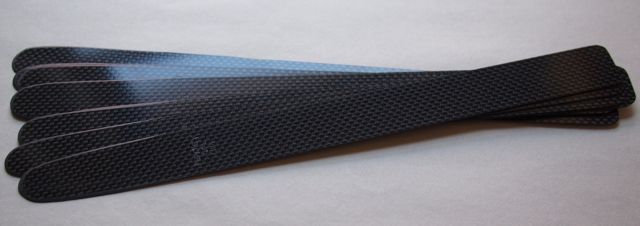
Carbon Fiber Lifter

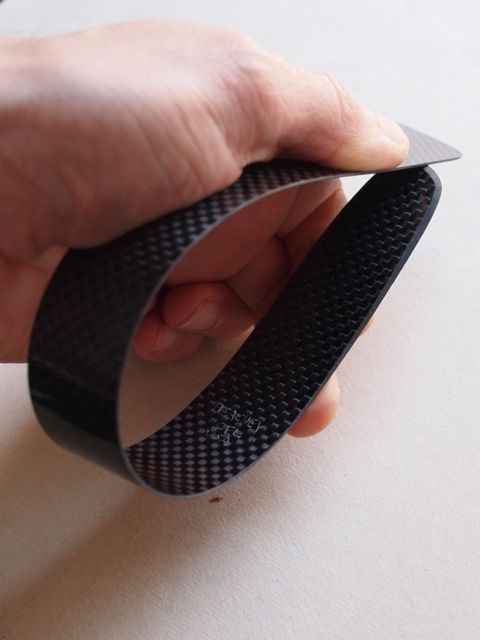
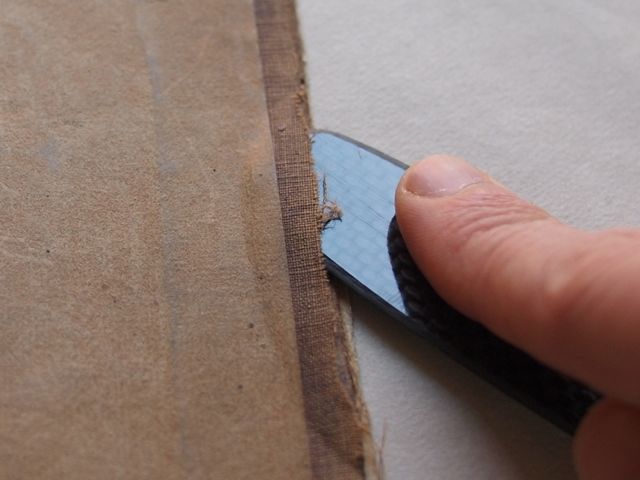
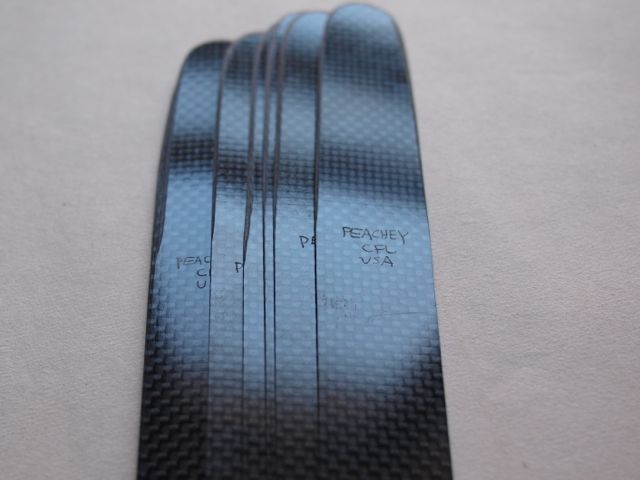
The carbon fiber lifter is a new tool to aid a conservator when mechanically lifting covering material, pastedowns and general delaminating.  Lifting knives, teflon tools, micro spatulas, teflon coated tools, and bamboo hera all have their place in a conservator’s arsenal. The carbon fiber lifter is between a teflon folder and bamboo in feel: much thinner and more rigid than teflon, stronger than bamboo and it slides easier. Very strong and flexible, though not indestructable. Great for paper, weak cloth, heavily embossed cloth, and lumpy, uneven boards.  It is flexible, yet provides unparalleled control even when it is in deep.  It is designed to slide between and separate adhered materials, but the blade is not really strong enough to split a board, like a knife can do.  The carbon fiber lifter is designed for sliding and prying lifting techniques.  I’ve also found it useful for reversing previous “repairs” like gluing a cloth case spine to the text block, given its thinness and long length. The cutting edge is rounded and extends about 2.5 inches (63 mm.)  The edge can be easily sanded to alter or repair the bevel, but I strongly recommend respiratory protection and gloves.  Here is the Material Safety Data Sheet MSDS. Additionally, the carbon fiber looks very cool. Materials: Woven carbon fiber embedded in epoxy.

Weight: .3 oz (8 grams)  Size: 1 x 12 x .030 inches (25 x 300 x .75mm)

ITEM #: CFL  Introductory price  $25.00   CURRENT PRICE $35.00

.

.

.