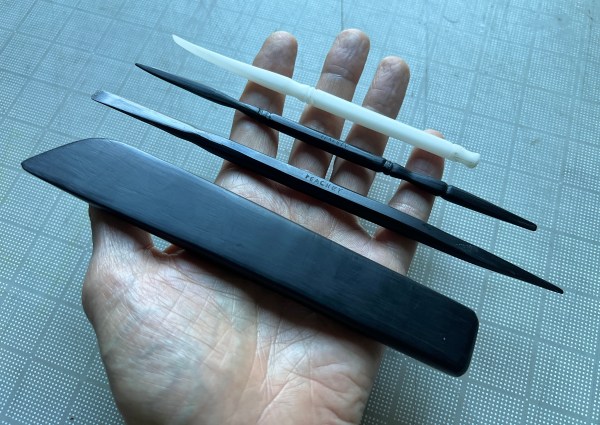
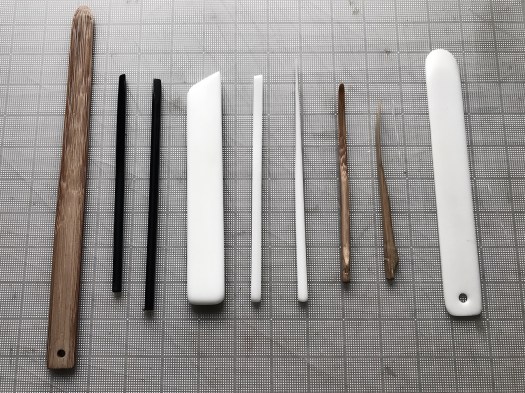
Some tools you can make in this workshop, or design your own.
Making Delrin Tools by Hand for Bookbinders and Conservators. Register here!
This is a rare chance to take a two day Delrin toolmaking workshop. Anyone who needs small hand tools for manipulating, delaminating, spreading adhesive, etc. is welcome. Making tools is engaging, fun, and practical. Delrin is an excellent material for many bookbinding and conservation tools, such as folders, lifting tools, microspatulas, hera, and creasing tools. We will work together designing, roughing out and finishing of several tools. Working Delrin is a meditative activity, no previous experience required. Safe, low dust methods of working Delrin will be emphasized. This workshop is a great opportunity to geek out with other tool lovers. After the workshop you will have some useful new tools, and possess the know-how to alter, maintain, and make more variants. Warning: tool making is highly addictive.
North Bennett Street School, Boston Mass. October 4-5 2025. Register here!
Making tools is not only engaging and fun, but entirely practical since the result is set of tools you can use daily. Book conservators, photo conservators, paper conservators, bookbinders, and others will find this workshop valuable. Filing, scraping and polishing are meditative activities, no previous experience required. Working Delrin and bamboo is a great way to start toolmaking and we will make folders, lifting tools, microspatulas, hera, creasing tools, tongs and more. This workshop also is a great way to learn how to maintain and modify your existing tools. Fair warning: making your own tools is highly addictive!
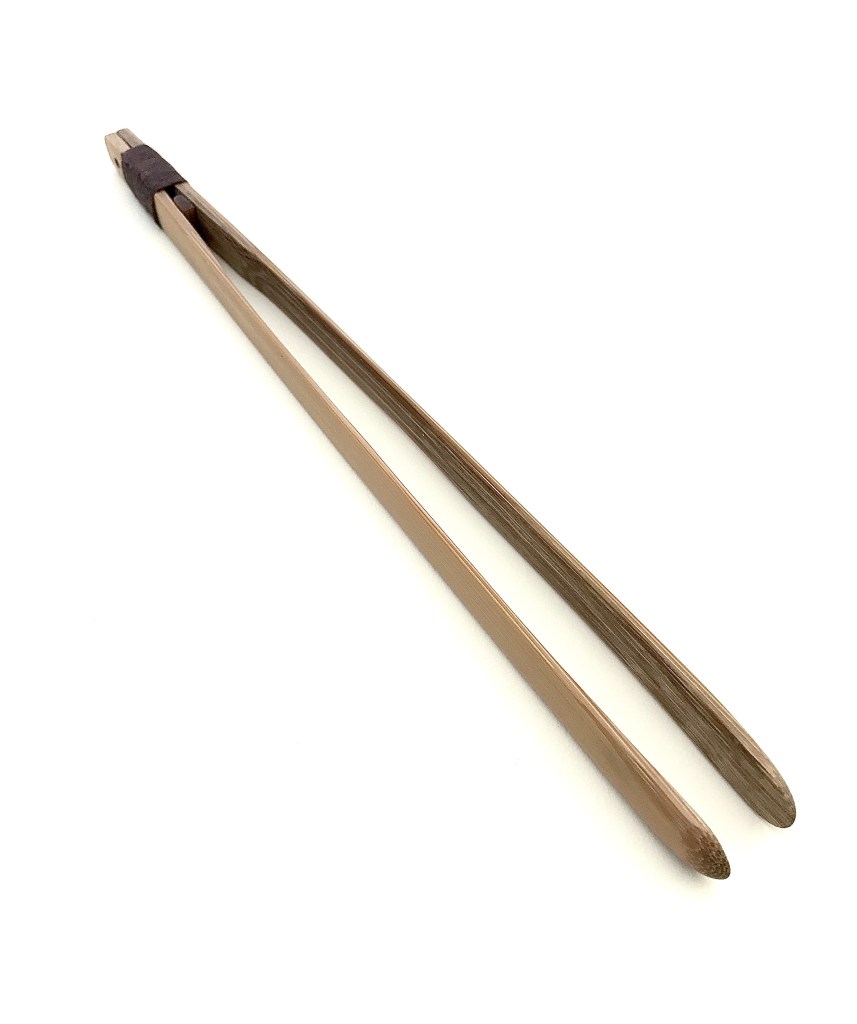
As a class, we worked through the process of making bamboo tongs, which turned out to be a great introduction to mechanics by jumping into the deep end!
OVERVIEW
All aspects of making tools with delrin and bamboo will be discussed in detail: design considerations, thinking through working procedures, cutting, filing, rough shaping, final shaping, and polishing. The workshop consists of two 3- hour synchronous zoom sessions with PPTs, videos, discussion of handouts, demonstrations, Q&A chat sessions, and working together. Also included is two week access to the workshop website, which contains information, links, videos and PPTs. The workshop includes a kit with enough materials to make nine tools with a retail value over $300. A set of hand tools is also included: a cherry bench hook, scraper, burnisher, a file for plastics, and a variety of sanding and polishing supplies. All you need is a stable work surface, some time to work, and an interest in making tools.
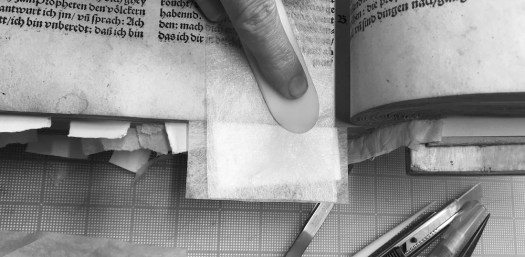
Using a Delrin lifting tool upside down to apply pressure to a paper repair.
SCHOLARSHIP
A generous patron has offered a scholarship for the “Delrin and Bamboo Toolmaking Workshop”, session to be held April 10 + 17, 2021. The award is intended for a book conservator or bookbinder with less than five years working experience, who are in need of financial assistance. International applications are welcome. To apply, contact me with the subject heading “Tool Making Scholarship (your name)”. The message should consist of two paragraphs, the first explaining why this scholarship is necessary to you, the second detailing how it would benefit your work. Applications are due February 20, and the successful candidate notified on February 27. Submissions not adhering to this format will not be considered, and unsuccessful candidates will not be notified.
SCHEDULE
Two 3-hour sessions for each workshop. The workshop will be offered three times on Saturdays. February 13+20, March 13 + 20, and April 10 + 17. 12-3pm Pacific, 1-4pm Mountain, 2-5pm Central, 3-6pm Eastern, 8-11pm GMT, 9-12 CET, 10 – 1am EET, 5am – 8am (+ 1 day) JST, 6am – 9am ( +1 day) UTC
INTERNATIONAL PARTICIPANTS
Email me for an invoice to pay by credit card. I will hold your place for 24 hours after I send the invoice.
COST
$375 US ($425 Canada, $445 other countries, includes shipping)
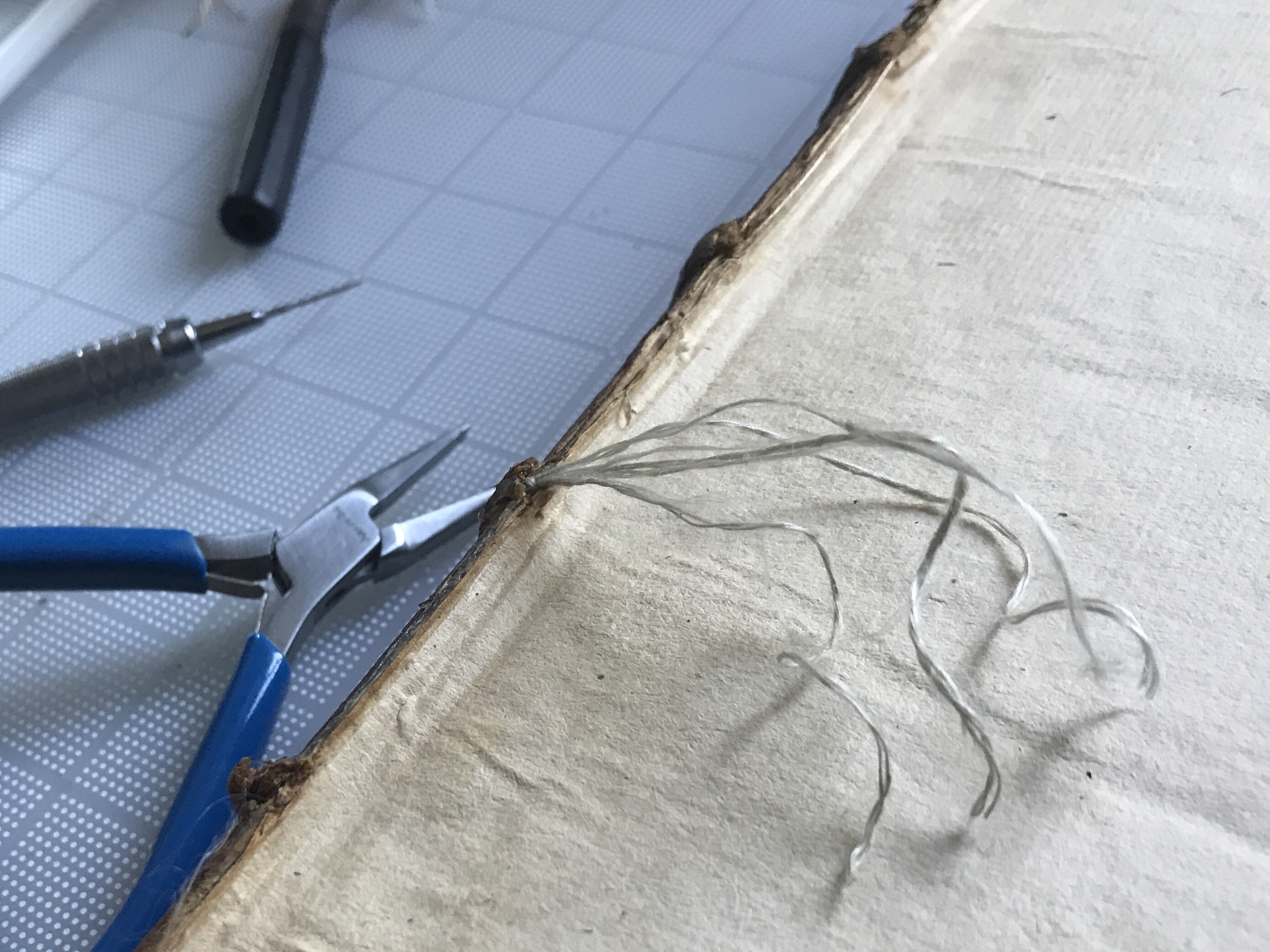
In this variant of sewing support extensions that I came up with, new thread is carefully looped in signatures and under or through existing cords, without having to lift the leather on the spine. Unlike joint tacketing, this method does not restrict the movement of the book spine at the shoulder.
I’ll be teaching this week long workshop for at Notre Dame University, South Bend, Indiana, March 9-13, 2020. The workshop will be devoted to a wide variety of contemporary book conservation techniques to deal detached boards, arguably the most common place books fail. There was much lively and informative discussion when I taught this two years ago at Emory University, and plenty of demonstrations and hands-on work time. The workshop details forty-six methods — although many are combined in practice — organized into five basic groups.
In this week-long intensive workshop, students will be introduced to a wide variety of current techniques used to conserve leather bookbindings. Book conservators, technicians, and bookbinders who wish to learn, expand, refresh their treatment skills are all welcome. Previous bookbinding or conservation experience is required.
Detached boards are the most common place leather bookbindings fail, and all five of the primary methods of treating this will be taught: mechanical sewing extensions and tacketing, inner hinge repairs, outer hinge repairs, interior-board repairs (both splitting and slotting), and several styles of rebacking. Many treatments involve a combination of these techniques. Questions concerning methods of consolidating older leather, the archival qualities of modern leather, and leather dyes will be discussed. A variety of methods to pare, consolidate, and lift leather will be introduced. Since a sharp knife is crucial to success in leather work, sharpening and easy ways to maintain a sharp edge will also be taught.
Participants should bring six to eight non-valuable leather bound books to practice on. It would be best to have a mix of tightback and books with hollows, and avoid case bound books. Skills to be learned include leather paring with a knife and paring machine, how various tools and machines for leather paring including a modified 151 spokeshave, and how to choose an appropriate lifting knife or tool for the task at hand.
There will be individual consultations with students before the workshop to discuss potential treatments for their chosen books, and determine if extra materials or tools might be required. Decision making based on the actual books brought to the class will be foundational.
The primary goal of this workshop is to equip participants with a more nuanced understanding of the pros and cons of currently practiced leather conservation techniques, gain supervised experience while performing them, and feedback when they are completed.

 Peachey Conservation