

Karen Hanmer
Bookbinder in solo practice, http://www.karenhanmer.com/
Only FIVE?!
Maybe that’s not so limiting after all. Two experiences have taught me that with tools it is true that less is more. First: observing time lost when someone is forever rummaging through their steamer trunk-sized toolbox. Second: over my career learning to work more efficiently. An important component of this has been finding several uses for whatever tool is in my hand rather than suspending work to reach for another.
These are the essential tasks I perform:
fold
sew
measure
mark
cut
apply
press
All of these tasks can be accomplished with a very modest toolkit made up of the following five items.
1. Folder. Bone for a sharp crease on paper, Teflon for surfaces that might become burnished. A Delrin Folder combines the best properties of both.
2. Needle. A #18 John James is strong enough to go through any paper text block and the eye is large enough to thread effortlessly with sizes up to 18/3, and with some persistence 12/3. I use the same size for sewing endbands.
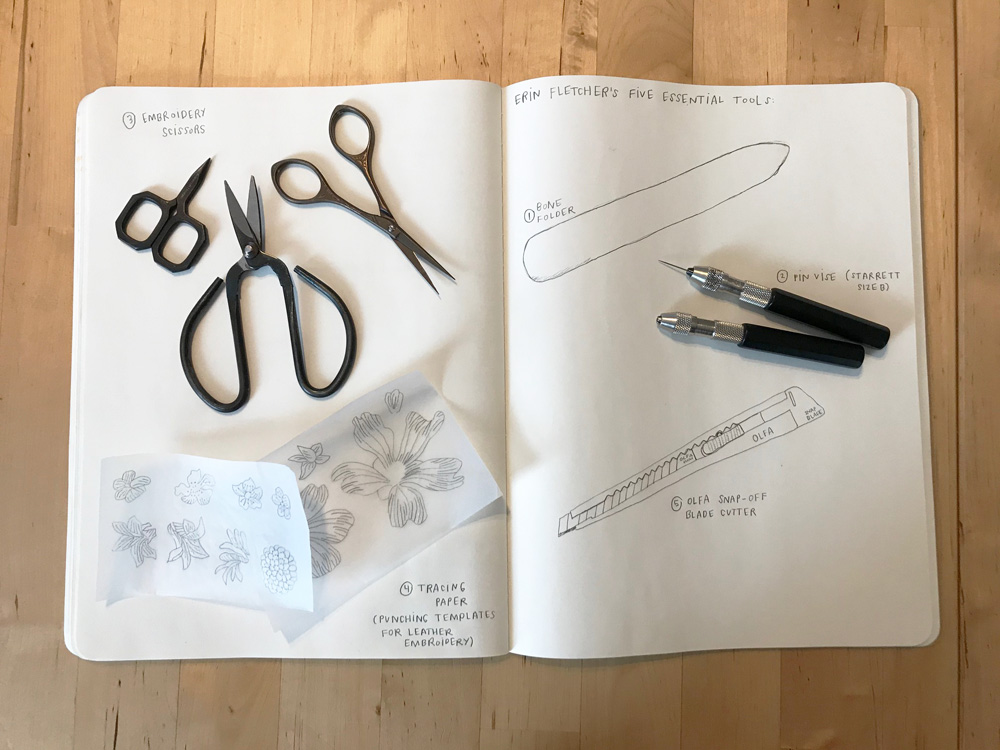
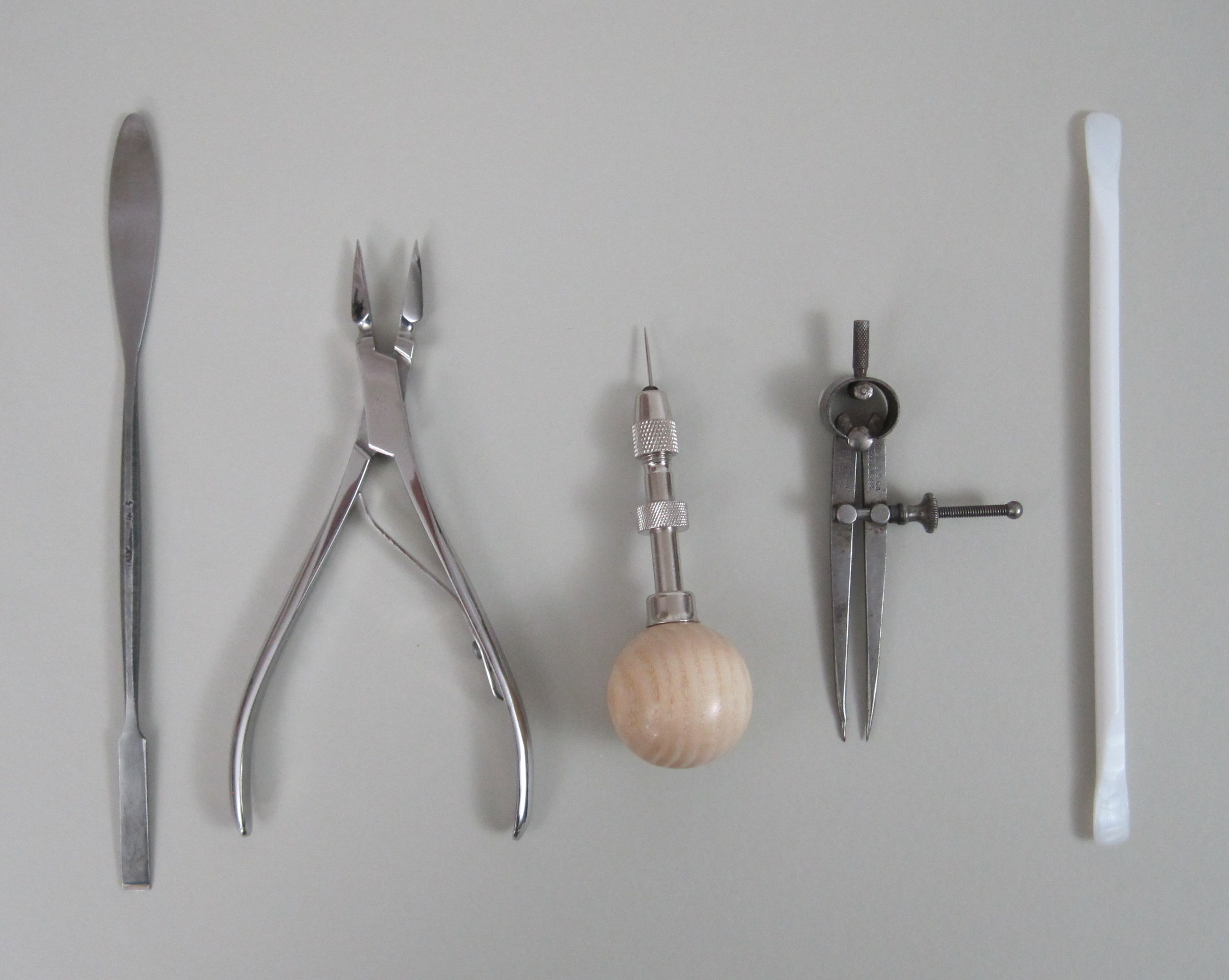
A needle in a pin vise becomes an awl, which can also be used to score, scribe lines, mark measurements, clean tooling, and apply adhesive or color to precise areas. A pin vise is more versatile than an awl because it can be outfitted with any size needle, sharp or blunt. I favor this one over Jim’s because it is narrow, rolls up with other tools for travel.
3. Knife. If limited to one, I’ll take an ergonomic scalpel handle and outfit it with a #23 Havel’s blade.
4. Straight edge. Not cork-backed. To make them non-skid I’ve been saving the ½-inch that remains after cutting the finest grit micro finishing films to fit sharpening plates and adhering that to the back of all my straightedges. Too fine to scratch whatever I place the straightedge on, and adds almost no thickness to skew my cuts.
5. Brushes. A selection appropriate in size to the area of adhesive being applied.
I’m going to consider the final two items freebies since they can be scrounged up in any home or office:
Paper “rulers.” Narrow strips of unprinted waste paper used with a pencil tick or fold mark to transfer measurements from one material to another, functioning as no-cost dividers, and sometimes better because they can measure spine width and other non-flat surfaces. These can also be used to mask areas when applying adhesive and to mark the center of sections when sewing endbands. [Note: this is called comparative measuring]
Weights.
I’d supplement a larger kit with the following:
A microspatula.
Dividers.
A small rectangle of non skid shelf lining anchors a finishing press in place, keeps beginners’ work from sliding all over the bench when they are learning to case in, and an even smaller piece will help grip a needle for binders who are losing their dexterity.
A small brass triangle with a handle is easy to grip and position, can mark corners prior to covering, is a stable mini straight edge, and doubles as a light weight to aid in placement.
The variety of machinist square called a “footed square” ensures book blocks and boards are square, aids transfer of marks at the board edge to the point of lacing, and is another light-duty weight.
A thin, narrow folder is essential for forming headcaps and doubles as a short-handled microspatula.
An inexpensive English paring knife separate from the one I use to pare leather for utility cutting: back corners, pre shaping boards prior to sanding, and cutting off excess cords and leather “pegs” on historical bindings.
 Peachey Conservation
