Upcoming Public Lecture at Emory University, Atlanta. The Conservation of Dante’s La Commedia

Please join us at Emory University for this event, free and open to the public—

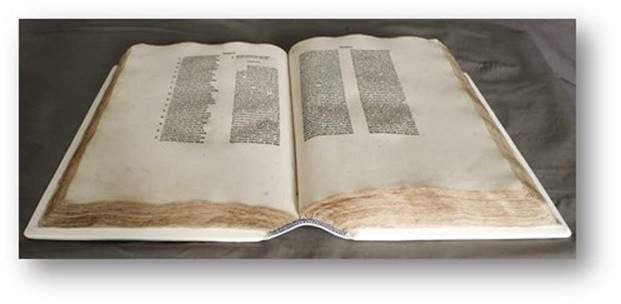
The Conservation of Dante’s 1477 La Commedia:  an illustrated talk by Jeffrey S. Peachey
Tuesday, November 6, 2018
4:00pm Talk and Q&A
5:00pm Reception

Jones Room
Robert W. Woodruff Library
540 Asbury Circle  Atlanta, GA 30322

Registration available here:  http://emorylib.info/peachey
Please feel free to share this information with others.

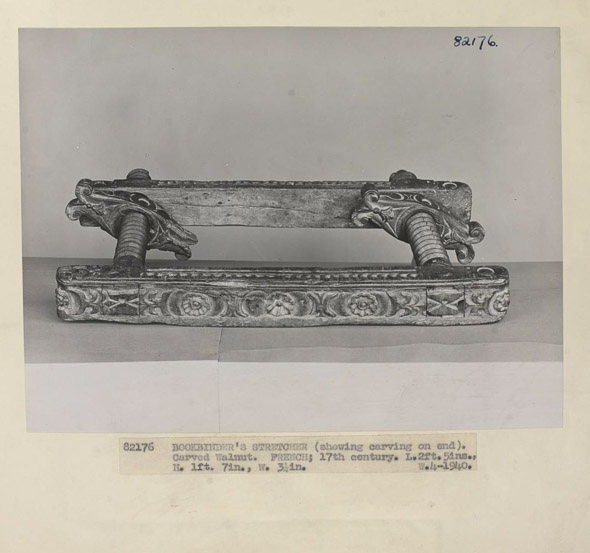
An Ornate 17th Century Bookbinding Press

Bookbinder’s Stretcher [sic]. Possibly French, Walnut, 1670-1700. © Victoria and Albert Museum, London
This is the most ornate finishing (?) press I’ve ever seen, as well as being one of the earliest dated ones. It is inaccurately described by the V&A as a book stretcher in the catalog, because in the early images (above and below) the tightening nuts were on the wrong side of the cheek. Usually tightening nuts like these are found on German or Netherlandish presses.

It would be nice to have a book stretcher on occasion, though.  Need to turn an octavo into a quarto?  No problem!  But was this really a book press, or a press intended for some other purpose? The 29 inch long cheeks are very, very thin in profile, and I imagine would deflect quite a bit even with just hand tightening.

Bookbinder’s Stretcher [sic]. Possibly French, Walnut, 1670-1700. © Victoria and Albert Museum, London
A later image shows the press assembled correctly, but it is still described as a book stretcher. Almost every non-functional inch of this remarkable press is covered with relief carvings. The tightening nuts are especially elegant.  It is made from walnut, a wood traditionally used for press boards in 18th century France.

Bookbinder’s Stretcher [sic] assembled correctly. Possibly French, Walnut, 1670-1700. © Victoria and Albert Museum, London
Many 17th century and earlier European woodworking tools, like planes, are encrusted with carving. Hand tools have became minimally decorated since the 20th century, all form deriving from efficient manufacture and use. The decorative deep carving must have taken a lot of extra time. Did the maker or consumer provide the agency? Was this a presentation piece, not intended to be used?  It seems to show very little wear, atypical of most presses. Or did the maker just want to make a beautiful tool? Do beautiful tools inspire binders to make beautiful books?

*****

Hats off to the V&A has a very progressive large image use policy.  You can download them instantly, share them widely, and even use them for publication. There are almost 750,000 searchable images on the V&A site. Let’s hope all institutions free their images.

V&A large image use form. © Victoria and Albert Museum, London


August Eickhoff French Style Paring Knives

A pair of August Eickhoff french style paring knives, made in New York, 19th century.

A side benefit of my regrinding and knife sharpening service is that I get to see some interesting antique knives. These August Eickhoff knives are beautifully made, have a wonderful balance, a lovely patina, and given the amount of distal taper (both on the blade and the tang) must have been forged. Eickhoff also made round knives (aka. head knives) for leatherworkers which occasionally show up for sale today. In the late 19th century, Eickhoff was located at 381 Broome St, NYC, making scissors, woodworking tools, and resharpening knives. He served on the NY Board of Education, and advertised his wares in a Teachers College Educational Monograph. It may be time to make a few reproduction Eickhoff knives.