What is a Conservation Binding?

The term “conservation binding” gets thrown around a lot. It certainly sounds different than just rebinding a book. But what does it really mean?

It is unknown who coined the term, and a google ngram search shows its use beginning in the 1960s, and peaking in the 1980s. It wouldn’t surprise me if it actually started in the 1950s in England. The 1980s were the peak of rebinding in book conservation, which resulted in many treatments that we would now consider too invasive. But the ethos then was to treat a book so that it would last 500 years. Of course, the correlation between the use of the term and making a conservation binding is not known.

Source: https://books.google.com/ngrams/graph?content=conservation+binding&case_insensitive=on&year_start=1900&year_end=2000&corpus=15&smoothing=3&share=&direct_url=t1%3B%2Cconservation%20binding%3B%2Cc0

The trouble is, it doesn’t have any agreed upon meaning, similar to the even more ubiquitous term “archival”. All the usual suspects for bookbinding terminology — Language of Bindings, Carter, Etherington, The Multilingual Bookbinding and Conservation Dictionary — don’t have an entry for conservation binding. In practice, it can simply mean a binding done by a conservator. And anyone can call themselves a conservator. Or it can often mean a reversible layer of paste and Japanese tissue on the spine of a fine binding. Or it can imply the use of durable and modern conversationally accepted materials (i.e. linen, handmade paper, tawed skin) incorporated into a binding, with minimal attention paid to decoration and finishing.

So here is my first stab at a definition:

A conservation binding is a rebinding that is structurally similar and aesthetically sympathetic to the time the text was printed. It is durable, easily reversible, non-damaging and alters the original binding materials as little as possible. It does not fool someone into thinking it is an original binding, though it is harmonious with actual historic bindings.
Long Live the Superstrop

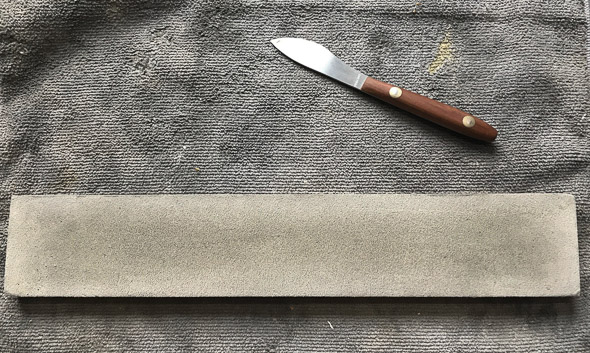
I introduced the Superstrop about eight months ago, and have been using this one for over a year without having to recharge the substrate, which is a .1 micron Poly Crystalline Diamond spray.  And last month, seven students used it to make a total of 24 leather bindings. So I’m guessing one application of the diamond compound, which comes with a new strop, will last at least a number of years under normal use. The substrate itself is more durable than leather. It holds the small diamond particles in place, allows them to move around a little to expose sharp edges, and doesn’t glaze over.The small knife at the top right is a prototype paper conservation scraping knife. Get the Superstrop here

2018 Historical Book Structures Practicum: Demonstrating, Draw Knives, and Paring Tawed Skins

I recently finished teaching a month long workshop on historic bindings for the Library and Archives Conservation Education Consortium of Buffalo State University, New York University, and the Winterthur/ University of Delaware. LACE for short. Seven MA students in conservation completed six historic models from the 15th to the 20th centuries.

This year it was hosted by The Winterthur/ University of Delaware Program in Art Conservation and took place in the first year student classroom, which is a really great space to teach in. The room has individual work stations for the students, as well as a group area with moveable work tables for lectures, ppt’s, discussion, and demonstrations.

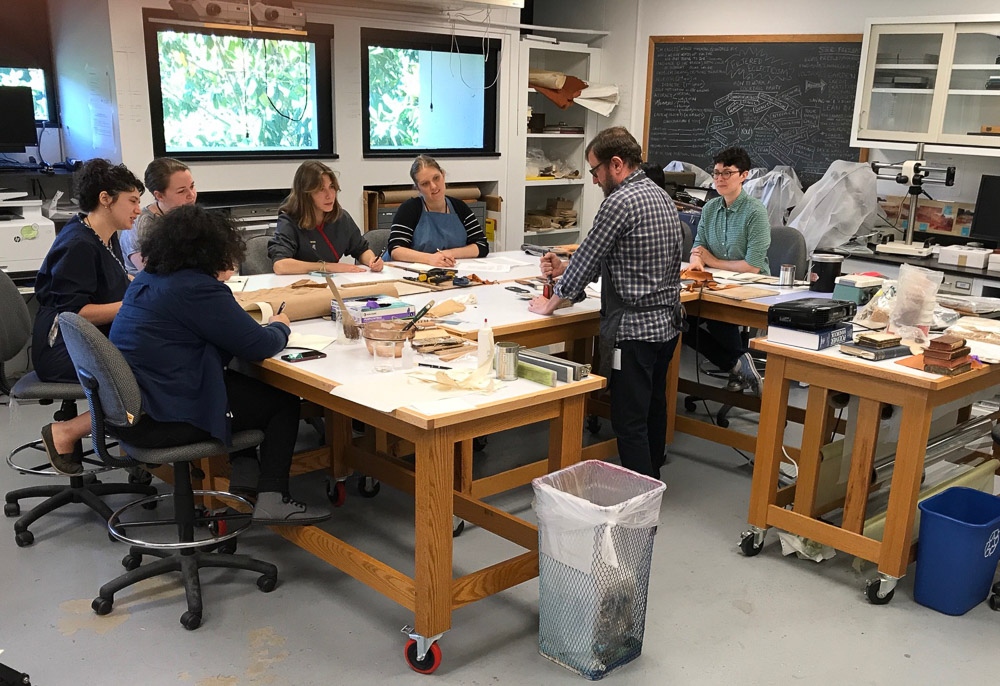
One configuration of the classroom.

It is important that the students can be comfortable and close enough to observe details during demonstrations. In this configuration, students could sit to watch and take notes, and I could stand, which is how I like to work. Having a task light would have made it ideal.

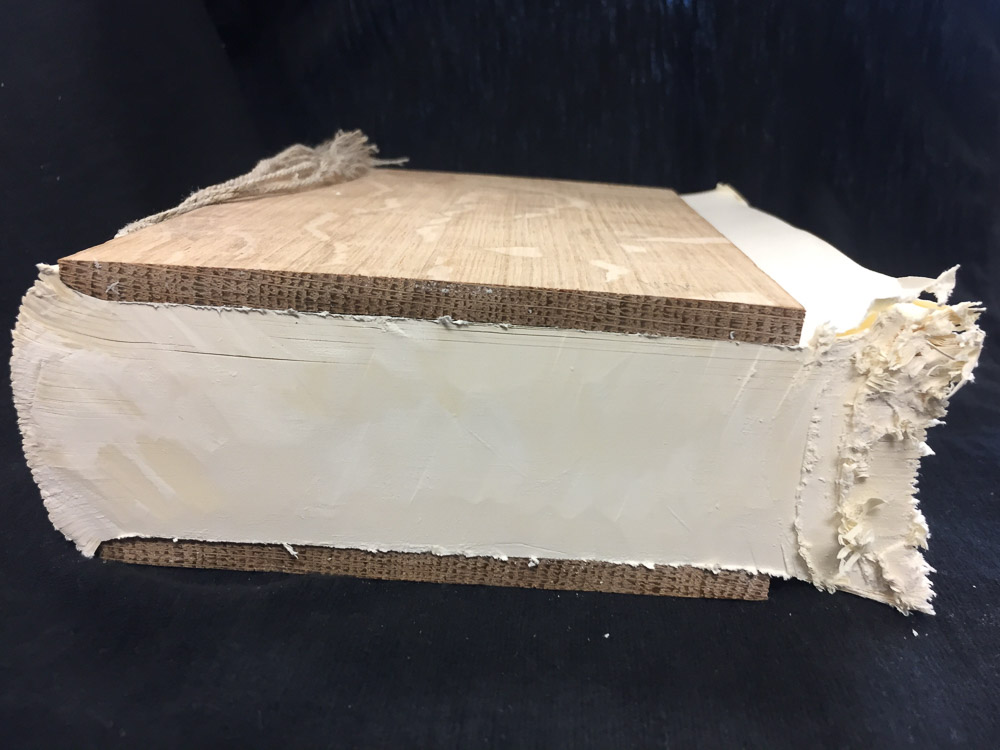
Edge of a bookblock cut with a drawknife. Photo Nicole Alvarado.

For our late Gothic model, some of the students wanted to try out a drawknife instead of a plough for edge cutting. Nicole Alvarado worked the edge in the above image. We found it quite difficult it is to achieve an edge that looked like historic examples. We had to start with the sides of the bookblock in order to shave it down. The resulting edges did not look like the example depicted in Fig. 9.14 from J.A. Szirmai’s The Archaeology of Medieval Bookbinding or on a first first folio of Shakespeare.

The edges on the Shakespeare and in Szirmai were presumably cut with a skewed and sliding stroke of a drawknife, with one stroke at a time advancing a significant amount through the book. It is easy to imagine this when looking at the images. We found it impossible to replicate this, though. Was our drawknife too small, the blade angle too obtuse, modern paper too hard, or our arms too weak?  A combination of all of these? Or was a different tool used? In both of these examples, each chop could have been caused by an aze or adze, in order to penetrate so far through the thickness of the bookblock. Time for more experimentation!

Paring and scraping a tawed skin with a round knife. Photo Karissa Muratore.

In bookbinding, usually vegetable tanned goat is the easiest leather to pare, followed by vegetable tanned calf, then tawed goat or calf. Tawed pig the most difficult. Tawed skins are quite abrasive, and quickly dull any knife. Karissa Muratore did a wonderful job of paring an alum tawed calfskin for her Gothic Model binding. Although tawed pigskin would have been traditional, all of the major bookbinding leather producers are no longer offering them, citing difficulty in obtaining quality raw skins.

Karissa’s image illustrates how a rounded blade knife can be used for edge paring (note the pieces in the foreground) and scraping (note the shavings in the background). Scraping is a safe, but slow way to even a skin out, as well as thin the spine and headcap area. I think that 15th century binders would have received the skins the appropriate thickness overall from the tanner, and only had to edge pare.

This late Gothic binding — clasps, alum tawed skin, wooden boards, double cord sewing —  is a satisfying final project, combining bookbinding, woodworking and metalworking skills.

By the end of the month, the students were more than happy to demonstrate what they learned about safe, professional, and thoughtful tool use.