A Method of Brushing Glue onto Paper

I’ll be teaching a hardcover pamphlet binding workshop to a group of undergraduates later this week, and wanted to include a diagram illustrating the technique of gluing paper.  I couldn’t find anything useful on the web, so had to draw my own. Is it considered too basic to bother describing? Clean and efficient glue handling is one of the most fundamental skills in bookbinding, and a common place to make mistakes.
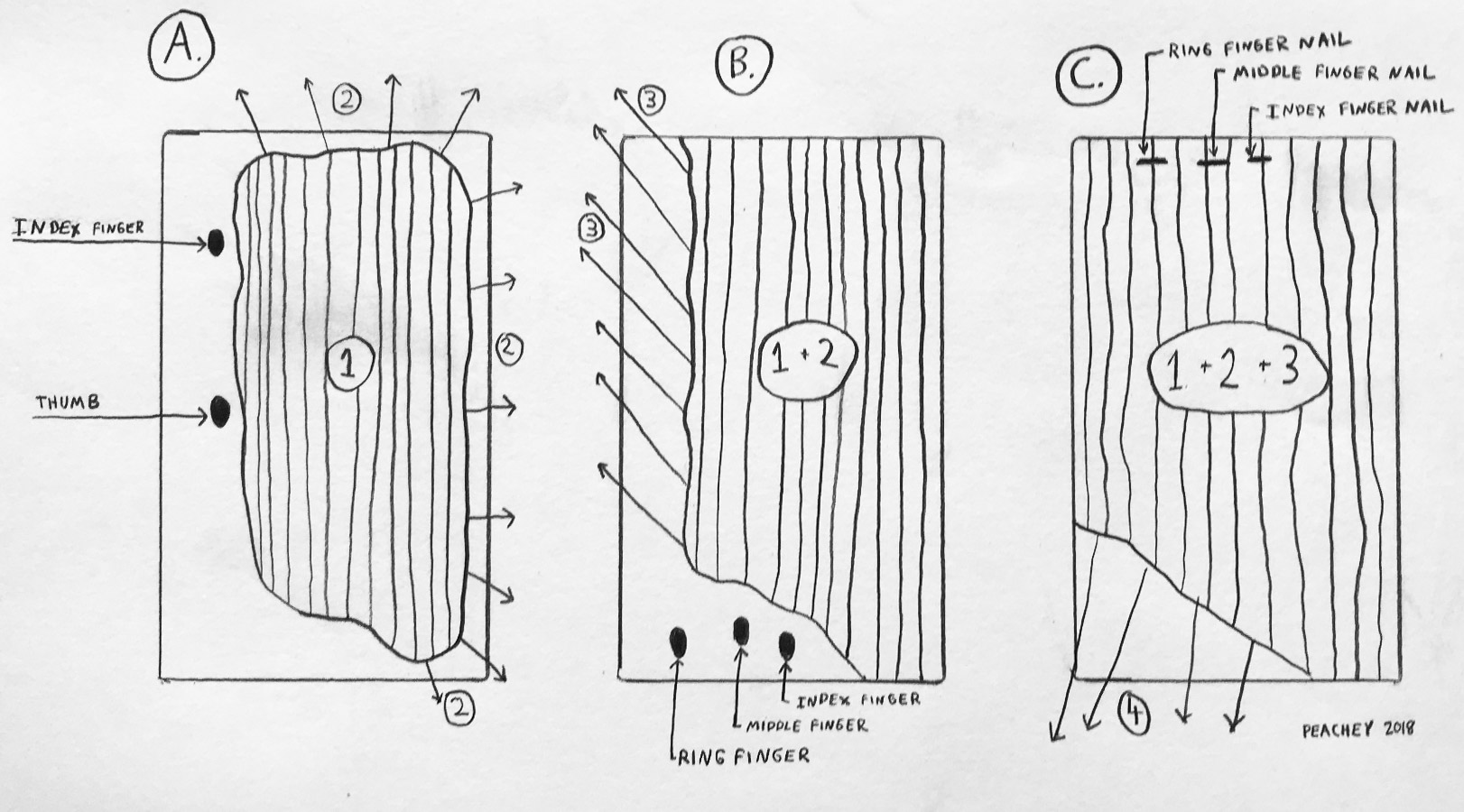
The sequence of applying adhesive to paper for a right hander. Click on the image to enlarge.

If your adhesive is the right consistency, your brush the right size, and it is charged appropriately, you should be able to cover the entire sheet without adding more. This is how I was taught by Thea Hamman, a German trained bindery supervisor who worked for many years at Columbia University.

A.  Apply the adhesive to a large area in the center of the sheet of paper, which is placed on a larger waste sheet. Press down firmly with your index finger and thumb to keep the sheet from shifting. If the paper is large or highly reactive to moisture, you might want to relax it by misting with water. I usually jigger the brush back in forth in Area 1 during application. Make sure to put enough on to later drag it over the edges.  Most commonly, I use a 1 inch Princeton 5450 Natural Bristle Brush. Since the adhesive is not on the waste sheet yet, if the paper happens to shift or expand a bit, the good side of the sheet remains clean. Next, brush the adhesive in Area 2, off the top and right side. If the paper expands or warps, hold it down so that it moves towards the left, so adhesive doesn’t get on the good side. 

B. Move your hand and place your ring, middle and index finger on the bottom of the sheet, in the area where there is not adhesive, then brush the top left side. This can also help keep the sheet from curling into into itself. On small sheets, 1, 2, and 3 can be done at the same time. All of this depends on a balancing how fast you are working, how reactive your paper is, and how much moisture is in your adhesive.

C. Now place your fingernails fairly flat on the top edge, making sure not not to dent the paper. By using the flat parts of your nails, the adhesive doesn’t get on your fingertips. If you do happen to get a little glue on your fingers, it is useful to keep a damp rag nearby to wipe them clean. Finish spreading the adhesive and lift the paper near two opposite corners, and stick it in place. Smooth it down, starting in the center, working outward, with the part of your hands that is opposite your thumbs to eliminate any bubbles.  This avoids your fingertips which now have adhesive on them. Then achieve firm adhesion by burnishing using a Delrin folder, or your weapon of choice.

Please comment if you have another preferred method!
New Tool For Sale! The M2 Hybrid Paring Knife

Traditionally, leather paring knives either have round or straight cutting edges.  I discuss the advantages and disadvantages of each in this post. I usually use an English style straight blade, but became tired of the fact it could only be used for edge paring. Partially inspired by the rounded corners of a spokeshave blade, I made a couple of other modifications to a standard M2 English style knife so that it can be used for more than edge paring.

A slightly curved cutting edge on essentially an English style knife allows it to scoop out leather, necessary for the spine area, headcaps, and decorative work. The blade is oriented at a 45 degree angle, like an English knife, so right and left handers need to purchase different knives. The corners of the knife are rounded so that the tip or heal will not cut through the skin while performing this scooping action. The tiny secondary bevel allows quick resharpening.

This knife can be used for all types of paring necessary in bookbinding: edge paring, reducing spine and caps, paring deep into a skin (similar to a spokeshave’s action) and even for overall scraping, if you are into that.

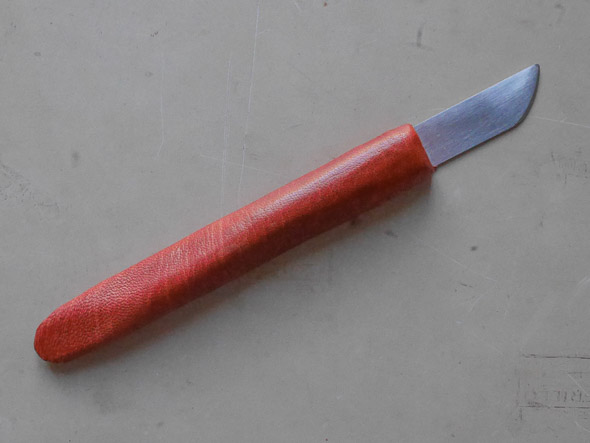
M2 Hybrid Knife. Around 8 – 9 inches long, and 1 inch wide. Since the grind marks on the primary bevel go along the length of the blade, the primary bevel is not apparent when looking at the top of the knife. The exact curve of the cutting edge varies a bit from knife to knife.

A lower angle primary bevel cuts down on the amount of time it takes to resharpen the blade, since there is less metal to remove. The 13 degree cutting edge is only a millimeter or two. The disadvantage is that there is not a large enough bevel that you can feel when you put your knife on the sharpening substrate; you have to trust your hands and the angle you are holding it at. This is quite similar to sharpening a kitchen knife by hand. Another advantage of the small secondary bevel is that it can be stropped back into shape very quickly, again because not much metal has to be removed. This is a perfect blade for sub-micron stropping. M2 steel seems easier to strop than A2, for some reason.

Cross section of primary and secondary bevels.

The slightly curved blade creates more opportunity to find a sharp area as the knife dulls, so it can be used longer. Straight blades, as they become dull, don’t seem to bite the leather enough to get started with a cut. The disadvantage is you can’t just rub it back and forth like a standard straight edged knife when resharpening. Stropping takes a slight twist of the wrist, to keep parts of the cutting edge in contact with the strop throughout the stroke.

The rounded areas allow you to work into a skin, for headcaps and the spine. But the shape also allows you to use it like a standard English style knife for edge paring.

The third change is that the tip and heel of the cutting edge are rounded.  This prevents the knife from cutting through the skin when you are working away from the edge, similar to how a spokeshave blade works. In practice, I don’t miss having a pointed, sharp tip. A rounded tip also makes it less likely to dig into your paring surface.

The M2 Hybrid used like a standard English knife for edge paring.

All of these aspects combine to make a sensitive and versatile knife intended for professionals. An analogy for cyclists might be this is more like a track bike than a road bike. This knife, in addition to edge paring, can do most of what a spokeshave can do, albeit with more “workmanship of risk”. If you want the most versatile knife on the market, look no further.

Close up of a piece of goatskin feather pared,, so that the valleys of the grain are cut through. The middle of the blade was used for this, almost parallel to the edge of the leather..
Progressively paring towards the center. The rounded edges keep the blade from cutting through the leather as it stretches.

M2 Hybrid Paring knife. M2 Steel. The handle is hand carved wood, covered with vegetable tanned goatskin, and ergonomically shaped. The metal is .040″ thick, the handle around 5/8″ at the thickest point. It is about 1 inch wide and around 8-9″ in overall length. The secondary bevel is 13 degrees.  Hand sharpened to .1 micron.

The M2 Hybrid Paring Knife.  $250.00.  Order here.

Small M2 Hybrid knife. The best knife for onlays and intricate leather decorations. Also great for paring paper. M2 Steel. The metal is .025″ thick, about 5/8″ wide and 6-7″ long. Leather covered wood handle. The  secondary bevel is 13 degrees. Hand sharpened to .1 micron.

The Small M2 Hybrid Paring Knife.  $150.00.  Order here.

Small M2 Hybrid knife bottom left, regular size next to it.

A W.O. Hickok Press

Source: https://theretrofactory.com/2014/03/28/an-1860s-book-press-repurposed-into-wine-storage-and-display/

On the one hand, I am happy to see this beautiful Hickok press, apparently still functioning, was not thrown into the trash heap. The repurposed aspects of this press appear easily reversible, simply by removing the wine box.

However, many artifacts are totally destroyed by being “repurposed”, which is often code for sold in the interior design marketplace. The Retrofactory blurb dates this press to ca. 1860’s, which seems like a wild guess. Hickok started in 1844, there are very scanty records pre-1930. If this date is correct, this press is the earliest known transitional Hickok book press I’ve ever seen. I’d love to see the documentation.

Transitional presses have metal and wood components. I used to sneer at them, so old fashioned!

Then I used one.

They develop wonderful creaking noises when gradually fully tightened, which gives some auditory feedback on the amount of compression. Look at the intelligent engineering of the thick cross-bracing on the upper platen — this is where rigidity is necessary in a press. The whole press is elegantly built for maximum lightness. The wood and iron elements interact complexly and organically. I think this helps prevent the press from backing off as much as all metal ones. The wood moves a bit, and the steel threads can settle in more parellel? The size of this press is very nice, the tightening wheel at a comfortable hand height. The wooden base is convenient to brace a foot against to keep the press from twisting in operation.

One of my pet peeves are presses that are not attached to a workbench or floor. You know who you are! If you have to hold onto the press while tightening it, you loose at least 30% of the compressional power, and are much more likely to damage whatever you are pressing.

Looking at the image of the press above, I bet a lot of shoes have braced themselves against it, though it was likely also bolted to the floor at some point, note the small slots at the ends of the feet. Given the distinctive shape of the four knobs on top of the wheel, there must have been a specialized press pin designed to fit them.

It irks me to see this beautiful press being removed from the functional bookbinding world, and co-opted into the interior design world, where its only value is to feed the appetite of the 1%. An unnecessary and silly wine storage rack for $3450.00.

More broadly, is sad when our collective culture values one of a limited number of remaining functioning 19th century Hickok presses more as a decorative object than functional one. Tools have become so invisible that we no longer even notice them, or value them.

Even though the W. O. Hickok Manufacturing Company is still in business, they have transitioned into primarily a job machining shop due to lack of demand for bookbinding equipment. Their web site mentions they still make presses and job backers on special order. The genuine Hickok 001/2 is my favorite press for general bookbinding and book conservation, much nicer than the copies of it. Please support them!

W.O. Hickok
Manufacturing Company

900 Cumberland St.
Harrisburg, PA 17103
ph 717.234.8041
fx 717.234.2587

wohickokmfg@comcast.net