The Dinkification of Tools

French knives
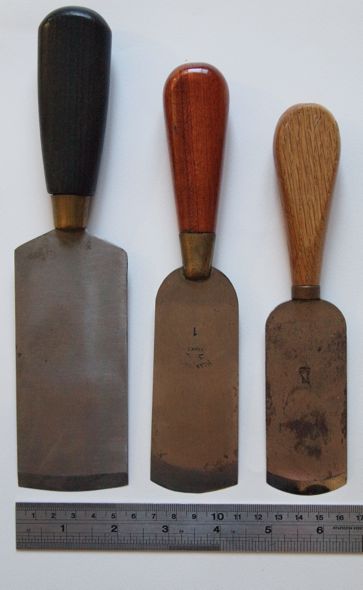
The dinkification of French leather paring knives. A completely unscientific approach. L-R: Big old knife, Medium moderately old knife, Small modern version.

Sometimes I half-jokingly refer to the dinkification of tools —the tendency of tools to get smaller, lighter, more flimsy, and often less functional — over time.

The above photo of three French Style leather paring knives from my collection illustrates this tendency nicely. I’m pretty sure they are arranged from the oldest on the left, to the newest on the right. Observe the cheapening of handle material: from ebony, to a stained wood, to a varnished one. The blades get thinner and narrower. The changes in the curve of the cutting edge is also of interest. The narrowest knife also has the greatest curve, which in my experience indicates it is designed for scraping than cutting, which runs counter to what I know historically about the history of leather paring.


Gebrauchsspuren

Gebrauchsspuren [1], like many other extremely precise and descriptive German terms, does not have an exact English equivalent. Generally it means marks or traces of use, a physical record of existence in the life-world.

When I examine a book, it is important to determine how the mark occurred, what it might mean to the object, its history, the culture that made it, the individual who purchased it, and so on. Marks of use are not only important historically, but are becoming increasingly valued aesthetically, perhaps as a counterpoint to our digitally sanitized environment. It sounds stupid to say this, but part of what I like about old things is that they look old!

I’ll go out on a limb.  I predict that in the future, the books that have real gebrauchsspuren will be the most valued. We already see the beginnings of this with some institutions buying heavily annotated and marked up copies. Although this is concerned with the text, I suspect (and hope) it will spread to the binding as well. For me, a pristine, unread book is often as uninteresting as a made-for-the-collectible-market plastic toy in the original blister pack.

Check back with me in 2040, the year singularity is projected to begin.

NOTE

1.  I discovered this term thanks to Graham Moss’s  The Anagnostakis Pocket Guide to Austrian, German and Swiss Antiquarian Bookdealers Terminology (Oldham, England: Incline Press, 2012) Graham is the man! Hats off for making this useful pamphlet. He also has printed many excellent and very reasonably priced books in sheets for binding.

Historic Book Structures for Conservators Workshop, 2015

I’m really excited about this summers Historic Book Structures for Conservators, which will be held at The Winterthur Museum, Garden and Library. July 1-31, 2015. This is a fantastic opportunity for serious students and professional conservators who want to eat, drink, live and breath historic book structures for an uninterrupted month. The icing on the cake— no tuition!

HISTORIC BOOK STRUCTURES FOR CONSERVATORS

This month long course is designed to refine basic bookbinding bench skills and to explore historic book structures in the context of the conservation of books as historic artifacts. It will be held at The Winterthur <http://www.winterthur.org&gt;, a museum, garden and library consisting of 1,000 acres of rolling meadows, gardens and woodlands. The focus will be on books bound in-boards from the 16th through 19th centuries. Readings in bookbinding history, researching book structures and creating models of historic structures are the basis of the course. Class presentations, several written essays and an independent project are required. This course is intended for pre-program through mid-career participants who are passionate about book conservation. Class size is limited.

Application requirements include a personal statement on the relavence of this class to your work and career, a portfolio of bookbinding or book conservation treatments that exhibits attention to detail, and a recommendation from a professional in the conservation or preservation field. Students will receive a full scholarship for tuition and can live on the the grounds of the Winterthur for nominal charge. International applications are encouraged. Students will have to supply their own hand tools, pay travel expenses, food, and a materials fee. Students will have 24/7 access to the workshop and a graduate level conservation library.

This class is intended to develop bookbinding skills, work on a portfolio for graduate school or job applications, or even for mid-carrear conservators wishing to recharge their batteries.

HOW TO APPLY

I will need four things from you.

1) A one page personal statement on your interest in book history/ book conservation and how this class will help you in your career.

2) Your resume or cv.

3) A portfolio of bookbindings and/ or book conservation treatments that exhibits hand skills and attention to detail. This can be submitted in person if you live near NYC, online or you can send me the images. They need to be at a high enough resolution to evaluate craft skills. You should submit three books, with one or two overall shots and one or two details of each. Please include a one paragraph description of the piece or treatment: when you did it, how it was made, materials, techniques, and other information you would like to include.

4) A letter of recommendation from a professional in the conservation or preservation field, or a teacher who is familiar with your work.

After reviewing the above material, finalists will be interviewed by telephone or Skype. Please contact me if you have any questions.

The deadline for application is March 15, 2015.

Decisions regarding acceptance will be made by April 1, 2015.

The class will be held July 1-31, 2015 at the The Wintertour, Delaware, USA.