Profitable Hobbies, March 1949, My Collection
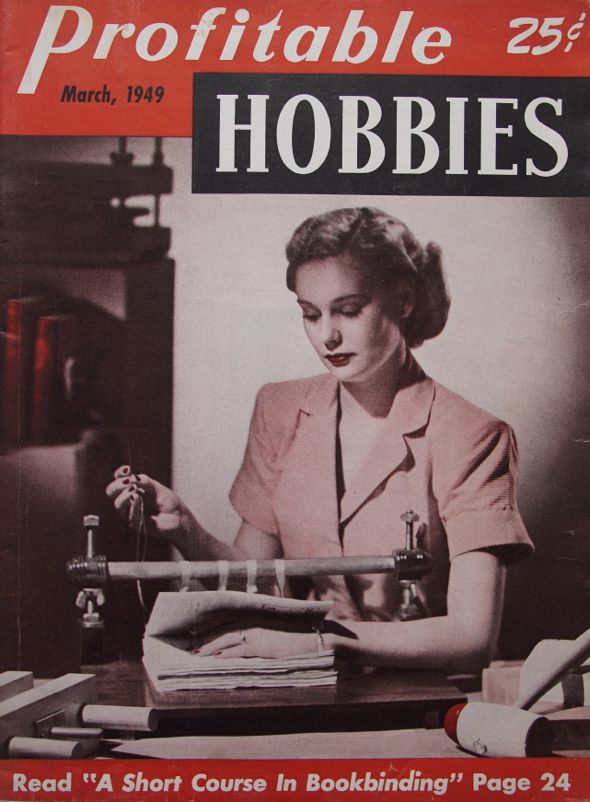
Manly Banister’s “A Short Course in Book Binding” barely presents the rudiments of bookbinding, but it is well worth the price of admission for Banister’s entertaining hubris and the highly stylized cover imagery. The woman sewing seems to have an expression somewhere between extreme self consciousness—”how do you want me to hold the needle?”— and a seething annoyance at having to pose yet again. It also appears she is sewing a newspaper? The black and white cover with red is almost noirish in its use of shadows. Despite Banister’s minimal knowledge of the field, his diagrams of DIY equipment, the sewing frame, press and plough above, may be of use to some. But like many introductory bookbinding manuals, it is not so much the information they contain that is important, but the sense of the audience for the craft that I find of interest. Binders might question how profitable bookbinding as a hobby might be, yet according to Banister bookbinding is pure profit! His recollection about how he began bookbinding is a gem:
“I got started on bookbinding when I was confined to bed for a week with a touch of the flu. There was a forty-year old book on book on bookbinding lying around which I read for the lack of anything better. I had not read far when my fingers began to itch for the feel of needle and thread. Of course, I had no tools to work with, but I went ahead anyway, propped up on pillows. I had two boards brought to me and some cord, and their combination served as my press. My wife’s old Bible was rapidly going to pieces, so I finished the process. The job was absorbing. I sewed the book and glued it and cut up an old leather jacket to cover it.”
“Bookbinding is easy. Anyone can bind a book—you and you and you! You just set your mind to it, and that’s all. If you can thread a needle, cut and fold paper, you can bind a book.”
The power of positive thinking aside, this issue of Profitable Hobbies does contain an important description of the Flash Dry method of printing, which was used by R.R. Donnelley & Sons for printing this very magazine, as well as Time, Life, Fortune, Farm Journal and Pathfinder. It supposedly is responsible for the “fine halftone work.”