
Bill Minter has recently written an excellent summary of how to adjust a Jacques Board shear, on the Guild of Book Workers Blog. There is also a fantastic diagram of the yoke and what the nuts, bolts and lock washers actually do. I had opportunity to take Bill’s workshop a few years ago on adjusting these troublesome beasts. For a large, seemingly indestructible cast iron machines, they are finicky to adjust, and even just moving them can cause alignment problems. It can take a long time to get them adjusted. But when they are working well, they are a real pleasure to use; much nicer than any currently manufactured board shear I’ve used. I’ve written a bit in the past about the importance of the board shear in the nineteenth century.
Bill mentioned two basic types of Jacques shears, though I would consider at least three early twentieth century ones and would guess there are more. Bill provides images of these three machines in a Jacques catalog from 1923, and below are earlier images starting around 1898. Although we generally call all of these machines board shears, some were originally made to cut specific types of board.
1. THE BOOKBINDERS’ SHEARS

The Paper Box Maker, Vol. 27, No. 1, November 1918, p. 29.
Above is my favorite Jacques Board Shear. Bill mentions the reinforced “L” shaped arm that makes these extremely rigid machines, but the outer gauge is also heavy duty, with a stop on the two rack and pinion. This is the only model I’ve used where the outer gauge can be adjusted and stays in place. Once you use one of these machines it is difficult to use another one. The only downside is that they take up the most floorspace, are the heaviest and are the most cumbersome to move.
2. THE CARD CUTTERS’ AND FINE PAPER BOX MAKERS’ SHEARS
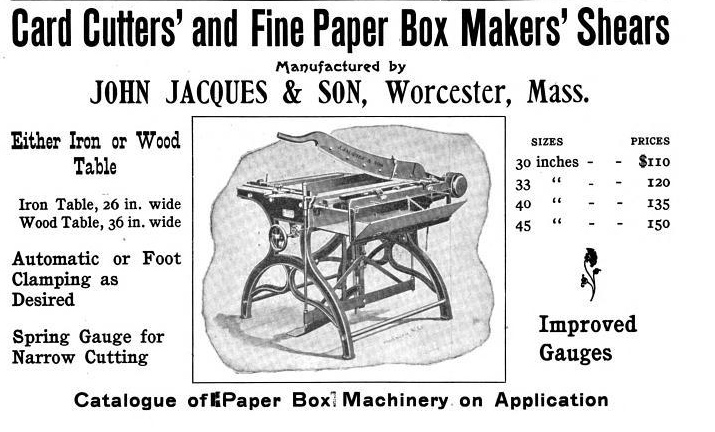
The Paper Box Maker and American Bookbinder, Vol. 7, No. 10, August 31 1899, p. 15.
The Fine Paper Box Makers’ Shears, were not only made in wood and metal tops, but with automatic or foot operated clamps. I have a small 30 inch machine with an automatic clamp. It is very cool: bring down the blade and the clamp automatically lowers onto the material to be cut. This is one sweet machine, though I wish the arm were a little beefier. This is not a hugh problem on my small 30″ machine, but might be on larger ones. Another nice feature of a Fine Paper and Box Makers Shear is that the clamp is very narrow, about 3/8″. This makes sighting the cut easy, but virtually eliminates the most common accident that happens on board shears, pinching your finger under the fence. Pinching is perhaps an understatement: I know binders who have lost a fingernail and had to go the the emergency room.
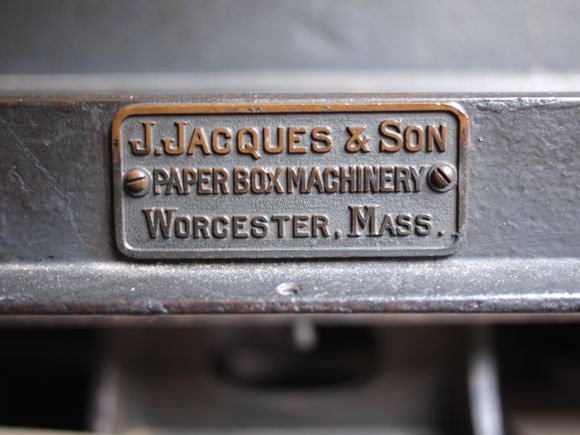
Name plate on my Jacques “Fine Paper Box Makers’ Shears” circa. 1899 with automatic clamp.
3. THE PASTEBOARD SHEARS
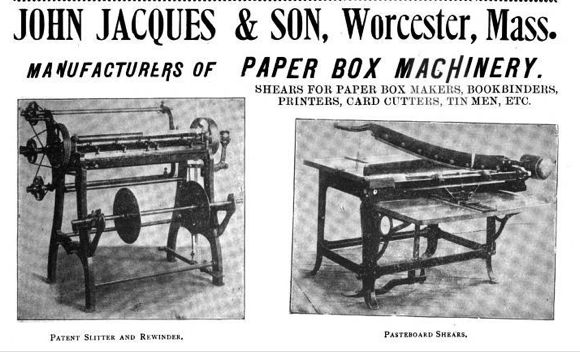
The Paper Box Maker and American Bookbinder, Vol. 7, No. 1,November 1898, p. 15
The pasteboard shears are the lightest, and least expensive of the three. Bill mentions that some board shear blades have a chisel edge, rather than a fairly obtuse grind that is best suited for mill or binders board. I have seen a number of these machines—all with wood tops—sold from leather working factories, were they also made specifically for cutting leather? They also tend to be very large, 50″ and up. The arms are not reinforced, so they are fine, but less than ideal for cutting thicker binders board, especially at full length. The wood top makes them lighter, though. In my experience, these are the most common machines encountered.
ADDITIONAL COMMENTS
Bill makes a number of important points in the article Instead of routinely regrinding the blades it is possible to touch them up fairly easily in situ. This not only extends blades life, but is cheaper and might be necessary in the future. Many blade grinders use expensive, large machinery and were dependent on printing and newspaper industries which are now in decline. I used to make a jig to sharpen blades, but now feel it is easier to hold a small diamond stone (like the fine/ extra fine folding handle stone, 4 11/32 x 7/8″) and touch up the blades by hand, concentrating on the portion closest to the handle where the blade is used the most.
Of course all of this is fairly preliminary research— the basic types of machines are barely identified, let alone the variations through time. The mechanization during the nineteenth century in bookbinding seems strongly related, if not tied to similar trades, like paper box makers. The first commercial paper box was reportedly sold in England in 1817. Much exciting research need to be done.
THE BAD NEWS
It is regrettable that the vendors of used machinery seem uninterested in researching, documenting, and preserving these machines. Of course, these machines need to be functional. But many of the alterations I have seen are done for aesthetic reasons, not functional. Many, even today, are routinely sandblasted and repainted, original wood tops replaced, historical value lost. There is a lot of finger pointing going on: Conservators blame the vendors for over-restoring machines, vendors claim that the purchasers want newly painted machines to match their bindery or conservation lab. How a book conservator can condone this wanton destruction of our mechanical heritage by participating in the marketplace is incomprehensible to me. If book conservators don’t know better, or hold themselves to a slightly higher standard than a non-specialist member of the general public, I’m not sure what to think of the field.


