New(ish) Translation of Amman’s Book of Trades

The Bookbinder, 1568
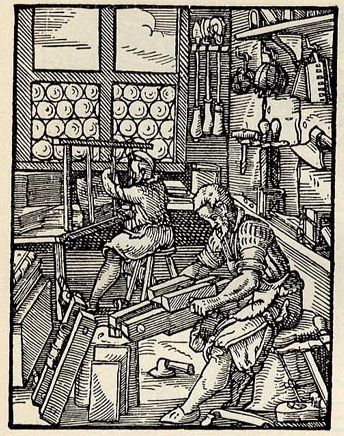
 

“Both lay and sacred, big and small,

Give me books: I bind them all

In parchment or in boards of wood.

And my clasps and locks look good.

I shape and cut the books for size,

And a stamp that beautifies,

And gild some spines, but just a few.

My income is quite handsome, too.”

________________________________________

Rabb, Theodore K. A Sixteenth-Century Book of Trades: Das Standebuch. (Palo Alto, CA: The Society for the Promotion of Science and Scholarship, 2009) 43.

Rabb’s introduction is fascinating. Jost Amman (1539-1591) was the son of a professor, moved to Nurenburg, and produced thousands of individual prints.   There are ten woodcuts relating to the book trade: the typefounder (the first depiction of one), the draughtsman, the gold beater, the parchment maker,  the tanner, the etcher, the papermaker, the printer, the illuminator, and the bookbinder. This book was groundbreaking in its straightforward description of crafts. The introduction concludes with some observations on German identity, craftsmanship, and Weber’s Protestant Ethic. There are striking similarities between the depiction of the goldbeater’s hammer and the beating hammer that the bookbinder is using — perhaps another early metal working and book making connection?

A Bookbinding is not a Picture Frame

“In point of fact, a stack of printed or handwritten sheets of paper does not become a book until it is bound. For this reason the binding cannot be seen apart from the book and differs therefore from the picture frame, with which it is sometimes compared but in which there is seldom any structural parallel with painting.” Jan Storm van Leeuwen [1]

Thinking of a book’s binding as something independent from “the book” as an entirety is a serious misconception. This raises some practical concerns:  if a book has been disbound, and perhaps remains disbound for the purposes of display, is it no longer a book? Does it now belong in a special category of the book; a disbound book? [2]   Much descriptive terminology adds similar qualifiers; an unbound book, a rebound book, etc…. A work of art remains a work of art if it is in its frame or not.  A textblock cannot just be taken out of its binding without radically altering its ontological status as a book.

__________________

[1] Jan Storm van Leeuwen. Dutch Decorated Bookbinding in the Eighteenth Century, Volume 1: General Historical Introduction. Den Haag: Hes & De Graff, 2006. p. 41.

[2] The extreme of this might be the leaf book, a new book made  to highlight a single leaf from another book. There are a number of excellent essays, including one by a lawyer/ leaf book collector who considers ethics and international law in the catalog to the exhibition Disbound and Dispersed: The Leaf Book Considered. Chicago: The Caxton Club, 2005.