Wooden Book Board Lacing Exposed

Above:  The anchoring and lacing pattern on the inner face of a wooden book board from 1453.

Not only is it remarkable that the tight “S” twist double cords are still held tightly by the treenail, but I find the almost casual tool marks from a gouge beautiful.  They look like they were cut yesterday, although they were protected and covered with a vellum pastedown that became detached at some point in the past.  Judging from the splintered wood on the right hand side, it looks as if the hole was drilled first, then the channel cut from left to right. The cuts must have started at the bottom, and worked upwards, ending with what I can imagine was an attempt to clean up the slightly splintered wood. And like most attempts to rectify an error, it only made things worse.  A bookbinders mistake from five centuries ago?  Notice the split in the board is not caused by the treenail or the two iron nails at the top and bottom of the image, which is often the case.

I’m always impressed by any mechanical object that is still intact and functioning after 557 years.

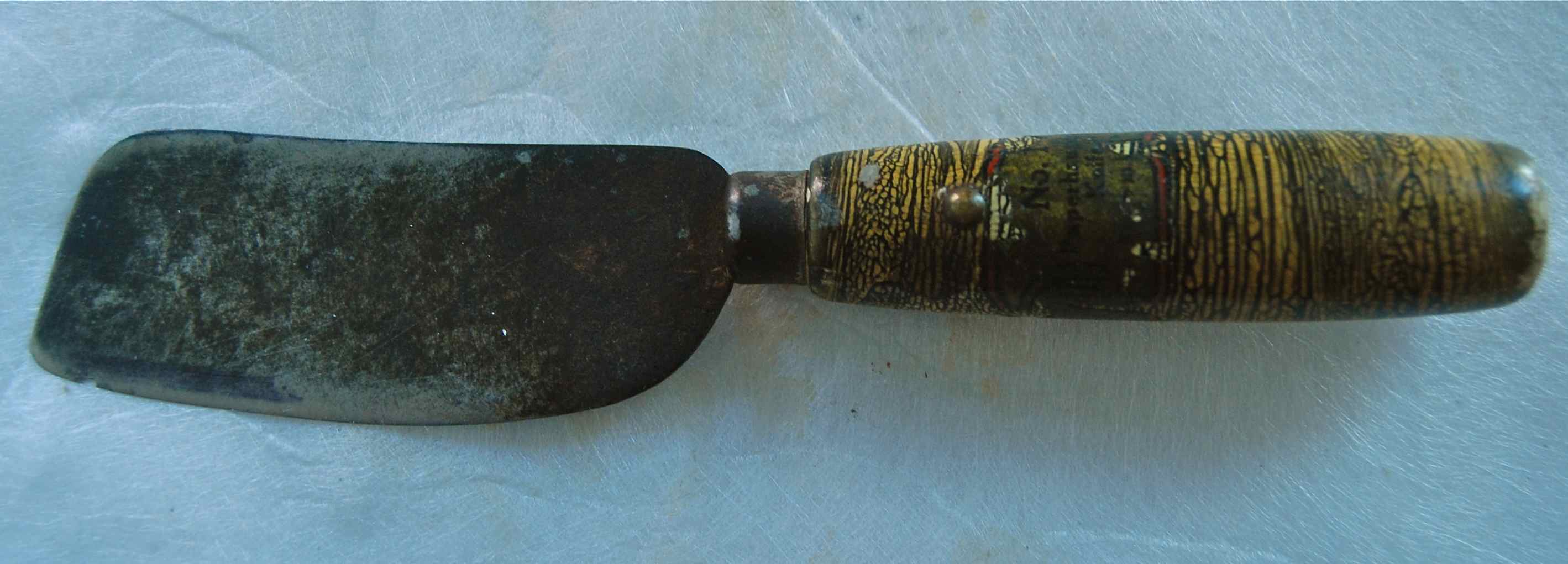
No. 1 Paperhangers Knife

I recently acquired this Knife.  It is 18 cm long, and the faded label appears to read “RIDGEL”, then “No. 1 Paperhangers Knife/ Made in U.S.A.”  The paint decorating the handle is quite spectacular, I’m guessing it is an oil based paint, but am unclear how this complex, tiny pattern was formed – the black paint appears to have been spun or dripped onto a turning handle? Any information is appreciated.

Outside Of The Text: My Work In Book Conservation

(The complete version of this article is at.  Center for Mennonite Writing, CMW Journal Vol. 2, No. 2. Don’t miss the new translation of a short lyric below Jan Luyken’s “The Bookbinder”, from his 1694 Book of Trades in the introduction to the Journal. My article details what book conservation is, how it differs from book restoration and bookbinding, then traces some ethical decisions during the course of a treatment. Below is the beginning.)

A book conservator often enters into public perception heavily colored by, and often confused with, romantic notions of a “Master Craftsman,” “Master Bookbinder,” or “Master Restorer.” In a world where many use their hands only to tap at a keyboard or lift a cup of coffee, the idea of a craftsman seems refreshingly simple, a bit anachronistic, very poetic and entirely appealing. Fortunately (or perhaps unfortunately!) these romantic ideas of a bookbinder bear little resemblance to what I do.

Although the terminology is somewhat debatable, in North America a bookbinder is usually someone who makes new fine bindings, or binds small editions, or repairs old books, often by putting new bindings on them. A book restorer, often working for the antiquarian or rare book trade, restores a book to an imagined, often pristine state, previous to damage, use or age. Many also make period bindings. (1) A book conservator attempts to preserve all the information that a book embodies, and ideally tries not to alter or change any existing element. Although conservators employ a full arsenal of craft skills, they also must know the history of book structure, be familiar with a wide variety of materials, have knowledge of preventative conservation and also understand methods of documentation. (2) The process is decidedly prosaic and cautious, and tends to adopt a scientific methodology.(3)

Figure 1

Fig 1. This romantic view is nothing new. Above is a 19th century plate of a bookbinder at work. Note the cherubic children who appear to be joyfully playing rather than working. Does the engraver imply that a bookbinder’s work was so simple a child could do it?

In contrast, bookbinding, or crafting an object, involves creating something, usually from raw or partially prepared materials. Craft often implies, at least today, a personal relationship to the work. Craft often involves handwork….

(READ THE ENTIRE ARTICLE HERE)

Or it is also located here:

http://www.mennonitewriting.org/journal/2/2/outside-text-my-work-book-conservation/